Sapphire Jewelry Guide 2026: September Birthstone Meaning, History & Modern Styling
Quick Answer: Sapphire — September's birthstone and the gem of wisdom — ranks 9 on the Mohs hardness scale, second only to diamond. It's the hardest colored gemstone you can wear every day without worry.
Table of Contents
- Sapphire Meaning & Symbolism: Why Blue Matters
- From Medieval Clergy to Princess Diana: Sapphire's Royal Story
- Beyond Blue: The Full Spectrum of Sapphire Colors
- Sapphire Quality: The 3 Factors That Determine Value
- Natural vs Lab-Grown Sapphire: An Honest Breakdown
- How to Style Sapphire-Blue Jewelry: 3 Real-World Looks
- Sapphire Care: The Nearly Indestructible Gem
- The ÉLARAMUSE Standard: Blue-Tone Craftsmanship
- FAQ: Sapphire Jewelry Questions Answered
- Editor's Picks: Blue & Celestial Pieces
Sapphire Meaning & Symbolism: Why Blue Matters
Sapphire has spent millennia as the stone of wisdom, divine favor, and sincerity. In the Middle Ages, clergy wore sapphire rings because the stone's celestial blue was believed to attract heavenly blessings — a physical connection between earth and sky. If you've ever held a fine blue sapphire under natural light, you understand why. That depth is hypnotic.
I've always found it interesting that sapphire is the traditional 5th and 45th wedding anniversary stone — not the 25th (silver) or 50th (gold). Five years is when a marriage finds its rhythm. Forty-five years is when it's outlasted everything. Sapphire represents the quiet, steady kind of commitment that doesn't need to announce itself.
Key symbolism at a glance:
- Wisdom & truth: Ancient Persians believed the earth rested on a giant sapphire whose reflection colored the sky blue
- Royalty & divine favor: Sapphire adorned the rings of medieval bishops and the crowns of European monarchs — a physical marker of heaven's approval
- Protection: In ancient Greece, those seeking answers from the Oracle of Delphi wore sapphire to guard against deception
- Loyalty & fidelity: The engagement ring connection — cemented by Princess Diana's 12-carat Ceylon sapphire in 1981, now worn by Kate Middleton
From Medieval Clergy to Princess Diana: Sapphire's Royal Story
Sapphire's documented history stretches back to at least 800 BCE. The ancient Sinhalese of Sri Lanka — still one of the world's premier sapphire sources — called it the "gem of gems." Persian rulers believed the sky was blue because earth sat atop an enormous sapphire. In the 12th century, Pope Innocent III decreed that bishops' rings must be made of pure gold set with an unengraved sapphire — a symbol of the priest's "separation from earthly passions."
The modern sapphire moment: 1981. When Prince Charles proposed to Lady Diana Spencer with a 12-carat oval Ceylon sapphire surrounded by 14 diamonds, the ring broke every royal tradition (royal engagement rings were custom-designed, never catalog-ordered). The Garrard catalog piece became the most famous engagement ring in the world — and single-handedly redefined sapphire as a romantic stone. GIA notes that sapphire engagement rings surged 300% in the two years following the royal wedding.
Today, sapphire remains the top choice for couples seeking an alternative to diamond — harder than ruby or emerald, more unique than diamond, and carrying a weight of history that mass-produced alternatives can only mimic.
Beyond Blue: The Full Spectrum of Sapphire Colors
Most people imagine sapphire as royal blue. But corundum — the mineral family sapphire belongs to — spans nearly every color except red (that's ruby, same mineral, different color tradition).
| Sapphire Color | Trade Name | Source | Value Level |
|---|---|---|---|
| Cornflower Blue | Kashmir Sapphire | India (historic), Myanmar | ★★★★★ (rarest) |
| Royal Blue | Ceylon Sapphire | Sri Lanka | ★★★★ (classic benchmark) |
| Violet-Blue | — | Madagascar, Sri Lanka | ★★★ (affordable elegance) |
| Pink Sapphire | Pink Sapphire | Madagascar, Myanmar | ★★★ (growing popularity) |
| Padparadscha | Padparadscha | Sri Lanka | ★★★★★ (sunset pink-orange) |
What this means for you: Unless you're specifically after a royal-blue Ceylon sapphire engagement ring, sapphire-blue simulants or lab-grown sapphire in demi-fine settings achieve the identical celestial depth at a fraction of the price. The color is what people notice — the origin matters primarily for investment-grade pieces.
Sapphire Quality: The 3 Factors That Determine Value
Sapphire grading is simpler than diamond grading — and far more forgiving. Here's what actually matters:
Color (Rules Everything): The ideal sapphire blue is vivid, medium-to-dark with a subtle violet undertone — neither so dark it looks black in low light, nor so pale it washes out. According to GIA grading guidelines, color accounts for roughly 70% of a sapphire's value.
Clarity (More Forgiving Than Emerald): Unlike emerald — where inclusions are celebrated as jardin — sapphire is expected to be relatively clean. "Eye-clean" (no visible inclusions to the naked eye) is the standard, not "loupe-clean." A loupe-clean blue sapphire over 2 carats is museum-grade territory.
Cut: Sapphire is typically cut with a deeper pavilion than diamond because its refractive index is lower — more depth means more color saturation. Cushion and oval cuts dominate center stones; they maximize the blue's richness.
Natural vs Lab-Grown Sapphire: An Honest Breakdown
| Factor | Natural Sapphire | Lab-Grown Sapphire |
|---|---|---|
| Composition | Al₂O₃ with trace iron/titanium | Chemically identical Al₂O₃ |
| Mohs Hardness | 9 | 9 (identical) |
| Visual Appearance | Subtle color zoning, natural inclusions | More uniform — can look "too perfect" |
| Price (1 ct equivalent) | $500–$10,000+ | $50–$500 |
| Best For | Heirloom, investment, milestone gifts | Everyday wear, travel, style experimentation |
My honest take: for most people reading a jewelry guide, lab-grown sapphire or sapphire-colored simulants in demi-fine settings is the smarter choice. You get the identical visual impact — that deep, magnetic blue — without the anxiety of wearing a mortgage payment on your hand. From a wearer's perspective, the daily experience is functionally identical.
How to Style Sapphire-Blue Jewelry: 3 Real-World Looks
Blue jewelry is more versatile than most people realize. Because sapphire blue sits on the cooler end of the spectrum, it harmonizes with neutrals and contrasts beautifully with warm tones.
1. The Workday Blue
One blue-toned piece — a subtle ring or small studs — paired with a navy blazer and white blouse. The blue jewelry deepens the navy without competing. This is the "put-together without trying" look.
Wear with: Frostwave Ring (blue zircon accent) + simple gold studs.
2. The Celestial Stack
Combine blue and silver-toned pieces for a deliberate "night sky" aesthetic — crescent moon motifs, star pendants, deep blue stones. This is the look for when you want your jewelry to feel like a personal talisman, not just an accessory.
Wear with: Moontrace Ring (silver crescent + lab diamond) + Nymph Ring (blue crystal vine) stacked together.
3. The Evening Contrast
Blue against warm gold creates the richest visual impact. Wear a blue-toned cuff or drop earrings with a warm gold chain — the cool-warm contrast amplifies both.
Sapphire Care: The Nearly Indestructible Gem
At Mohs 9, sapphire is genuinely hard to damage. This is the gemstone equivalent of a rugged tool — it takes abuse and keeps looking pristine. Here's what you can and can't do:
| Can I… | Sapphire (Stone Only) | Sapphire-Blue Demi-Fine Jewelry |
|---|---|---|
| Shower with it? | ✅ Yes | ✅ Yes — setting is gold-plated sterling silver |
| Wear daily? | ✅ Ideal — hard enough for anything | ✅ Yes — designed for daily wear |
| Use ultrasonic cleaner? | ✅ Safe | ⚠️ Avoid — protects gold plating |
| Wear to gym? | ✅ Yes | ✅ Yes — sweat-proof, rinse after |
| Sleep in it? | ✅ Yes | ✅ Yes — sleep-safe design |
The ÉLARAMUSE Standard: Blue-Tone Craftsmanship
We believe jewelry should work as hard as you do — shower-safe, sleep-safe, and never a source of anxiety. Every blue-toned piece in the ÉLARAMUSE collection is built on solid Ag925 sterling silver with 0.5-micron 18K gold plating, featuring precision-set blue zircon, blue crystal, or lab-created sapphire accents engineered for real life.
| Feature | Specification |
|---|---|
| Base Metal | Solid Ag925 Sterling Silver — 92.5% pure silver core |
| Plating | 0.5-micron 18K Gold Plating — 2× the industry standard |
| Blue Accent Stones | Blue Zircon / Lab-Created Sapphire / Austrian Blue Crystal — precision-set, secure prongs |
| Safety | 100% Nickel-Free, Hypoallergenic — Ni <0.01% |
| Durability | Water-resistant, Tarnish-resistant — built for shower, gym, and 24/7 wear |
Unlike fast-fashion "sapphire blue" jewelry that uses dyed quartz or coated glass — stones that scratch within weeks and lose their luster — every blue accent in an ÉLARAMUSE piece is a genuine mineral (zircon, sapphire, or precision-cut crystal) with inherent brilliance and scratch resistance.
Similarly — unlike natural sapphire solitaires that demand insurance premiums and "special occasion only" logic — our blue-toned pieces free you to live in them. Wear your Frostwave Ring to the gym. Stack your celestial rings through airport security. Forget you're wearing anything except something beautiful. That's the whole point.
FAQ: Sapphire Jewelry Questions Answered
Is sapphire harder than emerald?
Yes — significantly. Sapphire ranks 9 on the Mohs scale; emerald ranks 7.5–8. In practical terms: sapphire resists scratches from almost anything except diamond and other sapphires. Emerald can be scratched by quartz (common in dust and sand). If you're choosing between the two for daily-wear rings, sapphire is the objectively tougher choice.
What's the difference between sapphire and blue zircon?
Both produce a striking blue, but they're different minerals. Sapphire is corundum (Al₂O₃, Mohs 9) — one of the hardest minerals on earth. Blue zircon is zirconium silicate (ZrSiO₄, Mohs 6.5–7.5) — softer but with exceptionally high brilliance and rainbow fire (light dispersion). Blue zircon is often the stone in vintage 1920s–1930s jewelry. For daily-wear rings, sapphire wins on durability. For earrings or pendants (lower impact), blue zircon's brilliance is unmatched.
Does sapphire jewelry hold its value?
Natural sapphires — particularly untreated Ceylon or Kashmir stones over 2 carats with vivid color — appreciate over decades. Lab-grown sapphires and simulants do not appreciate — they're for wearing, not investing. But here's the perspective shift: a $150 lab-sapphire ring worn 300 times costs $0.50 per wear. A $5,000 natural sapphire worn 50 times (because you're afraid to damage it) costs $100 per wear. Value isn't just about resale — it's about use.
Can men wear sapphire jewelry?
Absolutely — and they always have. Sapphire signet rings have been a staple of men's jewelry since the medieval period. Modern men's sapphire pieces tend toward darker tones (navy, almost black-blue) set in wider bands or signet faces. The stone's 9 Mohs hardness makes it ideal for hands that actually work.
What's the best metal for sapphire-blue jewelry?
White gold and platinum create the most striking contrast against blue — the cool-on-cool pairing amplifies the sapphire's depth. Yellow gold creates a warmer, more traditional look (this is the Princess Diana ring combination). Rose gold against blue is unexpected and romantically soft. The ÉLARAMUSE collection uses 18K gold plating over Ag925 sterling silver — giving you the warmth of premium gold without the four-figure price tag.
Editor's Picks: Blue & Celestial Pieces
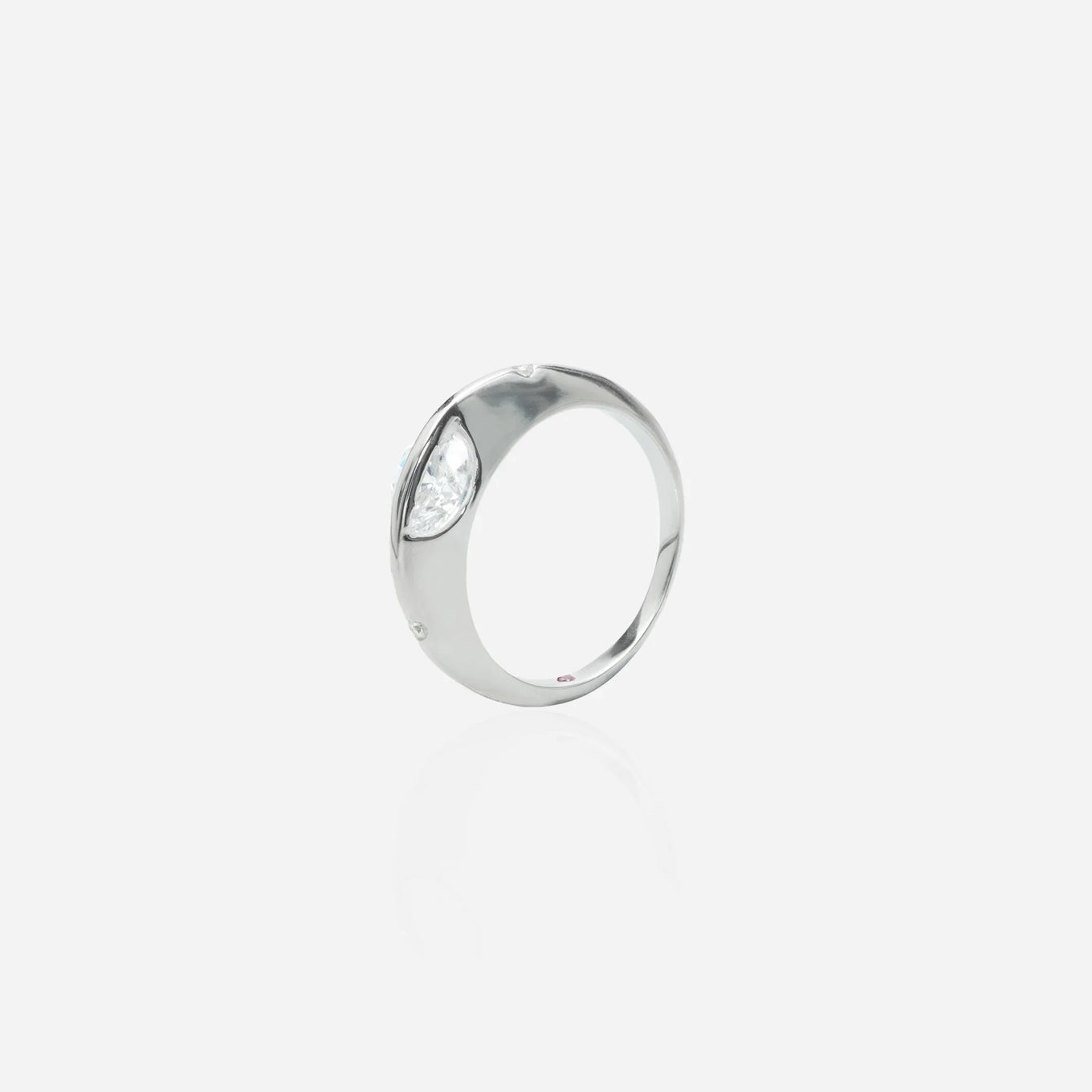
- Frostwave Ring — Silver Wave & Blue Zircon: A sculptural silver band with a blue zircon accent that catches light like deep water. The wavy silhouette makes it a standalone statement or a striking addition to any ring stack.
- Nymph Ring — Blue Crystal Vine Ring in Dainty Gold: A delicate vine-inspired band with blue crystal accents. Wear it solo for quiet elegance or stack with the Moontrace Ring for a celestial set.
- Moontrace Ring — Silver Crescent & Lab Diamond: A crescent moon silhouette with a lab diamond accent — the celestial companion to any blue-toned stack. Silver and sapphire-blue are made for each other.
Blue is the color of depth — of oceans, of twilight skies, of things that reward a second look. Every time I wear something blue, I feel a little more centered. It's not loud. It doesn't demand attention. But once you notice it, you don't stop noticing it. That's the magic of sapphire.
Find the piece that speaks to you. Be your own muse.