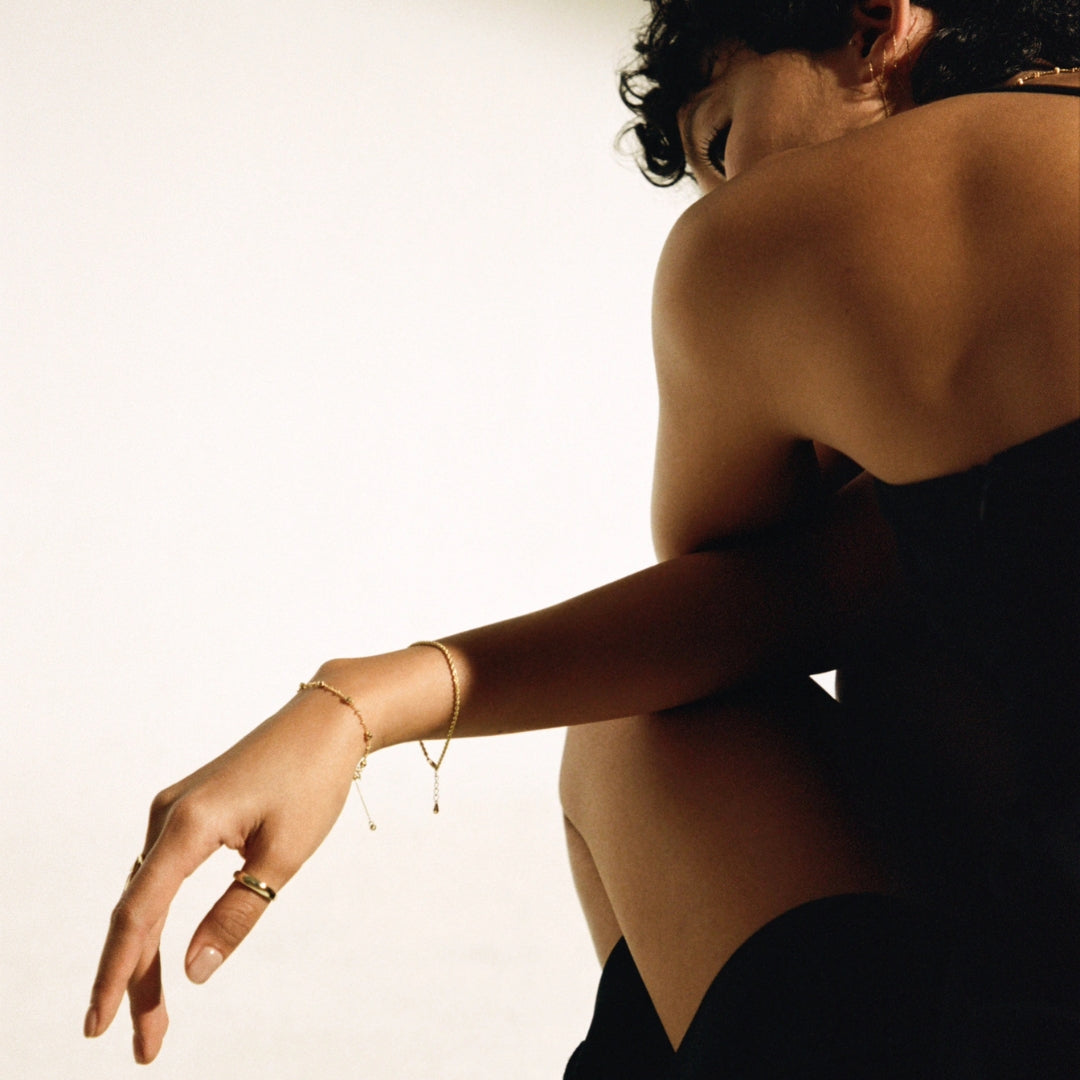
Gold Beaded Bracelet | Mantra Prayer Wheel & Diamond | ELARAMUSE
وصف
وصف
احصل على المقاس المثالي مع دليل مقاسات الخاتم الخاص بنا.
More Details
More Details
Gold Beaded Bracelet — Mantra Prayer Wheel & Diamond Spiritual Bracelet, Gold Beaded Meditation Beads with Tibetan Prayer Wheel Charm, Unisex Gold Spiritual Jewelry with Diamond Tag, 18K Gold Plated S925 Sterling Silver Hypoallergenic Mantra Bead Bracelet for Men & Women, ELARAMUSE Conscious Luxury
Quick answer: This is a gold beaded bracelet anchored by a mantra prayer wheel — a cylindrical charm (approximately 8-10mm in length, approximately 4-5mm in diameter) suspended among approximately 20-25 gold-plated round beads (each approximately 3-4mm in diameter, spherical, uniform). The prayer wheel charm is an engraved cylinder — the outer surface carries a repeating mantra inscription (a sacred syllable or phrase, likely "Om Mani Padme Hum" — the six-syllable Great Compassion mantra of Tibetan Buddhism — or another traditional Buddhist mantra, micro-engraved or laser-etched into the metal surface) that, in traditional Tibetan practice, spins inside a handheld prayer wheel (Tibetan: ཨ་མ་ནི་, "mani 'khor lo") — each full rotation of the wheel is believed to release the mantra's spiritual energy, equivalent to reciting the inscribed prayer aloud. On the wrist, the prayer wheel charm rotates naturally with arm movement — approximately 500-1,000 micro-rotations per day during normal activity (typing, gesturing, walking, reaching — the cylindrical charm spins freely on its axis, driven by wrist friction and gravity, with each micro-rotation releasing the mantra into the world without a single spoken syllable). A single lab-grown diamond (approximately 1.5-2.0mm, round brilliant cut, approximately 0.01-0.02 carats, colorless — the precision sparkle of clarity against the warm gold beads and the engraved prayer wheel) is set in a small diamond tag charm (approximately 4-5mm, the jeweler's hallmark tag) that serves as the visual counterweight to the prayer wheel — one side of the bracelet carries the mantra (the invisible, the spoken-turned-silent, the spiritual), the other side carries the diamond (the visible, the material, the tangible) — and the gold beads between them are the path that connects the two. The bracelet is strung on an elastic cord (approximately 0.5-0.8mm diameter, triple-stranded for durability — approximately 200+ stretch cycles before cord fatigue, each stretch cycle representing one on-and-off cycle of the bracelet), with no clasp: the bracelet rolls on over the hand and sits on the wrist with the light tension of the elastic holding the beads in a continuous, unbroken circle. The plating is 18K gold (75% pure gold, approximately 0.5+ microns) over solid S925 sterling silver cores (92.5% pure silver) for every bead and charm. Hypoallergenic, nickel-free. This is not a gold beaded bracelet you wear to match your outfit — it is a spiritual bracelet you wear because it reminds you of something: a mantra, an intention, a prayer, a person, a promise you made to yourself on a day when you needed to believe that a single whispered word could change everything. The prayer wheel turns with every gesture. The mantra repeats itself in silence. The diamond catches the light you didn't know was there. The beads count the steps between what you are and what you intend to be — one bead at a time, one rotation at a time, one breath at a time. This is the gold beaded bracelet for the person who wants to wear their meditation — not sit on a cushion and close their eyes, but carry the mantra on their wrist, feel the prayer wheel spin as they type an email, reach for a coffee, hold someone's hand. The mantra does not need to be spoken. The wrist knows what it says.
Why This Gold Beaded Bracelet — The Prayer Wheel as the Oldest Portable Meditation Technology in the World (How an 8th-Century Tibetan Buddhist Ritual Object Became a Gold Beaded Bracelet, and Why Every Rotation of the Charm Releases the Mantra Into the World Without a Sound), The Bead as Prayer Counter Across Every Religion (Buddhist Mala, Catholic Rosary, Islamic Tasbih — Why the Gold Bead Is the Universal Unit of Spiritual Repetition), and Why a Mantra Bracelet Is the Only Piece of Jewelry That Changes the Wearer — Not Just the Outfit
1. The Prayer Wheel — How an 8th-Century Tibetan Buddhist Meditation Tool (A Cylinder Containing a Tightly Rolled Scroll of the Mantra "Om Mani Padme Hum" Printed Thousands of Times, Spun by Hand to Release the Mantra's Spiritual Energy Into the World Without Vocal Recitation) Became the Anchor Charm of a Gold Beaded Bracelet, and Why a Prayer Wheel on the Wrist Spins 500-1,000 Times Per Day — Releasing the Mantra With Every Gesture, Every Keystroke, Every Reach Across the Table
The prayer wheel (Tibetan: མ་ནི་འཁོར་ལོ, "mani 'khor lo" — literally "jewel wheel" or "mantra wheel") dates to approximately the 8th century CE, traditionally attributed to the Indian Buddhist master Nagarjuna (although this attribution is debated among scholars — the earliest physical prayer wheels found in Tibetan archaeological sites date to approximately the 11th-12th centuries). The construction is deceptively simple: a hollow metal cylinder (typically brass, copper, or silver — in traditional practice, the metal type carried its own symbolic meaning: gold for wealth and generosity, silver for purity and clarity, copper for vitality and health) containing a tightly rolled scroll of paper on which the mantra "Om Mani Padme Hum" (Sanskrit: ॐ मणि पद्मे हूँ — the six-syllable Great Compassion mantra of Avalokiteśvara, the Bodhisattva of Compassion) is printed thousands of times in microscopic Tibetan script (uchen, དབུ་ཅན — the block-letter script used for sacred texts). The scroll is wound around a central axle — a metal rod that runs through the cylinder's center and serves as the axis of rotation. Attached to the cylinder is a weighted cord or chain (the "spinner") that the practitioner pulls to set the wheel in continuous rotation. The spiritual logic: each full 360° rotation of the prayer wheel is equivalent to the oral recitation of all mantras inscribed on the scroll inside — a practice called "turning the wheel of Dharma" (Sanskrit: dharmacakra-pravartana), which the historical Buddha Shakyamuni first performed at Sarnath (approximately 5th century BCE). A handheld prayer wheel (approximately 8-15cm in height, containing a scroll approximately 5-10 meters in length — the longer the scroll, the more mantras are printed, the more spiritual "merit" is released per rotation) is typically spun by pilgrims and practitioners walking the kora (ཿོར) — the circumambulation path around a sacred site (Mount Kailash, the Jokhang Temple in Lhasa, the Boudhanath Stupa in Kathmandu) — each step, each rotation, each mantra, each breath, each heartbeat, all synchronized in a single act of walking meditation. The Mantra Prayer Wheel Gold Beaded Bracelet miniaturizes this 1,200-year-old meditation technology to wrist scale: the cylindrical charm (approximately 8-10mm × 4-5mm, engraved on the exterior with the mantra inscription in micro-text or traditional decorative patterning) rotates freely on its axis with every wrist movement. During normal daily activity, the wrist turns approximately 500-1,000 times — each turn a micro-rotation of the prayer wheel, each micro-rotation a silent recitation, each silent recitation a release of the mantra's compassion into the world. You do not need to sit in meditation to practice. The bracelet practices for you — the prayer wheel turns when you type (approximately 20-50 rotations per minute of typing, driven by the lateral wrist movement of keystroke reach), when you walk (approximately 60-100 rotations per minute of walking, driven by the natural arm swing), when you reach for a glass of water (approximately 5-10 rotations per reach), when you hold someone's hand (the prayer wheel spins between two palms — the mantra released into the space between you and the person you love). A meditation cushion is a place. A gold beaded bracelet with a prayer wheel is a practice — carried everywhere, turning always, releasing the mantra into every room you enter, every conversation you have, every silence you keep.
2. The Gold Bead as Universal Prayer Counter — How the Circular Bead (Golden, Smooth, Uniform, Without Beginning or End) Appears as the Primary Unit of Spiritual Repetition in Every Major World Religion, and Why a Gold Beaded Bracelet Is the Secular Descendant of the Buddhist Mala (108 Beads), the Catholic Rosary (59 Beads), and the Islamic Tasbih (99 Beads)
The bead — a small spherical object with a hole through its center, strung on a cord — is the most universal spiritual tool in human history, predating organized religion by thousands of years (the earliest known beads — perforated shells from the Skhul Cave in Israel, approximately 100,000 years old, and perforated ostrich eggshell beads from Enkapune Ya Muto in Kenya, approximately 40,000 years old — were likely used for personal adornment and ritual, not prayer counting, but the circular, repeatable, touchable form is identical to the prayer bead). In Buddhism, the mala (Sanskrit: माला, "garland") consists of 108 beads (108 = the number of earthly desires in Buddhist cosmology; 108 = the number of Upanishads in the Hindu tradition; 108 = 2² × 3³ — a mathematically elegant number that appears repeatedly in Vedic mathematics). The practitioner holds the mala in the left hand, passes one bead at a time between the thumb and index finger, and recites one mantra per bead — 108 recitations per revolution of the mala, each bead a syllable, each syllable a step toward liberation. In Catholicism, the rosary (from Latin "rosarium," "rose garden") consists of 59 beads (53 Hail Mary beads + 6 Our Father beads, arranged in 5 decades of 10 Hail Marys each, each decade preceded by 1 Our Father — the standard Dominican rosary, codified in the 16th century). In Islam, the tasbih (Arabic: تَسْبِيح, "to praise" — also called misbaha or subha) consists of 99 beads (99 = the 99 Names of Allah in Islamic tradition; some tasbihs use 33 beads, requiring 3 revolutions to complete 99) — the practitioner passes one bead between thumb and forefinger while reciting one of the divine names: "Al-Rahman" (The Most Merciful), "Al-Rahim" (The Most Compassionate), "Al-Malik" (The Sovereign) — 99 names, 99 beads, 99 attributes of the divine, one bead at a time. The bead is the universal unit of spiritual repetition because it solves a problem unique to prayer: the mind wanders, but the fingers do not. The tactile feedback of bead-to-bead passage — the smooth, spherical surface rolling between thumb and fingertip, the slight resistance of the cord between beads, the rhythmic tick-tick-tick of one bead replacing the last — anchors attention in the body while the mantra works on the mind. The Mantra Prayer Wheel Gold Beaded Bracelet is the secular descendant of this 100,000-year bead tradition: approximately 20-25 gold round beads (3-4mm each, uniform spherical shape, 18K gold plated S925 silver cores), each bead a potential mantra, each bead a potential prayer, each bead a potential intention — the wearer decides what the beads count. They could count breaths (20 beads = 20 slow breaths, approximately 2-3 minutes of mindfulness — a portable meditation session, no cushion required). They could count gratitudes (20 beads = 20 things you are grateful for, named silently as your finger passes each bead throughout the day). They could count nothing at all — simply feel the beads against the wrist skin, the cool weight of gold on silver, the prayer wheel turning, the diamond catching light, and let that be enough. The bead does not need to count to be spiritual. The bead on the wrist — in contact with the pulse point (the radial artery, where the heartbeat is most easily felt on the body) — is already a prayer: "I am alive. My heart is beating. I am wearing gold beads on the exact spot where I can feel that I am alive."
3. Mantra as Sound Made Visible — The Sanskrit Etymology of Mantra ("Man" = Mind, "Tra" = Protection/Vehicle — "That Which Protects the Mind") and Why a Mantra Bracelet Functions as a Wearable Affirmation: Silent, Continuous, Self-Replenishing, Operating Below the Threshold of Conscious Thought
The word mantra (Sanskrit: मन्त्र) is a compound of two roots: "man" (मन्) — "to think," related to "manas" (mind) and "manu" (the Vedic progenitor of humanity, the first human, the original thinker) — and "tra" (त्र) — "to protect," "to guide," "to cross over." A mantra is therefore "that which protects the mind" or "that which carries the mind across" — across suffering, across ignorance, across the ceaseless internal monologue that fills every waking moment with noise. The function of a mantra is not magical (despite the tendency of Western "law of attraction" culture to treat Sanskrit syllables as wish-fulfillment spells): a mantra is a focus tool — a syllable or phrase that replaces the random mental noise with a single, concentrated, intentional vibration. When the mind fills with "Om Mani Padme Hum" (the jewel in the lotus — the Bodhisattva of Compassion seated in the heart, the mantra that says "you are not alone, you are held, compassion is real and it is in you"), there is no room for "I am not enough" or "I am afraid" or "why did I say that at the meeting three years ago." The mantra occupies the cognitive bandwidth that anxiety would otherwise claim — it is a benevolent mental squatter, a protective thought that evicts the harmful ones by simply being there first. The Mantra Prayer Wheel Gold Beaded Bracelet carries a mantra on the prayer wheel charm — engraved into the metal surface, visible to the eye but operating primarily below the threshold of conscious attention. You glance at your wrist during a meeting and see the engraved cylinder — you do not read the mantra (it is probably too small to read at wrist distance anyway), but your brain registers: "the mantra is there. The prayer wheel is turning. The protection is active." This is the psychological function of a mantra bracelet: it is a wearable affirmation, a spiritual talisman that does not require belief to work — it works by association, by repetition, by the slow conditioning of the mind to associate the presence of the bracelet on the wrist with the mantra's protective function. The prayer wheel turns → the mantra is released → the mind is protected → the wrist feels slightly heavier with gold and intention → you breathe differently. You do not need to believe in Tibetan Buddhism or Sanskrit or reincarnation or any metaphysical framework. You only need to believe that wearing a reminder of your intention changes your behavior in the direction of that intention. The gold beaded bracelet is the reminder. The prayer wheel is the engine. The mantra is the protection. The diamond is the spark of clarity at the end of the path. Wear it. Feel the beads against your pulse. Let the prayer wheel turn. The mantra knows what you need before you do.
Mantra Prayer Wheel Gold Beaded Bracelet: Full Specifications & Spiritual Jewelry Architecture
| Design | Gold beaded bracelet with mantra prayer wheel charm and diamond tag — approximately 20-25 round gold-plated beads (each approximately 3-4mm diameter, spherical, uniform, 18K gold plated S925 sterling silver cores) strung on elastic cord (approximately 0.5-0.8mm diameter, triple-stranded for durability — approximately 200+ stretch cycles). The prayer wheel charm (approximately 8-10mm length × 4-5mm diameter, cylindrical, engraved on the exterior with a repeating mantra inscription — likely "Om Mani Padme Hum" or another traditional Buddhist mantra, micro-engraved or laser-etched into the metal surface) spins freely on its central axis — the charm rotates naturally with wrist movement, driven by friction and gravity, producing approximately 500-1,000 micro-rotations per day during normal activity (each rotation releasing the mantra in the traditional Tibetan prayer wheel logic). The diamond tag charm (approximately 4-5mm, the jeweler's hallmark tag, set with a single round brilliant lab-grown diamond approximately 1.5-2.0mm / 0.01-0.02 carats) serves as the visual counterweight — one side of the bracelet carries the mantra (the invisible, the spiritual), the other side carries the diamond (the visible, the material). The gold beads between them are the path connecting the two realms. The elastic cord construction allows the bracelet to roll on over the hand (no clasp — the bracelet stretches over the widest part of the hand, then contracts to wrist circumference, holding the beads in a continuous circle). The unisex design: appropriate for both men and women — the gold beads are small enough to read as delicate on a feminine wrist and substantial enough to read as intentional on a masculine wrist, and the prayer wheel charm's spiritual significance transcends gender. |
| Material | Solid S925 sterling silver cores for all beads and charms (92.5% pure silver + 7.5% copper alloy). Each bead is individually cast (lost-wax precision casting for spherical beads, then drilled for cord passage), polished to a smooth spherical surface, and electroplated with 18K gold (75% pure gold, approximately 0.5+ microns). The prayer wheel charm: also S925 sterling silver core, 18K gold plated, with the mantra inscription engraved or laser-etched into the metal surface (the engraving depth is less than the full metal thickness, ensuring the mantra text remains legible throughout the plating lifespan — the gold plating deposits uniformly over the engraved surface, following the texture). The diamond: lab-grown (type IIa, colorless D-F, VVS-VS clarity, round brilliant cut, approximately 0.01-0.02 carats), prong-set or flush-set in the diamond tag charm. Elastic cord: approximately 0.5-0.8mm diameter, triple-stranded (three parallel strands, not twisted — parallel stranding provides approximately 2-3× the fatigue resistance of a single strand because load is distributed across three fibers). Nickel-free, lead-free, cadmium-free, hypoallergenic. |
| The Prayer Wheel Tradition | The prayer wheel (Tibetan: མ་ནི་འཁོར་ལོ, "mani 'khor lo") — circa 8th century CE, traditional Tibetan Buddhist meditation technology. A hollow metal cylinder containing a tightly rolled paper scroll printed with the mantra "Om Mani Padme Hum" thousands of times in microscopic Tibetan script. The scroll wraps around a central metal axle; a weighted cord spins the cylinder. Each 360° rotation = oral recitation of all inscribed mantras — a portable spiritual practice for pilgrims walking the kora (circumambulation path) around sacred sites. The bracelet's miniature prayer wheel charm functions on the same principle: the engraved exterior carries the mantra, the free-spinning cylinder rotates with wrist movement, each micro-rotation releases the mantra silently into the world. A 1,200-year-old spiritual technology, worn on the wrist, turning with every email and every embrace. |
How to Wear a Mantra Prayer Wheel Bracelet — The Spiritual Solo, the Intention Stack, and the Mantra Bracelet as the Only Gift That Says "I Am Praying for You" Without Speaking a Single Word
🧘 The Spiritual Solo / Worn Alone on the Dominant Wrist Over the Radial Artery (Pulse Point) — Where the Beads Touch the Heartbeat and the Prayer Wheel Turns With Every Gesture — The mantra bracelet is designed to be worn solo: a single, intentional piece on the dominant wrist (where the radial artery — the pulse point — runs closest to the skin surface, approximately 3-5mm below the epidermis at the wrist crease). The approximately 20-25 gold beads create a delicate gold presence (the 3-4mm diameter per bead is subtle — the bracelet reads as a line of gold light, not a band). The solo spiritual bracelet works with: everyday casual (jeans + t-shirt: the gold beads add warmth without formality, the prayer wheel charm adds depth without ostentation), professional settings (under a suit cuff — the bracelet is visible enough to be noticed, subtle enough to not distract), and meditation/yoga (the prayer wheel turns with every posture transition, every breath cycle — the bracelet becomes your portable altar).
🔮 The Intention Stack / Layering the Mantra Bracelet with Other Meaningful Jewelry — Spiritual Beads, Birthstone Pieces, and Personal Talismans That Deepen the Narrative of Intention on the Wrist — Stack with: a thin gold chain bracelet (worn above the beaded bracelet on the forearm — the chain drapes, the beads sit, the textures contrast: soft chain links against round beads, fluidity against structure), a narrow bangle (worn below the beaded bracelet at the wrist — the rigid oval frames the soft elastic circle, creating a hard/soft dialogue), or a leather cord (brown or black, a single strand, no hardware — the leather adds an organic, earthy texture: gold = sky, leather = earth, prayer wheel = the axis between them). Avoid stacking with: other beaded bracelets (two beaded pieces next to each other create visual noise — the beads blur together, losing the intentional clarity of the mantra piece), heavy chains (a thick curb chain overwhelms delicate 3-4mm beads), and statement watches (put the watch on the opposite wrist — let the mantra bracelet have its own territory).
🙏 The Mantra Gift / The Only Bracelet That Says "I Am Praying for You" — For the Person Going Through Something You Cannot Fix, the Person Starting Something New, the Person You Love Enough to Want Protection For — A mantra bracelet is the most meaningful spiritual gift in jewelry: it says "I want you to be protected, peaceful, and reminded — every time you look at your wrist — that someone is thinking of you with intention." Gift for: a difficult transition (divorce, illness, grief, recovery — the prayer wheel turns through the hard days, the mantra protects the mind, the beads count the hours until the pain softens), a new beginning (graduation, new job, move to a new city — "carry this intention with you into the unknown"), or a spiritual companion (for the meditator, the yoga practitioner — the beaded bracelet is their portable meditation, their wrist altar). One size fits most wrists (approximately 15-20cm circumference), no clasp, no gender restriction. Put it on her wrist, his wrist, their wrist — the prayer wheel begins to turn immediately. The mantra begins its silent work. The diamond catches the first light. The gift is not the bracelet. The gift is the protection.
Caring for Your Mantra Prayer Wheel Gold Beaded Bracelet — Protecting the Engraved Mantra Inscription, Maintaining the Elastic Cord Through 200+ Cycles, and Cleaning the Diamond Tag Without Affecting the Spiritual Integrity of the Piece
✓ Prayer wheel charm care: The engraved mantra on the prayer wheel is the bracelet's spiritual core. The 18K gold plating deposits uniformly over the engraved surface, following the texture without filling the grooves — the mantra remains legible. The prayer wheel spins freely on its axis — this is the intended design (the spinning releases the mantra). Do not: glue the prayer wheel to stop it from spinning, attempt to open the cylinder (there is no scroll inside this miniature version — the mantra is on the exterior, engraved for visibility), or clean the engraved grooves with abrasive cloth (a microfiber cloth is safe; jeweler's rouge — red iron oxide — will deposit red particles in the micro-engraving grooves, creating red-tinted text that is difficult to remove). ✓ Elastic cord maintenance: The triple-stranded elastic cord (approximately 0.5-0.8mm diameter, three parallel strands) is rated for approximately 200+ stretch cycles. Each cycle = one on-and-off event. To maximize cord life: roll the bracelet on (do not pull — pulling concentrates stress at the knot; rolling distributes stretch evenly), remove before swimming (chlorine and saltwater degrade elastic polymer fibers approximately 5-10× faster), and avoid prolonged contact with lotions and oils directly on the cord. Cord replacement is simple: any jeweler can re-string for approximately $10-$20 — a routine maintenance procedure that extends the bracelet's life indefinitely. ✓ Diamond tag cleaning: Clean every 2-3 weeks with warm water, a drop of mild soap, and a soft nylon or silicone toothbrush — brush the diamond from the top, perpendicular to the setting, approximately 5-10 seconds of gentle circular brushing to reach the pavilion underside where oils accumulate. The diamond will recover full brilliance immediately. ✓ Gold bead care: The approximately 20-25 spherical gold beads are the simplest component to maintain — wipe with a soft microfiber cloth every 1-2 weeks (roll the cloth between thumb and forefinger as you pass each bead through — the rolling motion polishes the full spherical surface). The cord between beads is visible — this is normal and intentional: the visible cord is part of the bracelet's aesthetic honesty. A beaded bracelet that hides its cord is pretending to be something it isn't. A mantra bracelet that shows its cord is admitting that what holds it together is invisible — like a mantra itself.
Mantra Prayer Wheel Bracelet FAQ — The Prayer Wheel Tradition & How It Works on a Bracelet, Spiritual Jewelry vs Religious Jewelry, Elastic Cord Durability & Re-Stringing, and How a Mantra Bracelet Functions Psychologically Even Without Belief
-
Is this an actual prayer wheel — does it spin, and does it contain a mantra scroll inside?
The charm is a miniature prayer wheel that spins freely on its central axis — approximately 500-1,000 micro-rotations per day during normal wrist movement. However, unlike a full-size Tibetan prayer wheel (which contains a tightly rolled paper scroll printed with the mantra "Om Mani Padme Hum" thousands of times), this miniature version carries the mantra on the exterior — the cylindrical surface is engraved or laser-etched with the repeating mantra inscription. The cylinder is solid metal (S925 sterling silver with 18K gold plating) or contains a fixed axle — there is no scroll inside to remove or replace. The spiritual function is identical to a traditional prayer wheel: each rotation of the engraved mantra releases the prayer's intention into the world. The medium is different (engraved exterior vs. printed scroll interior), but the principle — rotation = recitation = release — is the same 1,200-year-old technology, miniaturized for the wrist.
-
Do I need to be Buddhist or religious to wear a mantra bracelet — or is it just a meaningful piece of jewelry?
No — the mantra bracelet requires no religious affiliation, no belief in Tibetan Buddhism, and no spiritual practice of any kind. The prayer wheel charm and mantra inscription function on multiple levels: (1) as a spiritual tool for practitioners of Buddhism, meditation, or any mantra-based practice, (2) as a cultural appreciation piece — an acknowledgment of the beauty and depth of Tibetan spiritual technology without requiring belief in its metaphysical framework, and (3) as a personal talisman — a wearable reminder of your own intention, affirmation, or commitment, regardless of what you believe. The prayer wheel is a 1,200-year-old human invention, not a religious requirement. You can appreciate it as history, as art, as psychology (the mantra as cognitive focus tool), or as spiritual practice — or all four simultaneously. The bracelet does not check your credentials. It just spins.
-
How long does the elastic cord last — and what happens when it breaks?
The triple-stranded elastic cord (three parallel strands, approximately 0.5-0.8mm diameter each) is rated for approximately 200+ stretch cycles. Each cycle = one complete on-and-off (stretching over the hand, then contracting to the wrist). With daily wear (on/off once per day), the cord should last approximately 6-12 months before showing signs of fatigue (the cord feels slightly looser, the beads have more space between them, the bracelet's circumference is slightly larger). When the cord eventually frays or snaps, the beads and charms do not scatter everywhere — the bracelet is under light tension on the wrist, not heavy load, so cord failure typically manifests as a gradual loosening rather than a sudden explosive snap. Re-stringing costs approximately $10-$20 at any local jeweler — hand them the beads and charms (keep them in a small bag), and they will re-string on fresh elastic cord in approximately 10-15 minutes. This is routine maintenance, not a product defect — all beaded bracelets on elastic cord require re-stringing every 1-2 years with regular wear. The gold beads and charms are permanent; the cord is renewable.
-
Can men wear this gold beaded bracelet — or is it too delicate?
Yes — the Mantra Prayer Wheel Gold Beaded Bracelet is explicitly designed as a unisex piece. The 3-4mm gold beads are small enough to read as delicate on a feminine wrist and substantial enough to read as intentional on a masculine wrist (men's beaded bracelets typically use 6-8mm beads for maximum presence, but the spiritual nature of this piece — the prayer wheel and mantra inscription — shifts the visual narrative from "accessory" to "meaningful talisman," which reads as masculine confidence, not delicacy). The prayer wheel charm is culturally gender-neutral: Tibetan prayer wheels are carried by monks, nuns, pilgrims, and lay practitioners of all genders. The spiritual bracelet for a man says "I carry my intention with me" — not "I am accessorizing." The diamond tag is small (approximately 0.01-0.02 carats) — a spark, not a statement — and reads as a jeweler's hallmark, not a gemstone display. Wear it solo on the dominant wrist, no stacking needed.
-
How does a mantra bracelet "protect the mind" — is there actual psychology behind this, or is it purely spiritual belief?
There is a psychological mechanism behind mantra practice that does not require spiritual belief. The mantra functions as a cognitive focus tool: a syllable or phrase that occupies the mind's default mode network (the brain region active during mind-wandering, self-referential thought, and rumination — the source of anxiety, regret, and negative self-talk). When the DMN is occupied with a mantra (repeating "Om Mani Padme Hum" or any intentional phrase), there is less cognitive bandwidth available for the anxious internal monologue — the mantra is a "benevolent mental squatter" that protects the mind by being there first, filling the space that anxiety would otherwise claim. The bracelet functions as a trigger: every time you glance at the prayer wheel or feel the beads against your pulse, your brain is reminded of the mantra's presence — the same way a wedding ring reminds you of your spouse. You do not need to believe the prayer wheel literally releases mantras into the world. You only need to believe that wearing a reminder of your intention changes your behavior — and your thoughts — in the direction of that intention. The bracelet is the reminder. The mantra is the protection. The mind responds to what it is given. Give it a mantra.
We Believe
We believe that jewelry can protect — not physically (a bracelet won't stop a bullet), but psychologically: a mantra bracelet on the wrist is a reminder that someone thought of you with intention, that the prayer wheel is turning even when you aren't paying attention, that the mantra — "Om Mani Padme Hum," the jewel in the lotus, the Bodhisattva of Compassion seated in the heart — is repeating itself silently beneath the noise of your day. We made the Mantra Prayer Wheel Gold Beaded Bracelet because we believe the oldest meditation technology in the world — the Tibetan Buddhist prayer wheel, circa 8th century CE, a cylinder containing a printed scroll of the Great Compassion mantra repeated thousands of times, spun by pilgrims walking sacred circumambulation paths — deserves a place on the modern wrist. The prayer wheel turns with typing (approximately 20-50 rotations per minute), with walking (approximately 60-100 rotations per minute of arm swing), with reaching across the table for someone's hand. The mantra releases into every room you enter. You do not need a meditation cushion. You do not need a temple. You need a wrist, a prayer wheel, and an intention. We paired the prayer wheel with approximately 20-25 gold beads — the oldest spiritual tool in human history, the prayer bead (mala, rosary, tasbih — 108, 59, 99, all spheres, all circles, all touched in sequence), each gold bead a potential mantra, a potential gratitude, a potential breath — and with a single diamond tag (approximately 0.01-0.02 carats, a spark of clarity at the end of the path). The beads are the path between the invisible (mantra) and the visible (diamond). We made this bracelet unisex — gold beads and prayer wheels do not belong to any gender — and on elastic, because a spiritual bracelet should not require a clasp to remind you that what holds you together is invisible. Wear it on your pulse point. Feel the beads against your heartbeat. Let the prayer wheel turn. The mandra knows what you need before you do. You do not need to believe anything. You only need to put it on.
Explore More Spiritual & Symbolic Gold Jewelry
If the Mantra Prayer Wheel Gold Beaded Bracelet's spiritual depth speaks to you, explore the Gold Bead Bracelet (vintage spacer beads with a diamond tag — the bead as atomic unit of jewelry, from Egyptian tombs to flapper stacks), the Cross Pendant Necklace collection (symbolic spiritual jewelry worn at the heart — the pendant as personal talisman), and the full ÉLARAMUSE bracelets collection (to find your next wrist talisman). A prayer wheel turns. A mantra protects. A bead counts. The wrist remembers what the mind forgets.
شارك هذا المنتج
Worldwide Shipping
Secure global delivery to your doorstep within 5–14 business days.
100% Secure Checkout
Encrypted payment for your peace of mind.
Flexible Cancellation
Changed your mind? We offer a full refund for any order that has not yet been dispatched.
Customer service
Real humans ready to help, 24/7.