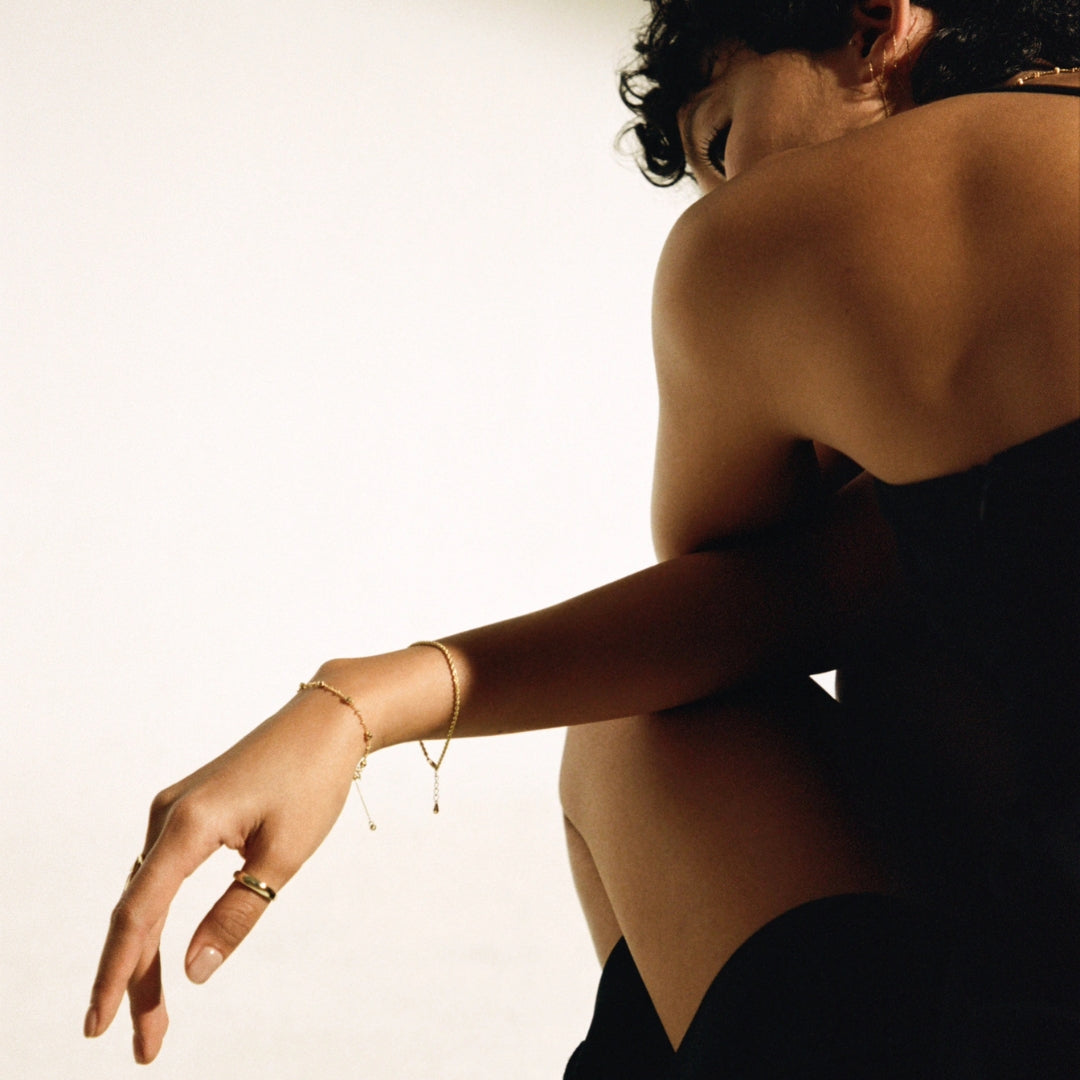
Ruby Calla Lily Pendant | Botanical Jewelry | July Birthstone Gift
وصف
وصف
احصل على المقاس المثالي مع دليل مقاسات الخاتم الخاص بنا.
More Details
More Details
Ruby Calla Lily Pendant — Sculpted 3D Botanical Necklace, Genuine Ruby Center, 18K Gold S925
This ruby pendant necklace is a three-dimensional sculpted calla lily — not a flat stamping, not a die-cut silhouette, but a fully formed 3D botanical form cast in S925 sterling silver with 18K gold plating. The calla lily's iconic structure is anatomically accurate: a flared spathe (the curved petal-like bract that wraps around the central column) curves outward from the spadix (the central finger-like spike that rises from the center of the flower). At the base of the spathe, where the curved petal meets its own reflection: a single genuine ruby (2mm round, faceted, July birthstone) is precision-set, glowing against the gold-toned metal like a drop of red wine caught in a golden cup. The pendant measures approximately 22mm tall × 14mm wide × 8mm deep, weighs approximately 3.8 grams, and hangs from a 45cm (18-inch) adjustable box chain (40cm + 5cm extender) in matching 18K gold-plated S925 sterling silver. The bail (the loop connecting the pendant to the chain) is integrated into the flower's stem — the calla lily's stem arches backward into a loop, and the chain passes through the loop, so the pendant hangs as if the flower is still attached to its stem. Ruby is the July birthstone, making this a natural birthstone gift, but the design transcends birthstone jewelry: a calla lily is one of the most universally recognized flower silhouettes in the world, associated with weddings (bridal bouquets), Art Deco architecture (the streamlined spiral was a favorite motif of 1920s design), and the ancient Greek myth of Hera. Ships in ELARAMUSE signature packaging. Free US shipping over $99. 30-day returns.
Why This Ruby Calla Lily Pendant
1. 3D Botanical Sculpture — Not a Flat Stamp. Anatomically Accurate Calla Lily in Metal.
Most floral pendant necklaces use the "stamping" method: a flat sheet of metal is pressed between two dies to create a raised relief image of a flower — like a coin with a flower on it. The result is a two-dimensional silhouette with some surface texture but no depth. This ruby calla lily pendant is produced through lost-wax casting: a three-dimensional wax model of a calla lily is sculpted by hand, encased in a plaster mold, the wax is burned out (the "lost" in lost-wax), and molten S925 sterling silver is poured into the cavity, capturing every curve of the original wax sculpture in solid metal. The result is a fully 3D flower: the spathe curves outward from the center in a spiral (the calla lily's defining characteristic — one continuous petal that wraps around itself), the spadix rises from the center (the finger-like column that carries the flower's true, tiny flowers — botanically, the calla lily's "petal" is not a petal but a modified leaf called a spathe, and the "center spike" is a spadix covered in microscopic true flowers), and the ruby sits at the spathe's base where the petal folds inward toward itself. From the side: you see the spathe's curve in profile, the spadix standing straight, and the ruby glowing from within the fold. From the front: the calla lily's iconic spiral silhouette, the golden spathe wrapping around the ruby center. From the back: the stem arches into the bail loop, and the reverse side of the flower is contoured with the same 3D depth as the front — this is not a hollow-backed stamping but a solid botanical sculpture that looks complete from every angle. The lost-wax casting process is the same technique used by fine jewelry houses for sculptural pieces (Buccellati, Tiffany Schlumberger, Cartier's flora collections) — the difference is the metal (plated S925 rather than solid 18K gold), not the fabrication method.
2. Genuine Ruby — July Birthstone, Corundum Family, Mohs 9. The Second Hardest Natural Gemstone on Earth.
Rubies are a variety of the mineral corundum (Al₂O₃ — aluminum oxide), the same mineral family as sapphires. The red color comes from trace chromium atoms substituting for aluminum atoms in the crystal lattice — the more chromium, the deeper the red. This ruby pendant necklace features a genuine natural ruby (not synthetic, not glass-filled, not diffusion-treated) measuring 2mm in diameter, faceted (round brilliant cut), with a medium-deep red color (pigeon blood is the legendary top grade; this stone sits in the garnet-red to ruby-red range, with slight secondary purple undertones visible in sunlight — a characteristic of chromium-based red, as opposed to iron-based red which tends toward brown). Ruby is Mohs 9 hardness — second only to diamond (Mohs 10) and tied with moissanite. This means the ruby will survive decades of daily wear without scratching: the only materials that can scratch a ruby are diamond, moissanite, and other rubies/sapphires. The Mohs 9 hardness is irrelevant for a pendant (the stone is protected by the metal surround and doesn't contact surfaces), but it matters psychologically — knowing the stone at the center of your calla lily is one of the hardest substances on Earth adds a layer of permanence to a gift. Ruby is the July birthstone (established in 1912 by the American National Association of Jewelers, which standardized the modern birthstone list). But its association with July predates the 1912 list by at least 2,000 years: the Roman scholar Pliny the Elder (23–79 CE) wrote in his Naturalis Historia that ruby was associated with the month of July because the stone's red color matched the sun's intensity at the height of summer (the Roman month Quintilis, later renamed Julius after Julius Caesar). Ruby is also the traditional gift for the 15th and 40th wedding anniversaries.
3. The Calla Lily — A Flower That Is Not a Lily, Born from Hera's Spilled Milk, Sacred to Art Deco
The calla lily (Zantedeschia aethiopica) is botanically not a lily — it belongs to the Araceae (arum) family, native to southern Africa (Lesotho, South Africa, Eswatini), and was introduced to Europe in the 17th century by Dutch traders operating out of the Cape Colony. The name "calla" comes from the Greek word κάλλος (kallos), meaning "beauty." The "lily" was appended by European botanists who noted the flower's superficial resemblance to true lilies (Lilium genus), but the resemblance is coincidental — calla lilies and true lilies are not related. The ancient Greek myth: Hera (queen of the gods, wife of Zeus) was tricked into nursing the infant Heracles (Hercules) — Zeus's illegitimate son by the mortal Alcmene — while Hera slept. When Hera awoke and discovered she was nursing her husband's bastard child, she pulled the infant from her breast in fury. Her breast milk sprayed across the heavens (creating the Milky Way galaxy, according to the myth) and drops that fell to earth grew into the first calla lilies — pure white flowers, the color of milk. The Roman variation substitutes Juno (Hera's Roman counterpart) and has Venus (Aphrodite) cursing the flowers' beauty out of jealousy — Venus added the spadix (the central spike) to the center of the flower, saying "no flower should be perfect." The calla lily has been a recurring motif in decorative arts: Art Nouveau (1890–1910) used the calla lily's sinuous spiral as a natural counterpart to the whiplash curve; Art Deco (1920–1939) abstracted the calla lily into streamlined geometric arcs (the flower's one-piece spiral was inherently Deco — the movement's obsession with the single flowing line found its perfect natural expression in the calla lily). Georgia O'Keeffe's calla lily paintings (1920s, notably "Calla Lily Turned Away" 1923 and "Two Calla Lilies on Pink" 1928) cemented the flower as a symbol of modern American art. Today, the calla lily is a top-5 wedding flower (alongside roses, peonies, hydrangeas, and orchids) and a universal symbol of purity, rebirth, and beauty — "kallos" from its Greek etymology. This ruby calla lily pendant carries that entire cultural lineage in its 22mm sculpted form: a flower that is not a lily, born from a goddess's breast milk, painted by O'Keeffe, streamlined by Art Deco, and now cast in gold-toned silver with a ruby at its heart.
Specifications
| Pendant Design | 3D sculpted calla lily — lost-wax cast in S925 sterling silver, 18K gold plated. Anatomically accurate: flared spathe (curved bract) + spadix (central column). Not a flat stamping |
| Ruby | Genuine natural ruby (corundum, Al₂O₃ + Cr). 2mm round brilliant cut. Mohs 9 hardness. July birthstone. Medium-deep red color with slight purple undertone. Faceted, precision-set at spathe base |
| Pendant Size | ~22mm tall × 14mm wide × 8mm deep. Weight: ~3.8g (pendant only, without chain) |
| Chain | 18K gold-plated S925 sterling silver box chain. 40cm (16″) + 5cm (2″) extender — adjustable 40–45cm (16″–18″). Spring-ring clasp |
| Metal | S925 sterling silver base (92.5% pure silver) with premium 18K gold plating (0.5+ micron). Nickel-free, lead-free. High-polish finish on spathe surface; satin-textured spadix |
| Bail | Integrated stem-loop bail — the calla lily's stem arches backward and loops, forming the chain attachment. Chain passes through this loop |
| Packaging | ELARAMUSE signature gift box with polishing cloth and care card |
History: The Calla Lily — From Hera's Milk to O'Keeffe's Canvas to Your Necklace
- Ancient Greek Mythology (~5th Century BCE): The oldest surviving written version of the Hera-and-Heracles myth appears in Pseudo-Apollodorus's Bibliotheca (2nd century CE), but the oral tradition predates the text by centuries. Hera, nursing the infant Heracles, discovers his identity and pulls him away — her milk sprays across the sky (the origin of the Milky Way, according to this myth) and the drops that fall to earth become lily flowers. Later traditions specify that the flowers were calla lilies — white, pure, shaped like a drop of milk suspended in time. The Greek word κάλλος (kallos, "beauty") was applied to the flower by Theophrastus (371–287 BCE), Aristotle's successor as head of the Lyceum, in his botanical writings — the first recorded use of the name "calla."
- Dutch Cape Colony Introduction (1690s): The calla lily (Zantedeschia aethiopica) is native to the wetlands of southern Africa — Lesotho, South Africa's Eastern Cape, and Eswatini (formerly Swaziland). Dutch traders operating out of the Cape Colony (established 1652) shipped the first live calla lily rhizomes to Europe in the 1690s. The flower thrived in European greenhouses and botanical gardens (it requires warm, wet conditions — exactly what African wetlands and European hothouses share). By 1731, the calla lily was listed in Philip Miller's Gardeners Dictionary (the most influential horticultural reference of the 18th century) as "Arum aethiopicum" — the African arum. The botanical name was later changed to Zantedeschia to honor Giovanni Zantedeschi (1773–1846), an Italian botanist and physician who studied the flora of northern Italy.
- Art Nouveau & Art Deco Adoption (1890–1939): The calla lily's one-piece spiral — the spathe curving around the spadix in a single continuous line — made it the ideal flower for two successive art movements. Art Nouveau (1890–1910) used the calla lily as a natural expression of the "whiplash curve" (coup de fouet), the sinuous line that defined the movement (Victor Horta's ironwork, René Lalique's jewelry, Alphonse Mucha's posters). Art Deco (1920–1939) abstracted the calla lily further: the spiraling line became a geometric arc, the spadix became a vertical column. Cartier produced calla lily brooches in platinum and diamond in the 1920s; Van Cleef & Arpels followed with calla lily clips (earrings) in the 1930s. The calla lily was the most sculpted flower in high jewelry — its natural form was already a sculpture.
- Georgia O'Keeffe (1920s): The American painter Georgia O'Keeffe (1887–1986) painted the calla lily obsessively between 1923 and 1930 — "Calla Lily Turned Away" (1923), "Two Calla Lilies on Pink" (1928), "Calla Lily with Red Rose" (1928), and dozens more. O'Keeffe's calla lily paintings magnify the flower to fill the entire canvas, abstracting its spiral into an almost architectural form — the spathe becomes a curved wall, the spadix becomes a tower, the flower's interior becomes a hidden chamber. Art critics of the era (predominantly male) interpreted the paintings as erotic symbolism (the curving fold, the protruding spadix). O'Keeffe consistently rejected this reading — "I made you take time to look at what I saw," she said, "and when you took time... you hung all your own associations with flowers on my flower." The paintings remain some of the most expensive American artworks ever sold — "Jimson Weed/White Flower No. 1" (1932, not a calla lily but from the same flower-painting period) sold for $44.4 million in 2014, the highest price ever paid for a work by a female artist.
- Wedding Tradition (20th–21st Century): The calla lily became a wedding flower in the early 20th century — its pure white color (the original wild species is white; pink, yellow, and purple cultivars were developed in the 20th century), its sculptural form (photographs beautifully — one calla lily in a bride's hand reads as architecture, not bouquet), and its mythological associations with purity (Hera's milk), rebirth (the flower emerges from a rhizome, a underground stem — it dies back each winter and returns each spring), and beauty (kallos). Today, calla lilies are a top-5 wedding flower alongside roses, peonies, hydrangeas, and orchids. A ruby calla lily pendant makes a natural wedding gift — the calla lily for the bouquet, the ruby for passion (red = love), the gold for permanence — and an equally natural gift for a July baby (birthstone + flower) or a self-purchase from someone born in July or drawn to the calla lily's mythological weight.
How to Style a Ruby Calla Lily Pendant
Solo Statement (The O'Keeffe Approach): Wear this ruby pendant necklace alone against a solid-color top — black, cream, or deep forest green. The 22mm pendant is substantial enough to be the sole necklace, and the 3D sculpted form catches light differently from a flat pendant — the spathe's curve creates a shadow on one side and a highlight on the other, drawing the eye. Adjust the chain to the shortest length (40cm / 16″) to place the pendant at the collarbone notch — the classic "pendant" position. At 45cm (18″), the pendant falls to the upper sternum, which works better with V-neck or scoop-neck tops. The gold tone reads as warm and classic against all skin tones. The ruby — only 2mm — is not the dominant visual element; it's the accent that rewards closer inspection. From across a room: a golden calla lily. Up close: a ruby at the flower's heart.
Botanical Layering: Pair with other botanical ELARAMUSE pendants — the Gold Leaf (Ginkgo) pendant and the Pink Queen Conch Shell Necklace — for a curated "natural history museum" layered necklace look. Vary the chain lengths: shortest = this calla lily at 40cm, middle = Ginkgo leaf at 45cm, longest = Conch Shell at 50cm. The three botanical forms — a flower (calla lily), a leaf (ginkgo), and a shell (conch) — create a taxonomy of natural forms on one neckline. The gold tones unify the three pieces visually; the different pendant sizes and chain lengths keep the layering from looking cluttered.
Gift Context — "July Baby, Wedding, or 'I See the Art in You'": This ruby calla lily pendant lands at the intersection of three gift-giving occasions: (1) July birthday — ruby is the July birthstone, and a calla lily is one of July's birth flowers (alongside larkspur and water lily, depending on which birth flower list you consult — the calla lily is the summer-blooming flower most commonly gifted as cut stems in July); (2) wedding — the calla lily has been a wedding flower for 100+ years, from Art Deco bridal bouquets to modern minimalist ceremonies, and the ruby (passion) + gold (permanence) completes the marital symbolism; (3) art gift — the person who loves O'Keeffe's flower paintings, Art Deco jewelry, or botanical illustration will recognize the sculptural quality of a 3D cast flower in metal. The ELARAMUSE gift box with the gold calla lily + ruby combination reads as a serious jewelry gift, not a novelty flower necklace. Ships free in the US over $99.
Care: 3D Sculpted Metal, Ruby & Gold Plating
- 3D Form Cleaning: The sculpted calla lily has interior surfaces — the space between the spathe and the spadix (the curled interior of the flower) — that can trap skin oil, lotion, and dust over weeks of wear. This ruby calla lily necklace should be cleaned every 3–4 weeks. Method: fill a small bowl with warm water + a drop of mild dish soap, submerge the pendant (chain optional), let soak for 5 minutes, use a soft children's toothbrush (extra-soft bristles) to gently brush inside the spathe fold and around the spadix base (where the ruby sits), rinse thoroughly under running water, pat dry with a lint-free microfiber cloth. The ruby does not require special cleaning — it's Mohs 9, chemically inert, and will not be scratched or affected by mild soap. Avoid ultrasonic cleaners for heavy soil: the ultrasonic vibration can, over repeated cycles, loosen the ruby's setting if the vibration frequency aligns with a resonance in the metal prongs holding the stone. This is a low-probability risk (most jewelers consider ultrasonic safe for ruby-set pieces), but with a complex 3D cast form, manual brushing is safer and equally effective.
- Ruby Durability: The 2mm ruby is extremely durable — Mohs 9 hardness means it will not scratch from fabric contact, skin oils, or casual knocks. The ruby is recessed within the calla lily fold (protected by the spathe on the outside and the spadix on the inside), so direct impact on the stone is unlikely in normal wear. The one vulnerability: the ruby's setting prongs (tiny metal tabs holding the stone). Over years of wear, these prongs can gradually loosen — a standard jewelry maintenance task (a jeweler tightens prongs in seconds with a specialized tool). Check the ruby annually: gently try to rock the stone with a toothpick — no movement = secure; slight wiggle = have prongs tightened at any jewelry repair shop ($10–15, 5 minutes). The odds of a 2mm stone falling from a pendant setting are extremely low (pendants experience far less mechanical stress than rings), but the annual check is free peace of mind.
- Gold Plating Maintenance: The 18K gold plating (0.5+ micron) on the S925 silver base will wear with daily use — the high-contact zones are the back of the pendant (where it rests against the skin and clothing) and the chain links (where the links rub against each other and against the wearer's neck and hair). Gold plating fades gradually over 12–24 months of daily wear to reveal the S925 sterling silver underneath. Re-plating is available through any local jeweler ($20–40, 3–5 business days). To maximize plating life: store the pendant in the ELARAMUSE box when not worn, remove before swimming and hot-tubbing (chlorine accelerates plating wear), and avoid direct perfume/hairspray contact on the plated surface.
- Water Exposure: This pendant is water-resistant for brief exposure — handwashing, light rain, a quick splash. The gold plating, S925 silver, and ruby are all impervious to water. Remove for: swimming (chlorine degrades plating and can discolor silver over extended exposure), hot tubbing (heat + chlorine = accelerated wear), saunas (the heat differential between the hot air and the cooler metal can, over many cycles, accelerate plating adhesion loss), and extended showering (the combination of hot water, soap, and steam gradually degrades the gold-silver interface). If accidentally immersed — rinse with fresh water, dry thoroughly, no damage.
What We Believe
We believe a floral pendant should be a sculpture, not a stamping. This ruby calla lily pendant is a fully three-dimensional botanical form — the spathe curves around the spadix in the calla lily's iconic one-piece spiral, the ruby glows from the fold where the petal meets itself, and the stem arches back into the chain loop as if the flower was just picked from the earth. Each pendant is cast using the lost-wax method (the same technique used by fine jewelry houses for sculptural pieces since antiquity), then gold-plated to a warm 18K finish and set with a genuine ruby — the July birthstone, Mohs 9, the color of passion and protection. The calla lily is not a lily (it's an African arum, Zantedeschia aethiopica, named for beauty — κάλλος — by the Greek botanist Theophrastus in the 4th century BCE). Its mythology spans 2,500 years: Hera's milk falling to earth (Greece), Venus cursing the flower with the spadix (Rome), O'Keeffe painting it obsessively (America), Art Deco streamlining it into a geometric arc (Paris). This pendant carries that entire lineage in 22mm of gold-toned silver and one small red stone. It's a birthstone gift for July birthdays, a wedding gift for the calla lily bride, an art gift for the O'Keeffe lover, and a self-purchase for anyone who believes a necklace should be more than a logo or a charm — it should be a sculpture that happens to hang from your neck. Free US shipping over $99. 30-day returns.
Design Philosophy
Why a calla lily? Because it is the hardest flower to do wrong. Most flowers in jewelry are simplified: a five-petal daisy stamping, a generic rose silhouette, a flat lotus cutout. The calla lily resists simplification — its defining feature is its three-dimensionality, the one-piece spiral of the spathe wrapping around the spadix. You cannot stamp a calla lily. You have to cast it. That constraint — "you must build this in three dimensions" — was the starting point for this ruby calla lily pendant necklace. The lost-wax process lets you sculpt every curve: the exact flare of the spathe (12° outward from the spadix at the base, 45° at the tip — measured from a live Zantedeschia aethiopica bloom), the precise height ratio of spadix-to-spathe (1:1.8 — the spadix rises 12mm, the spathe extends 22mm), the ruby placement at the spathe base where the petal folds inward (the deepest recess of the flower, protected by two layers of curved metal). The result is a pendant that photographs differently from every angle — rotate it 10° and a new highlight appears on the spathe's curve, a new shadow inside the fold, the ruby catching light from a new quadrant. A flat pendant has one good angle. A cast pendant has infinite. The calla lily was chosen because it is the most sculptural flower in the botanical world — its natural form is already a work of art, and our job was simply to translate it faithfully into metal.
Key Terms
- Lost-Wax Casting (Cire Perdue): A metal casting process dating back to at least 4500 BCE (Chalcolithic period, present-day Israel). A wax model is sculpted, encased in a heat-resistant plaster mold, and the wax is burned out (lost), leaving a hollow cavity in the shape of the original model. Molten metal is poured into the cavity, filling every contour of the original wax form. Once cooled, the plaster mold is broken away, revealing a solid metal replica of the wax model. Advantages for jewelry: captures sub-millimeter surface detail (the wax can hold texture at a microscopic level), allows undercuts (the spathe curving around the spadix creates hidden interior surfaces — undercuts — that cannot be formed by stamping), and produces a fully 3D object (front, back, sides all complete). This ruby calla lily pendant is lost-wax cast in S925 sterling silver, then 18K gold plated.
- Ruby (Corundum, Al₂O₃ + Cr): A red variety of the mineral corundum (aluminum oxide), colored by trace chromium atoms. Mohs hardness 9 — second only to diamond. Ruby and sapphire are the same mineral (corundum); the color distinguishes them: red = ruby, all other colors (blue, pink, yellow, green, colorless) = sapphire. The chromium content determines the red intensity — "pigeon blood" red requires ~0.1–0.3% chromium by weight. Rubies form in metamorphic rocks (marble, gneiss) under high pressure and temperature (5–30 km depth, 500–800°C). The finest rubies historically come from Myanmar's Mogok Valley (formerly Burma), but significant deposits also exist in Thailand, Sri Lanka, Mozambique, and Madagascar. This pendant's ruby is 2mm round brilliant cut, natural (not synthetic), medium-deep red color.
- Calla Lily (Zantedeschia aethiopica): A flowering plant in the Araceae (arum) family, native to southern Africa. Not a true lily (Lilium genus). The visible "flower" is actually two structures: the spathe (a modified leaf, petal-like, typically white but cultivated in pink, yellow, purple, and near-black) and the spadix (a central spike covered in the plant's true microscopic flowers). The name "calla" derives from Greek κάλλος (beauty). Introduced to Europe from the Dutch Cape Colony in the 1690s. Symbols: purity (the white spathe), rebirth (dies to rhizome in winter, regrows in spring), beauty (kallos). Famous in art: Georgia O'Keeffe's calla lily paintings (1923–1930), Art Deco jewelry (Cartier, Van Cleef & Arpels), and as a top-5 wedding flower.
- Spathe & Spadix: The two anatomical structures of the calla lily (and all arum family flowers, including peace lilies, anthuriums, and jack-in-the-pulpits). The spathe is the showy, petal-like bract that wraps around the spadix — botanically a modified leaf, not a petal. The spadix is the central column (finger-like spike) covered in the plant's true flowers — tiny, numerous, and botanically complete (each one has petals, stamens, and pistil, but they are too small to see without magnification). In this ruby calla lily pendant, the spathe is the gold curved bract that defines the flower's silhouette, and the spadix is the central vertical column rising from the flower's center.
Frequently Asked Questions
Is the ruby real? How can I tell?
Yes — the ruby in this ruby calla lily pendant is a genuine natural ruby (corundum, Al₂O₃ + chromium), not synthetic, not glass-filled, not a garnet impostor. At 2mm, the stone is too small for a definitive gemological assessment without a loupe (10× magnification), but there are simple tests: (1) ruby is Mohs 9 — it will scratch glass (Mohs 5.5) and quartz (Mohs 7) but cannot be scratched by a steel knife (Mohs 5.5–6); (2) ruby fluoresces red under UV light (long-wave 365nm) — a blacklight will make the ruby glow a vivid crimson-red, while garnet, glass, and most simulants show no fluorescence; (3) ruby is doubly refractive — if a light source viewed through the stone appears as two slightly offset images, it's genuine corundum (this requires a polariscope for a 2mm stone — too small for the naked-eye double-vision test). The ruby in this pendant is natural and untreated — no heat treatment, no diffusion treatment, no fracture filling. At 2mm, the stone's clarity is naturally high (small stones have fewer inclusions because the crystal volume is small — inclusions are distributed through the crystal, and a small stone captures fewer of them). The ruby is securely set in four prongs at the base of the calla lily spathe.
Is this a real lily flower? What flower is this?
This is a calla lily (Zantedeschia aethiopica) — botanically not a true lily (Lilium genus), but a member of the Araceae (arum) family, native to southern Africa. The name "calla" means "beauty" in Greek (kallos). The "lily" was appended by European botanists who noted the superficial resemblance to true lilies. The calla lily is recognizable by its one-piece spiral: a single petal-like bract (the spathe) that curves around a central spike (the spadix). This ruby calla lily pendant faithfully reproduces that form in 3D cast metal — the spathe flares outward from the center, the spadix rises from within, and the ruby sits at the spathe base where the petal folds inward. If you've seen a calla lily in a wedding bouquet, a Georgia O'Keeffe painting, or a Cartier brooch — this is the same flower.
What does the ruby symbolize in this pendant?
Three layers of symbolism: (1) Ruby is the July birthstone — gift for anyone born in July, the month named for Julius Caesar, when the summer sun is at peak intensity (and ruby's red matches the sun's fire, per Pliny the Elder, 1st century CE). (2) Ruby symbolizes passion and protection — in ancient Hindu tradition (the Ratna Pariksha, a Sanskrit gemological text from ~500 CE), ruby was the "king of gems," believed to protect the wearer from harm and attract prosperity. Burmese warriors embedded rubies under their skin before battle, believing the stone made them invincible. (3) In this pendant's specific design — the ruby sits at the calla lily's heart, the deepest recess of the flower where the spathe folds inward, symbolizing hidden passion, love that doesn't need to shout, the fire at the center of beauty. The combination of the calla lily (purity, beauty, rebirth) + ruby (passion, protection, birth) creates a pendant that works as a birthstone gift, a romantic gift, or a self-purchase with layered personal meaning.
Is this pendant heavy? Will it pull on the chain?
The pendant weighs approximately 3.8 grams — equivalent to about three paperclips. At that weight, the pendant does not pull on the chain — it rests comfortably against the collarbone or sternum without sagging or causing the chain to slide forward. The included 18K gold-plated S925 box chain is rated for pendants up to ~15 grams, so the 3.8g pendant is well within the chain's comfortable weight range. The weight balance is intentional: the calla lily's mass is distributed vertically (22mm tall), so the pendant hangs straight (not tilted) — the center of gravity aligns with the bail (stem loop), keeping the flower upright. If you own heavier pendants and are used to a noticeable weight on the neckline, this will feel light in comparison. If this is your first pendant necklace, the weight is imperceptible after the first minute of wear.
Can I wear this every day? Will the flower shape catch on clothing?
Yes — this ruby calla lily pendant necklace is designed for daily wear. The 3D form is sculptural but has no sharp points or edges: the spathe's edge is rounded (lost-wax casting produces naturally smooth edges — there are no stamped sharp corners), the spadix tip is blunted (not needle-sharp), and the overall profile is a smooth teardrop shape (22mm tall, 14mm wide) that slides over fabric without catching. The only potential snag point is the bail (the stem loop where the chain passes through), and the spring-ring clasp at the back of the neck — these are standard chain components present on virtually all pendant necklaces and do not cause meaningful snagging during daily wear (typing, reaching, hugging, putting on/taking off clothing). The pendant lies flat against the chest (8mm depth is the front-to-back thickness — it projects less than 1cm from the skin), so it doesn't collide with objects during daily activities. Remove before sleeping (the chain can kink if slept on, and the pendant can press uncomfortably against the chest or throat during side-sleeping) and before vigorous exercise (the pendant can swing and hit the chest during running/jumping).
Will the gold plating wear off on the calla lily details?
The 18K gold plating (0.5+ micron thickness) will show wear over time with daily use — this applies to all plated jewelry. The high-contact zones are: the back of the pendant (where it rests against skin and fabric), the bail (where the chain links rub through the stem loop), and the chain links (where they rub against each other). The 3D interior of the calla lily — the fold between the spathe and spadix — is a low-contact zone (protected from direct friction by the surrounding metal), so the gold plating in the flower's most detailed areas will last longer than the plating on the back surface. Expect visible wear on the pendant back and chain after 12–18 months of daily wear. The underlying S925 sterling silver has the same structural integrity as the plated surface — just a different color (warm silver instead of gold). Many wearers prefer the naturally worn two-tone look (gold on the flower's sculpted front, silver on the back). Re-plating: $20–40 at any local jeweler, 3–5 business days. To maximize life: remove before swimming, store in the ELARAMUSE box, and avoid direct contact with perfume/lotion on the pendant surface.
EXPLORE THE NECKLACE COLLECTION
Ruby Calla Lily Pendant | 3D Botanical Sculpture | July Birthstone | 18K Gold S925 | ÉLARAMUSE →شارك هذا المنتج
Worldwide Shipping
Secure global delivery to your doorstep within 5–14 business days.
100% Secure Checkout
Encrypted payment for your peace of mind.
Flexible Cancellation
Changed your mind? We offer a full refund for any order that has not yet been dispatched.
Customer service
Real humans ready to help, 24/7.