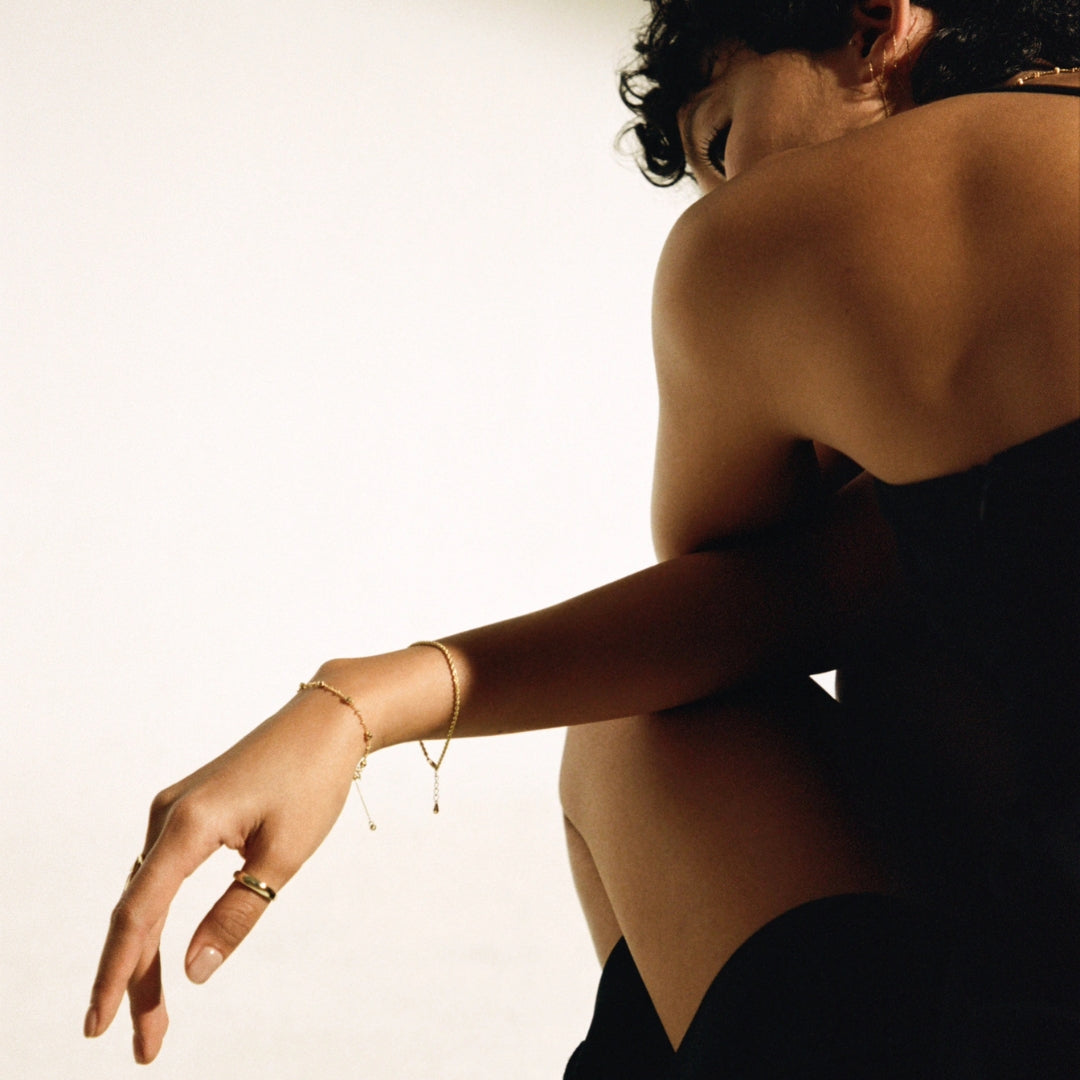
Natural Garnet Bracelet | January Birthstone | Healing Talisman
وصف
وصف
احصل على المقاس المثالي مع دليل مقاسات الخاتم الخاص بنا.
More Details
More Details
Garnet Bracelet — January's Birthstone, 5,000 Years of Deep Red Meaning, in Alternating 18K Gold Beads
This garnet bracelet is strung with 100% natural deep-red garnet round beads (4mm), alternating with 18K gold-plated S925 sterling silver spacer beads (3mm) in a rhythmic pattern — garnet, gold, garnet, gold — on a high-tensile elastic strand. Every garnet bead in this bracelet is untreated: no dye, no heat enhancement, no irradiation. The deep wine-red color (from iron and chromium in the garnet's crystal structure) is exactly as it came out of the ground. Garnet (from Latin granatus, meaning "seed-like" — a reference to the gem's resemblance to pomegranate seeds) is the birthstone for January, a stone with 5,000 years of documented human use stretching from pharaonic Egypt (where garnet beads were found in tombs dating to 3100 BCE) to Roman signet rings to Saxon sword fittings to Victorian mourning jewelry. It is the stone of fire, passion, commitment, and protection. Worn as a garnet birthstone bracelet on a January birthday or as a daily red accent for any month, the alternating bead rhythm catches light on the gold spacers while the garnets absorb it — deep red pools between flashes of gold. Fits wrists approximately 15–19cm (5.9–7.5 in). Nickel-free. 30-day returns. Free US shipping over $99.
Why This Garnet Bracelet
1. 100% Natural Garnet — No Dye, No Heat, No Treatment. Just Iron and Chromium in Crystal Form.
Most red gemstone beads on the market are dyed. Agate dyed red to look like carnelian. Howlite dyed red to look like coral. Quartz dyed red to look like ruby. The dye job fades — unevenly, from the surface inward — leaving blotchy, pale beads after 6–12 months of wear. These beads are different. The red in this garnet bracelet is intrinsic — iron (Fe²⁺) and chromium (Cr³⁺) ions in the crystal lattice absorb green and blue wavelengths, reflecting only red. This is called idiochromatic coloration: the color comes from elements that are part of the mineral's chemical formula, not from impurities or treatments. You cannot bleach the red out of a garnet. You cannot heat-treat it into a different shade (unlike amethyst → citrine). The specific garnet variety is almandine (Fe₃Al₂(SiO₄)₃), the most common gem-quality garnet species, characterized by deep purplish-red to brownish-red body color with a vitreous (glassy) luster. Each 4mm bead in this bracelet was cut from natural almandine rough and polished — no coatings, no fillers, no dye. The slight color variation from bead to bead (some deeper red, some with a hint of purple) is evidence of natural origin — perfectly uniform color in a strand of garnet beads is a red flag for dye treatment.
2. January Birthstone — From Egyptian Tombs to Victorian Rings, 5,000 Years of Garnet as a Talisman
Garnet has been worn as jewelry longer than almost any other gemstone. The timeline: 3100 BCE — garnet beads found in predynastic Egyptian tombs, the earliest known gemstone jewelry. Ancient Rome — carved garnet signet rings used to seal wax on documents (garnet is Mohs 7–7.5, hard enough to resist wear from wax but soft enough to carve). Anglo-Saxon England (5th–7th century CE) — garnet cloisonné (garnet slices set in gold cells) decorated sword pommels, shield fittings, and the famous Sutton Hoo shoulder clasps. Medieval Europe — garnet was called carbuncle (from Latin carbunculus, "little coal" because it glowed red when held up to light, like a hot ember) and was believed to illuminate dark rooms, warn of poison, and protect travelers from nightmares. Victorian Era (1837–1901) — garnet became the most popular gemstone for mourning jewelry (black jet and deep red garnet were the only socially acceptable colors). In 1912, the American National Association of Jewelers standardized the modern birthstone list — garnet was assigned to January. Today, wearing a garnet birthstone bracelet connects you to 5,000 years of human history: Egyptian eternity, Roman authority, Saxon battle-magic, medieval protection, and Victorian devotion — all in a strand of 4mm red beads.
3. Alternating Gold Bead Rhythm — 4mm Garnet × 3mm 18K Gold = A Visual Pulse on the Wrist
The design of this garnet bracelet is not random — it is a calculated alternating rhythm: 4mm deep-red garnet round bead, 3mm 18K gold-plated S925 spacer bead, 4mm garnet, 3mm gold, repeating around the entire strand. The spacing serves three purposes: (1) Light contrast: the gold beads catch and reflect ambient light (high reflectance), while the garnets absorb it (low reflectance). The result is a bracelet that flashes in motion — dark, light, dark, light — creating visual interest from across the room. (2) Bead protection: the 3mm gold spacers prevent garnet-on-garnet contact. Garnet is Mohs 7–7.5 — hard enough to scratch other garnets. Over years of wear, adjacent garnet beads rubbing against each other would develop flat wear facets (tiny polished flats visible under magnification). The gold spacers eliminate this — each garnet bead touches only gold spacers (Mohs ~2.5–3, much softer), so the garnets polish the spacers, not each other. (3) Proportional balance: the 4mm:3mm ratio (garnet:gold) prevents the gold from visually dominating. The garnet is the star; the gold is the supporting rhythm. The elastic strand is high-tensile cord — designed for rolling on and off without a clasp, fitting wrists approximately 15–19cm.
Specifications
| Gemstone | Natural almandine garnet (Fe₃Al₂(SiO₄)₃) — deep red, vitreous luster, Mohs 7–7.5. Untreated (no dye, no heat, no irradiation) |
| Bead Size | 4mm round garnet beads, 3mm round 18K gold-plated S925 spacer beads |
| Spacer Beads | S925 sterling silver base, 18K gold-plated (0.5+ microns). Nickel-free |
| Strand | High-tensile elastic cord — roll-on/roll-off, no clasp. Replacement life: 2–3 years daily wear |
| Fit | Fits wrists approximately 15–19cm (5.9–7.5 in). Stretches over hand, contracts to wrist |
| Birthstone | January — official modern birthstone (since 1912 standardization by ANJA) |
| Hypoallergenic | Nickel-free, lead-free. Garnet is hypoallergenic (silicate mineral, non-reactive) |
| Packaging | ELARAMUSE signature gift box with polishing cloth and garnet care/lore card |
Gemology: What Makes a Garnet Red — for 5,000 Years
- Crystal System: Garnet crystallizes in the cubic (isometric) system — the most symmetrical crystal system, with three equal axes at right angles. This cubic symmetry means garnet has no directional color variation (pleochroism) — it looks the same deep red from every angle, unlike sapphire or tourmaline which change color as you tilt them.
- Chemical Formula: Almandine garnet is Fe₃Al₂(SiO₄)₃ — three iron atoms, two aluminum atoms, three silica tetrahedra. The iron (Fe²⁺) is what makes it red. The silica tetrahedra (SiO₄) are the mineral's backbone — isolated silicate tetrahedra (nesosilicate structure) that give garnet its hardness (Mohs 7–7.5) and chemical stability (resistant to acids, sweat, and household chemicals).
- Idiochromatic Red: Unlike most colored gemstones (which are allochromatic — colored by trace impurities), almandine garnet is idiochromatic — the red color comes from iron, an essential element in the mineral's formula. Remove the iron, and it is no longer almandine. This means the red in this garnet bracelet is permanent at the atomic level — it cannot fade, leach, or be removed by any process short of complete chemical dissolution.
- Distinction from Ruby: For most of history, all red gemstones were called "carbuncle" or "ruby" — the distinction between ruby (red corundum, Al₂O₃, Mohs 9) and garnet (Fe₃Al₂(SiO₄)₃, Mohs 7–7.5) was not scientifically established until the late 18th century. Many "rubies" in historical crown jewels are actually garnets — including the "Pyrope" (another garnet species) in the Bohemian Crown of St. Wenceslas. To the naked eye, a high-quality deep-red almandine garnet is essentially indistinguishable from a lower-grade ruby — both are deep red, vitreous, and translucent to opaque — but garnet costs a fraction and requires no treatment.
- Natural Color Variation: Each 4mm bead in this garnet birthstone bracelet comes from a different part of the rough garnet crystal. Some beads lean slightly purplish (higher chromium), others lean slightly brownish (higher iron). This micro-variation across the strand is the fingerprint of natural, untreated garnet — a strand of perfectly identical red beads at this price point would indicate dyed agate or synthetic material. The beads are matched by eye for overall color harmony, not selected by machine for identical spectrophotometer readings.
How to Style a Garnet Birthstone Bracelet
January Birthday Stack: Wear this garnet bracelet as a standalone birthstone piece — the deep red against skin reads as intentional, personal, and meaningful. Add a simple gold chain bracelet on the same wrist (different texture, same metal tone) for a stacked look that doesn't compete. The garnet is the color anchor; the gold chain is the frame. If you were born in January, you own your birthstone — wear it with the confidence of 5,000 years of garnet history behind you.
Red Accent Layering: Layer this garnet birthstone bracelet with neutral-tone bracelets — white quartz, black onyx, grey pearls. The red punctuates like an exclamation point in a sentence of neutrals. The alternating gold spacers create visual rhythm, so even when layered behind other bracelets, the flash of gold between garnet beads catches the eye through the stack. Keep the garnet bracelet closest to the hand (the most visible position in a stack) and the neutrals closer to the elbow.
Gift Pairing — January Birthdays: A garnet bracelet for a January birthday paired with a garnet pendant or earrings creates a meaningful birthstone set. The deep red works year-round — it is a winter birthstone (January) but a warm, fire-colored stone that reads as cozy in cold months and vibrant in warm months. Include the garnet lore card that ships with this bracelet — the 5,000-year history from Egyptian tombs to Victorian rings makes the gift feel researched and intentional, not just "I picked your birthstone."
Care: Keeping Your Garnet Bracelet Brilliant
- Garnet Durability: Garnet is Mohs 7–7.5 — harder than steel (Mohs ~5–6), harder than glass (Mohs ~5.5), harder than most household surfaces. It is safe for daily wear under normal conditions. The 4mm round beads in this garnet bracelet are polished to a high vitreous luster that resists dulling. The main threat to garnet is not scratching but chipping — a sharp impact (banging the bracelet against a granite countertop, dropping it on tile) can chip a bead edge. The gold spacer beads between each garnet reduce the risk of garnet-on-garnet impact wear.
- Cleaning: Soak the entire garnet bracelet in warm water with a drop of mild dish soap for 5 minutes. Gently brush between beads with a soft toothbrush (the area where the gold spacer meets the garnet accumulates the most skin oil and lotion residue). Rinse thoroughly. Dry with a lint-free microfiber cloth. Do not use ultrasonic cleaners — the vibration can loosen the drill holes in the beads over time. Do not use steam cleaners — the thermal shock can crack the beads.
- Gold Spacer Maintenance: The 18K gold-plated S925 spacers will tarnish slowly (developing a warm patina on the silver base beneath the gold). Because the spacers are only 3mm, the gold plating covers proportionally more surface area relative to the bead volume than a larger bead would. Polish the spacers gently with the included cloth every 4–6 weeks to maintain bright gold contrast against the deep red garnets.
- Elastic Cord: Rated for 2–3 years of daily wear. Warning sign: the bracelet feels noticeably looser and the elastic doesn't snap back fully after stretching. Take it to any jeweler or bead shop for restringing — the garnet beads and gold spacers are reusable, only the elastic cord is replaced. Remove before swimming, hot tubs, and showering (chlorinated water and soap degrade the elastic cord).
What We Believe
We believe a birthstone should not require a gemology degree to appreciate — but the knowledge should be there if you want it. This garnet bracelet is 100% natural almandine garnet — undyed, unheated, untreated. The 4mm deep-red beads alternate with 3mm 18K gold-plated S925 spacers in a rhythm that flashes light-dark-light-dark in motion. Garnet is Mohs 7–7.5 — daily-wear durable. Elastic strand for clasp-free on/off. Nickel-free. The January birthstone designation dates to 1912, but garnet has been worn as jewelry since 3100 BCE — Egyptian tombs, Roman signet rings, Saxon sword fittings, Victorian mourning jewelry. Five thousand years of human history, in a strand of red beads. Free US shipping over $99. 30-day returns on unworn items.
Design Philosophy
Why garnet? Because January birthstone jewelry is a category dominated by mass-market brands that treat "birthstone" as a checkbox — drop a colored-glass bead on a chain, call it a birthstone bracelet, and move on. We went the opposite direction. We found natural undyed almandine garnet rough, cut it into 4mm rounds, matched the beads by eye for deep-red harmony (accepting the natural micro-variation that proves authenticity), and spaced them with 3mm 18K gold beads so the garnets never touch each other (preventing wear facets). The alternating rhythm — 4mm red, 3mm gold — creates a visual pulse. The result is not a "birthstone product" that ticks a box. It is a garnet bracelet that happens to be the January birthstone, backed by 5,000 years of documented garnet use, made from gemstone beads that will still be deep red when your grandchildren ask about them. The deep red is permanent — iron atoms in crystal lattice form, reflecting only red light, for as long as garnet exists. That is our definition of "birthstone jewelry": an heirloom, not a checkbox.
Key Terms
- Almandine Garnet: The most common gem-quality garnet species — Fe₃Al₂(SiO₄)₃, iron-aluminum silicate. Deep purplish-red to brownish-red body color. Mohs 7–7.5 hardness. Vitreous (glassy) luster. Cubic crystal system (isometric, most symmetrical). Idiochromatic — the red color comes from iron (Fe²⁺), an essential element in the crystal formula, not a trace impurity. This means the color is permanent and cannot be removed by heat, chemical treatment, or UV exposure. Used in jewelry for 5,000+ years.
- Idiochromatic vs. Allochromatic: An idiochromatic gemstone gets its color from an element that is part of the mineral's chemical formula (garnet: iron = red, peridot: iron = green). An allochromatic gemstone gets its color from trace impurities — elements that are not part of the formula (ruby: chromium impurity in colorless Al₂O₃ = red; sapphire: iron + titanium impurity in colorless Al₂O₃ = blue). Idiochromatic stones have permanent, unfadeable color. Allochromatic stones can be heat-treated to change their color (amethyst → citrine, brown zircon → blue zircon).
- January Birthstone (1912 Standardization): In 1912, the American National Association of Jewelers (now Jewelers of America) standardized the modern birthstone list to eliminate regional disagreements and marketing confusion. Before 1912, different countries and jewelers assigned different stones to the same month. Garnet was assigned to January, replacing earlier associations (January was sometimes linked to onyx or jacinth). The 1912 list also standardized amethyst (February), aquamarine (March), diamond (April), and emerald (May).
- Carbuncle: The historical name for red garnet (and all red gemstones) from antiquity through the Renaissance. From Latin carbunculus — "little coal" or "little ember" — because a garnet held up to light glows red like a hot coal. Medieval lapidaries (gemstone encyclopedias) claimed carbuncle could illuminate dark rooms, warn of poison by changing color, protect travelers, and cure inflammatory diseases. The term fell out of use after the 18th century when gemology distinguished garnet from ruby.
- Garnet-on-Garnet Wear Facets: When two garnet beads rub against each other in a bracelet strand, the harder bead gradually wears a small flat facet (a polished flat spot) onto the softer bead. Over years of daily wear, this creates visible flat patches on the beads. The 3mm 18K gold spacers in this garnet bracelet eliminate garnet-on-garnet contact — each 4mm garnet bead touches only gold spacers (Mohs ~2.5–3), so the garnets polish the softer gold rather than wearing each other down. This is a deliberate design choice, not a cost-saving measure (gold spacers cost more than stringing garnets directly together).
Frequently Asked Questions
Are the garnets real or dyed?
100% real almandine garnet — no dye, no heat treatment, no irradiation. The deep red color is idiochromatic: the iron (Fe²⁺) in the garnet's crystal lattice (Fe₃Al₂(SiO₄)₃) absorbs green and blue light, reflecting only red. This color is permanent at the atomic level — it cannot fade, leach, or bleach out. The slight color variation from bead to bead (some deeper purplish-red, some more brownish-red) is natural micro-variation — proof of untreated origin. Perfectly identical red beads at this price point would indicate dyed agate or synthetic material. This garnet bracelet uses natural, untreated almandine exclusively.
Is garnet durable enough for a bracelet? Won't it scratch or chip?
Garnet is Mohs 7–7.5 — harder than steel (~5–6), glass (~5.5), and most household surfaces. It is entirely durable enough for daily bracelet wear. The main risk is not scratching but chipping — a sharp impact on a hard surface (granite countertop, tile floor) can chip a bead edge. Our 3mm gold spacer beads between every 4mm garnet prevent garnet-on-garnet contact, eliminating the slow mutual wear that creates flat facets on unprotected strands. Remove this garnet birthstone bracelet before rock climbing, weightlifting, or any activity where it might strike hard surfaces at speed.
Can I wear this if I'm not born in January?
Absolutely. Birthstone rules are modern social conventions (standardized in 1912), not laws of nature. For 4,900 of the past 5,000 years, garnet was worn by everyone — Egyptians, Romans, Saxons, Victorians — regardless of birth month. Deep red is a universally flattering color that works in every season. The only practical consideration: if the recipient was born in January, this garnet bracelet becomes an especially meaningful gift with a built-in story (birthstone + 5,000 years of history). For other months, it is simply a beautiful strand of dark red natural gemstone beads with gold accents — the January designation is bonus context, not a restriction.
What's the difference between garnet and ruby?
Chemically: ruby is red corundum (Al₂O₃ + chromium impurities), garnet is iron-aluminum silicate (Fe₃Al₂(SiO₄)₃). Ruby is Mohs 9 (second hardest after diamond), garnet is Mohs 7–7.5. Ruby's red comes from trace chromium (allochromatic), garnet's red comes from iron in the formula (idiochromatic). Visually: a high-quality deep-red almandine garnet is essentially indistinguishable from a lower-grade ruby to the naked eye — both are deep red, vitreous, and translucent to opaque. Many "rubies" in historical crown jewels are actually garnets. Ruby costs 10–100× more per carat. This garnet bracelet gives you natural red gemstone beads with a 5,000-year history at a fraction of ruby's price — and without the routine heat treatment that virtually all commercial ruby receives.
Will the elastic cord break?
The high-tensile elastic cord is rated for approximately 2–3 years of daily wear. It will not snap suddenly — the warning sign is progressive looseness and loss of spring-back. When the bracelet starts to feel baggy on the wrist, take it to any jeweler or bead shop (it's a 2-minute restringing job). The garnet beads and gold spacers are all reusable — only the cord is replaced. To extend cord life: roll the bracelet on and off gently (don't yank the elastic to its maximum stretch repeatedly), remove before showering/swimming, and dry promptly if it gets wet. Treat the cord as a consumable — the garnets last forever, the elastic doesn't.
Does the gold on the spacer beads wear off?
Yes — all plating eventually wears. The 18K gold plating on the 3mm S925 spacers is 0.5+ microns thick. Because spacer beads are sandwiched between garnet beads (not exposed to direct skin/friction on their outer surface the way a bracelet clasp or pendant front is), the gold plating lasts longer than you might expect — the garnets protect the spacers. When the gold does eventually thin after years of wear, what emerges beneath is sterling silver — a precious metal that reads as a tonal contrast (silver beads beside red garnet) rather than a defect (the way brass emerging under gold looks cheap). Polish with the included cloth every 4–6 weeks to maintain bright gold.
Is the bracelet adjustable?
This garnet bracelet is strung on an elastic strand — it stretches to fit over the hand and contracts to sit on the wrist without a clasp. It fits wrists approximately 15–19cm (5.9–7.5 inches) in circumference. If your wrist is on the smaller side (~15cm), the bracelet will fit loosely and may slide with arm movement. If your wrist is on the larger side (~19cm), the elastic will hold snugly (not tight). The bracelet is not adjustable in the traditional sense (no extender chain, no clasp to reposition). If your wrist is outside the 15–19cm range, contact ELARAMUSE — we can advise whether the fit will work or suggest alternatives in our bracelet collection.
EXPLORE THE BRACELET COLLECTION
Garnet Bracelets & January Birthstone Jewelry | Natural Almandine | 18K Gold S925 | ÉLARAMUSE →شارك هذا المنتج
Worldwide Shipping
Secure global delivery to your doorstep within 5–14 business days.
100% Secure Checkout
Encrypted payment for your peace of mind.
Flexible Cancellation
Changed your mind? We offer a full refund for any order that has not yet been dispatched.
Customer service
Real humans ready to help, 24/7.