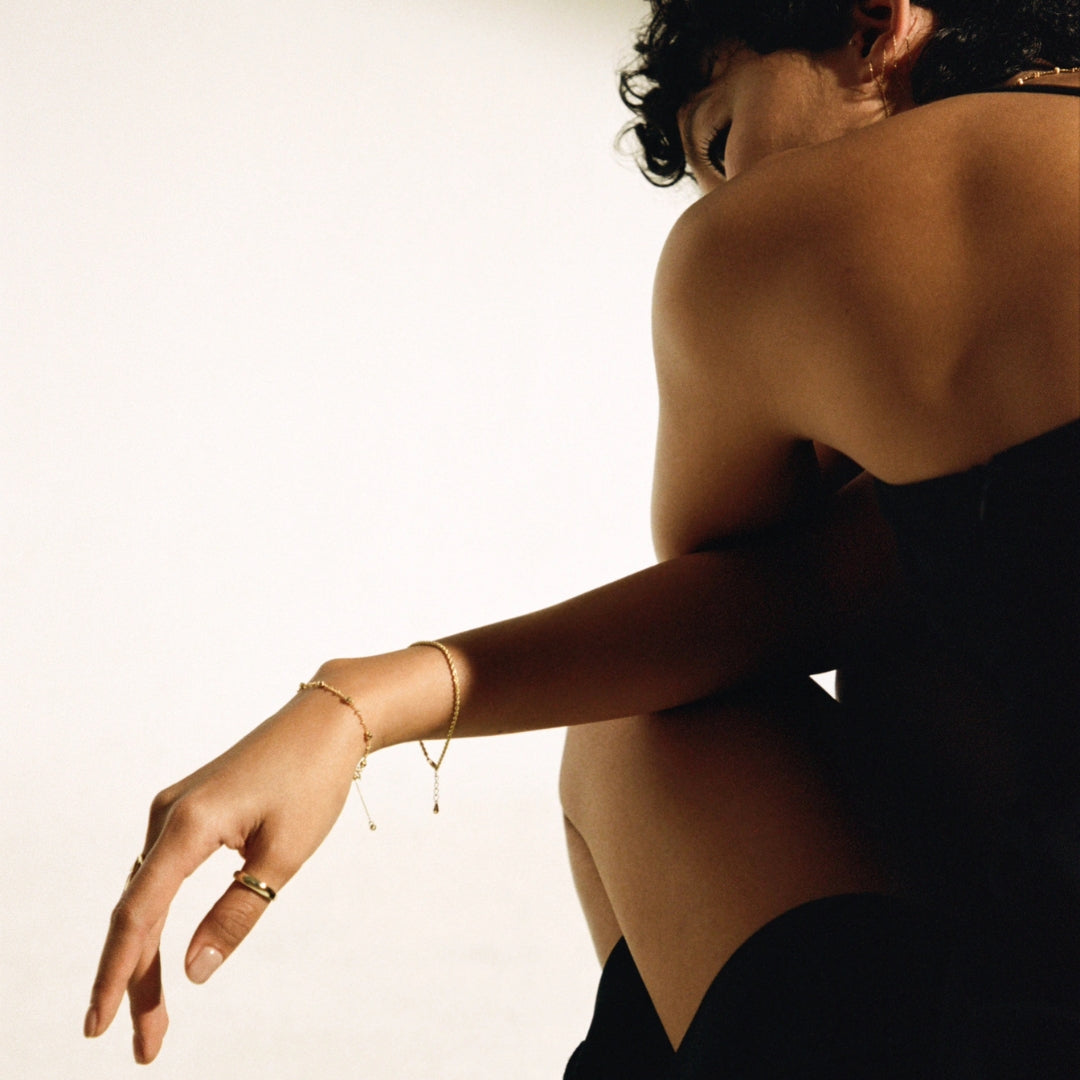
Gold Leaf Pendant | Nature Inspired Art | 18K Gold Plated Silver
وصف
وصف
احصل على المقاس المثالي مع دليل مقاسات الخاتم الخاص بنا.
More Details
More Details
Gold Leaf Pendant — A Ginkgo Leaf in 18K Gold That Outlived the Dinosaurs and Now Hangs from Your Neck
This gold leaf pendant is not a generic leaf shape stamped from sheet metal — it is a three-dimensional ginkgo biloba leaf, cast from an actual ginkgo leaf, in 18K gold-plated S925 sterling silver. Every vein, every undulation, and every split in the fan-shaped blade is there because the original leaf was there first — the pendant is a botanical sculpture, not an artist's sketch of what a leaf should look like. The ginkgo tree (Ginkgo biloba) is the oldest surviving tree species on Earth — 270 million years old, predating the dinosaurs, the only surviving member of its entire botanical division (Ginkgophyta). It is a living fossil. When you wear this ginkgo leaf necklace, you are wearing a piece of botanical history cast in precious metal — a symbol of resilience, survival, and the beauty of things that endure. The pendant measures approximately 22mm × 20mm with a 3D relief on the front (veins raised, leaf margin scalloped) and a smooth gold back. Includes a 40+5cm adjustable 18K gold-plated S925 chain. Ships in ELARAMUSE signature gift packaging with free US shipping and 30-day returns.
Why This Gold Leaf Pendant
1. Ginkgo Biloba — 270 Million Years of Survival, Cast in Gold
The ginkgo is not just some tree. It is the tree. Fossil ginkgo leaves from the Permian period (270 million years ago) are virtually identical to the leaves on ginkgo trees today — the species has not changed its leaf shape in a quarter-billion years. Dinosaurs walked under ginkgo trees. The K-Pg asteroid that wiped out 75% of life on Earth at the end of the Cretaceous period could not kill the ginkgo — it survived in isolated refugia in what is now China, where Buddhist monks cultivated it in temple gardens for over a thousand years, preserving the species. In 1945, six ginkgo trees located 1–2 km from the Hiroshima atomic bomb hypocenter survived the blast, resprouted from charred trunks, and are still alive today. They are called hibakujumoku — "survivor trees." A gold leaf pendant shaped like a ginkgo leaf carries this meaning: resilience no matter what happens, continuity across deep time, beauty that outlasts extinction events. No other leaf-shaped pendant on the market can tell this story because no other leaf belongs to a species that has been alive for 270 million years.
2. Botanical Sculpture — Cast from a Real Leaf, Not Drawn by an Artist
Most gold leaf pendant necklace designs begin with a designer sketching a leaf shape, which is then digitized, tooled into a mold, and stamped. The result: a leaf that looks like what a person thinks a leaf looks like — symmetrical, simplified, generic. This pendant began differently. An actual ginkgo leaf was selected — a mature fan-shaped leaf with a characteristic split (the apical notch that divides the broad blade into two lobes), healthy venation (parallel veins radiating outward from the petiole attachment point like a fan), and a slightly wavy margin (the scalloped edge characteristic of the species). That leaf was used to create a mold — a process called lost-leaf casting (adapted from lost-wax casting, where the organic material is burned out of the investment mold, leaving a cavity that is filled with molten silver). The resulting silver casting — every vein, every scallop, every undulation — is then 18K gold-plated on the front face. The back is polished smooth for comfort against the skin. What you see on the pendant is not a drawing of a leaf. It is a metal ghost of a leaf that once existed.
3. Real Metals — 18K Gold Plate on S925, Not Brass Undercoat
This gold leaf pendant is made from S925 sterling silver (92.5% pure silver + 7.5% copper for hardness), with 18K gold plating on the front face at 0.5+ microns thickness. There is no nickel underplate — the gold bonds directly to the silver base. This matters for two reasons: (1) Hypoallergenic safety: nickel is the most common metal allergen in jewelry (approximately 10–20% of the population has nickel sensitivity), and many budget leaf pendants use a nickel underplate between brass and gold because nickel provides a smooth, bright base for plating. We don't. The gold goes directly onto S925 silver. (2) Wear character: as the gold plating eventually thins (all plating does, over years of wear), the silver that emerges beneath it is also a precious metal — not a brassy yellow base that reads as "cheap jewelry showing its age." When this pendant ages, it reveals silver beneath gold, not brass beneath gold. The chain (40cm + 5cm extender) is also 18K gold-plated S925, with matching lobster clasp and jump rings.
Specifications
| Design | Ginkgo biloba leaf — 3D botanical relief (raised veins, scalloped margin), cast from a real ginkgo leaf |
| Material | S925 sterling silver base, 18K gold-plated front face (0.5+ microns). Nickel-free, lead-free |
| Pendant Size | Approximately 22mm × 20mm × 2.5mm (height × width × depth at thickest vein point) |
| Chain | 40cm (15.7 in) with 5cm (2 in) extender — adjustable 40–45cm. 18K gold-plated S925 cable chain |
| Clasp | Lobster clasp — S925 base, 18K gold-plated. Spring-loaded for secure closure |
| Hypoallergenic | Nickel-free, lead-free. Gold plated directly over S925 — no nickel underplate |
| Packaging | ELARAMUSE signature gift box with polishing cloth and care card |
Botany: Why Ginkgo Is Called a "Living Fossil"
The term "living fossil" — coined by Charles Darwin in On the Origin of Species (1859) — describes a species that has survived virtually unchanged for millions of years while all its close relatives went extinct. Ginkgo biloba is the textbook example:
- 270 million years old (Permian Period): Ginkgo fossils from the Permian — before the dinosaurs — show leaves indistinguishable from modern ginkgo leaves. The species predates the Atlantic Ocean. It predates flowers (angiosperms had not evolved yet). It predates birds.
- Only surviving member of Ginkgophyta: The ginkgo belongs to its own botanical division — Ginkgophyta — which once contained multiple families, genera, and species. All of them are extinct. Ginkgo biloba is the last one standing. There is nothing else like it on Earth.
- Hiroshima survivors: Six ginkgo trees located 1–2 km from the 1945 atomic bomb hypocenter survived the blast, resprouted from charred trunks, and are alive today at temples in Hiroshima — including Anraku-ji, Hosen-ji, and Myōjō-in temples. They are marked with signs reading "A-bombed ginkgo" (hibakujumoku).
- Dioecious species: Ginkgos are dioecious — individual trees are either male or female. The female produces seeds with a soft, fleshy outer layer that smells of butyric acid (rancid butter). For this reason, most cultivated ginkgos are male clones.
- Leaf morphology: The ginkgo leaf is fan-shaped (flabellate), with parallel veins radiating from the base of the leaf blade (petiole attachment) outward — no branching, no net venation. This is a primitive leaf structure shared with ferns and cycads, unlike the reticulate (net-like) venation of modern broadleaf trees. The ginkgo leaf necklace on this page reproduces this fan venation in 3D relief — each vein is a raised ridge in the gold casting, exactly as botanically observed.
How to Style a Gold Leaf Pendant Necklace
Solo with Significance: Wear this gold leaf pendant alone on its 40cm chain — it falls just below the collarbone, where the ginkgo shape is fully visible against a solid-colored top. The 3D relief catches light from above (overhead lighting, sunlight through a window) and casts tiny leaf-vein shadows on your skin. This is the configuration for people who wear jewelry as a conversation piece — "Is that a ginkgo leaf?" is the most common question this pendant invites, which opens the door to "Yes. Did you know six ginkgo trees survived Hiroshima?"
Nature Stack: Layer this ginkgo leaf necklace with a longer chain (50–55cm) carrying a simple gold circle or bar pendant. The ginkgo sits higher (40cm), the longer pendant sits lower. The contrast — organic leaf shape above, geometric circle below — reads as intentional layering. Keep both in the same metal tone (gold on gold). The different lengths prevent tangling.
Botanical Pairing: Pair with ginkgo-themed earrings — the ELARAMUSE Gold Ginkgo Earrings (Gold Ginkgo Earrings) complete the set. Leaves on the ears + leaf at the neck = a botanical ensemble that reads as curated, not matched. The earrings and pendant both feature the same fan-vein relief pattern, but at different scales — ear studs at ~12mm, pendant at ~22mm.
Care: Keeping Your Gold Leaf Pendant Brilliant
- 3D Relief Cleaning: The raised veins on this gold leaf pendant create dozens of tiny valleys between ridges — these can accumulate skin oils, lotion residue, and environmental dust. Clean the front face every 2–3 weeks with a soft toothbrush dipped in warm water with a drop of mild dish soap. Gently brush along the vein direction (from the petiole attachment outward, following the natural fan pattern) to avoid bending the delicate raised ridges. Rinse thoroughly. Dry with a lint-free microfiber cloth. Do not use ultrasonic cleaners — the high-frequency vibration can micro-fracture the thin gold plating at the tips of the raised veins.
- Chain Care: The gold-plated S925 cable chain is durable but fine (approximately 1.2mm link thickness). It will tangle if stored loose. Always clasp the chain when not wearing it — an unclasped chain will knot itself into a frustrating bird's nest within hours. Store the pendant and chain in the included ELARAMUSE pouch.
- Gold Plating Longevity: The 18K gold plating is 0.5+ microns thick — a robust demi-fine standard. Because a pendant hangs freely and experiences less friction than a ring (no gripping, no hand washing abrasion), the plating on this gold leaf pendant necklace will outlast plating on a ring of the same thickness. Remove before showering, swimming, exercising, or applying perfume/hair products to the neck area. Perfume contains alcohol and essential oils that can accelerate gold wear at the molecular level.
- Storage: Store flat or hanging. Do not pile other jewelry on top of the pendant — the 3D raised veins can be pressed flat by sustained weight. The leaf shape is sculptural; treat it like a tiny sculpture, not a flat medallion.
What We Believe
We believe jewelry should have somethingto say. This gold leaf pendant — a 3D ginkgo biloba leaf cast from a real leaf — says something no generic leaf pendant can: that the species it represents has been alive for 270 million years, survived the Permian extinction, survived the K-Pg extinction that killed the dinosaurs, and survived the atomic bomb at Hiroshima. It is 18K gold-plated S925 sterling silver (0.5+ microns). Nickel-free. Lead-free. The front face has raised botanical venation and a scalloped leaf margin. The back is smooth gold over silver for skin comfort. The 40+5cm adjustable chain is also gold-plated S925. Every material is disclosed. Every process is traceable. We tell you the leaf shape is a ginkgo, we tell you why that matters, and we let you decide if you want to wear a piece of botanical history around your neck. Free US shipping over $99. 30-day returns on unworn items.
Design Philosophy
Why a ginkgo leaf? Because it is the only leaf on Earth that can legitimately claim to have watched the dinosaurs come and go. A generic leaf pendant says "I like nature." A ginkgo leaf necklace says "I know about resilience across geological time scales." That distinction matters in jewelry design — the difference between decoration and meaning. Our design process started not with a sketchpad but with a botanical reference: pressed ginkgo leaves from a 200-year-old temple ginkgo in Kyoto, photographed under raking light to reveal the exact venation pattern. That pattern was transferred to a casting mold. That mold produced this pendant. The design is not "a leaf" — it is a specific leaf from a specific species with a specific 270-million-year history. Every person who asks about this pendant gets a story that makes them look at jewelry differently. That is the design goal: not just to decorate the neck, but to start a conversation about deep time, survival, and the fact that a tree that predates the Atlantic Ocean is still dropping fan-shaped leaves on sidewalks today.
Key Terms
- Ginkgo biloba (Living Fossil): The oldest surviving tree species on Earth — 270 million years old (Permian period, predating the dinosaurs by ~40 million years). The sole surviving member of the division Ginkgophyta. Identified by its distinctive fan-shaped (flabellate) leaf with parallel venation radiating from the petiole attachment. The species name "biloba" refers to the split (bi-lobed) leaf shape — a characteristic apical notch that divides the broad fan into two lobes. Six ginkgo trees survived the Hiroshima atomic bomb and are alive today. The ginkgo is a botanical symbol of resilience, longevity, and survival against impossible odds.
- Lost-Leaf Casting: A jewelry casting technique adapted from the ancient lost-wax method. An actual organic leaf (in this case, a ginkgo leaf) is embedded in investment plaster (a refractory mold material). The mold is heated — the organic leaf burns away completely, leaving a cavity in the exact shape of the leaf, capturing every vein, every scallop, and every undulation down to the cellular level. Molten silver is poured into the cavity. The result: a metal casting that is a faithful 3D reproduction of the original leaf. This is fundamentally different from die-stamping (a flat sheet of metal pressed between two engraved dies), which produces simplified, symmetrical leaf shapes. A lost-leaf cast gold leaf pendant preserves the organic irregularity of the original — the slight asymmetry, the natural wave, the precise venation density.
- Hibakujumoku (被爆樹木): Japanese for "survivor tree" or "A-bombed tree" — specifically refers to trees that survived the atomic bombing of Hiroshima on August 6, 1945. Approximately 170 trees within 2 km of the hypocenter survived, including six ginkgo trees. These trees are marked with official signage and are visited as symbols of peace and resilience. The ginkgo's survival is attributed to its extremely thick bark, its ability to resprout from epicormic buds (dormant buds beneath the bark), and its general stress tolerance — the same traits that enabled it to survive the K-Pg extinction.
- Flabellate Venation (Fan-Veined): A primitive leaf venation pattern where veins run parallel to each other, radiating outward from the base of the leaf like a fan, without branching or forming a network. Found in ginkgo, ferns, and cycads — all ancient plant lineages. Contrasts with reticulate (net-like) venation found in modern broadleaf trees (oaks, maples, etc.). The ginkgo leaf necklace reproduces flabellate venation in 3D gold relief on the pendant face.
- Petiole Attachment Point: The point where the leaf stem (petiole) connects to the leaf blade. In the ginkgo pendant design, the bail (the loop through which the chain passes) is positioned at this natural attachment point — the petiole base — so the pendant hangs as if the leaf is suspended from its own stem. This is a deliberate anatomical design choice that distinguishes it from generic leaf pendants where the bail is arbitrarily attached to the center top of the leaf.
Frequently Asked Questions
Is this an actual ginkgo leaf dipped in gold?
No — the pendant is solid S925 sterling silver (with 18K gold plating on the front). It was created using a lost-leaf casting process: a real ginkgo leaf was used to create a mold, the leaf burned away during mold firing, and molten silver was poured into the leaf-shaped cavity. What you receive is a silver-and-gold metal reproduction of a real ginkgo leaf — not a coated organic leaf. The result is durable, tarnish-resistant jewelry that will last for decades. A real leaf dipped in gold would be fragile and would degrade within months.
Why ginkgo? Why not any other leaf?
Because the ginkgo is the most botanically significant leaf on Earth. 270 million years old — older than dinosaurs, older than flowers, older than the Atlantic Ocean. It survived the Permian extinction (252 million years ago, "The Great Dying" that killed 96% of marine species), the K-Pg extinction (66 million years ago, the asteroid that killed the dinosaurs), and the Hiroshima atomic bomb (1945). It is the sole survivor of its entire botanical division. Wearing a gold leaf pendant shaped like a ginkgo is wearing a symbol of resilience across geological time — not just "I like leaves" but "I understand why this particular leaf matters." The fan-shaped (flabellate) leaf is also geometrically beautiful — parallel veins radiating from a single point, no branching, pure and primitive. A generic leaf pendant cannot offer this depth of meaning.
Will the 3D veins flatten over time?
The raised veins on the front face of this gold leaf pendant necklace are cast in solid silver (not stamped), approximately 0.3–0.5mm in relief height. Under normal wear conditions — the pendant hanging freely against clothing — the veins will not flatten. They are integral to the metal body, not applied surface detail. Avoid pressing the pendant under heavy objects (do not store books or other jewelry on top of it). Do not polish aggressively on the front face — polishing cloths are fine for light buffing, but heavy-handed rubbing with abrasive compounds could gradually wear down the fine vein tips over many years of aggressive cleaning. Normal wear = permanent relief. The veins are there for the life of the pendant.
Is the chain included?
Yes — this ginkgo leaf necklace includes a 40cm (15.7 in) 18K gold-plated S925 cable chain with a 5cm (2 in) extender, giving an adjustable range of 40–45cm (15.7–17.7 inches). The chain matches the pendant — same gold tone, same S925 base, same nickel-free construction. The lobster clasp is spring-loaded for secure closure. If you prefer to wear the pendant on your own chain, the bail (the loop at the top of the pendant, positioned at the petiole attachment point) accommodates chains up to approximately 2mm in link thickness — most standard necklace chains will fit through the bail without issue.
Is it hypoallergenic? I have nickel sensitivity.
Yes. This gold leaf pendant is nickel-free and lead-free. The base is S925 sterling silver (92.5% silver + 7.5% copper), and the 18K gold plating is applied directly over the silver — there is no nickel underplate. Nickel underplate is common in budget jewelry because nickel provides a bright, smooth surface that makes gold plating look more brilliant, but it is the most common metal allergen (~10–20% of the population has some degree of nickel sensitivity). We skip it entirely. The chain is also nickel-free S925 with direct gold plating. If you have a severe metal allergy, this pendant and chain should be safe for all-day wear.
Does the gold wear off?
All gold plating eventually wears with friction and time — this is true of every plated jewelry piece on the market. The 18K gold plating on this pendant is 0.5+ microns thick, which is at the upper end of the demi-fine standard. Because a pendant hangs freely on a chain and experiences significantly less friction than a ring (constant hand contact, gripping, washing) or a bracelet (desk contact, sleeve friction), the plating on this gold leaf pendant necklace will outlast plating on rings or bracelets of the same thickness. When the gold does eventually wear through after years of daily wear, what emerges beneath is sterling silver — a precious metal — not brass or base metal. This means the pendant ages gracefully: gold fading into silver, rather than gold flaking off to reveal a cheap yellow base. Remove before showering, swimming, exercising, or applying perfume to the neck area to maximize plating life.
Where do ginkgo trees grow? Can I see one?
Ginkgo trees are cultivated worldwide as ornamental street trees, park trees, and temple/religious site trees. They are especially common in East Asia (China, Japan, Korea — where the species was preserved by Buddhist monks for over a thousand years), but you can find mature ginkgos in cities across North America, Europe, and Australia. In the US, notable ginkgo plantings include: the ginkgo grove at the New York Botanical Garden, the row of ginkgos along the National Mall in Washington DC, and the ginkgo at Bartram's Garden in Philadelphia (planted 1785, among the oldest in the US). If you want to see a ginkgo up close, look for a tree with fan-shaped leaves that turn brilliant yellow in autumn and drop all at once (ginkgos are famous for dropping their entire leaf canopy in a single day in late fall). If you live in a city with street trees, there is likely a ginkgo within a few blocks of you — it is one of the most widely planted ornamental trees on Earth. When you find one and hold a leaf against this gold leaf pendant, you will see: the veins match, the scalloped margin matches, the apical notch matches. It is a 1:1 botanical reproduction.
EXPLORE THE PENDANT COLLECTION
Gold Leaf Pendants & Ginkgo Necklaces | Botanical Jewelry | 18K Gold S925 | ÉLARAMUSE →شارك هذا المنتج
Worldwide Shipping
Secure global delivery to your doorstep within 5–14 business days.
100% Secure Checkout
Encrypted payment for your peace of mind.
Flexible Cancellation
Changed your mind? We offer a full refund for any order that has not yet been dispatched.
Customer service
Real humans ready to help, 24/7.