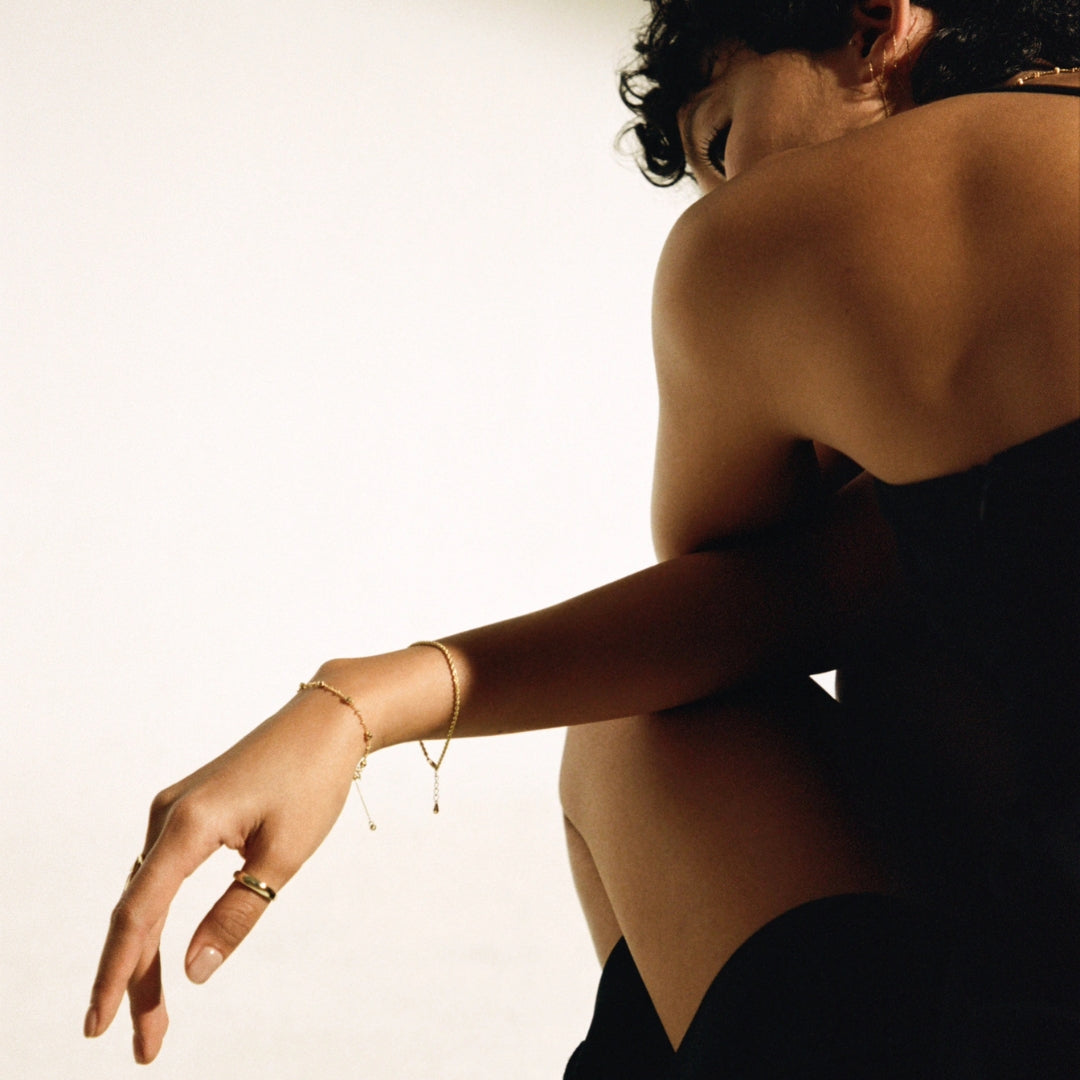
Red Rutilated Quartz Bracelet | Geometric Fire Quartz Talisman
Beschreibung
Beschreibung
Finden Sie die perfekte Passform mit unserem Ringgrößen-Leitfaden.
More Details
More Details
Rutilated Quartz Bracelet — Geometric Fire Quartz Crystal Pillars with Natural Red Rutile Needle Inclusions, Hematoid Quartz Talisman, 18K Gold-Plated on Adjustable Chain
Quick answer: The Crimson Bloom Bracelet threads five chunky geometric pillars of natural rutilated quartz — specifically hematoid fire quartz, a rare variety where red rutile needles (titanium dioxide crystallized with iron oxide, giving the inclusions their red-gold fire coloration) are suspended inside clear rock crystal in thick, densely packed clusters. Each pillar (approximately 8mm × 6mm × 5mm) is faceted with flat geometric planes that create windows into the quartz interior — tilt the bracelet and the rutile needles shift angle behind the crystal faces like a frozen fire viewed through ice. The quartz pillars are linked by 18K gold-plated S925 cable chain with an adjustable lobster clasp. Every rutilated quartz pillar is unique — the density, angle, and clustering of the red rutile needles varies from pillar to pillar, making each bracelet a one-of-a-kind mineral specimen. This is not factory-made uniformity — it's geology on the wrist. A healing crystal bracelet for those who want their crystal energy wrapped in gold geometry. Hypoallergenic. Water-resistant.
Why This Rutilated Quartz Bracelet — Three Layers That Turn a Crystal Bracelet into a Wearable Geology Specimen
1. Hematoid Fire Quartz: What Makes Red Rutile Form Inside Clear Quartz — and Why It's Called 'Fire'
Rutilated quartz is silicon dioxide (SiO₂, quartz) that crystallized around pre-existing needle-like crystals of rutile — titanium dioxide (TiO₂) that formed microscopic rods and threads inside the quartz host as both minerals grew simultaneously in a hydrothermal vein. Standard rutile in quartz — the kind most rutilated quartz bracelets use — is gold-colored: the inclusion is pure titanium dioxide, appearing as thin metallic gold threads suspended in the clear quartz, like a spiderweb spun in gold wire. Hematoid fire quartz — also called red rutilated quartz or hematite-included quartz — adds a third mineral to the mix: hematite (iron oxide, Fe₂O₃), the same mineral that gives Mars its red color, coating the rutile needles or crystallizing alongside them in the quartz matrix. The result is a crystal where the rutile needles are no longer gold — they're red-gold, crimson, rust, fire-orange, sometimes so densely packed that the quartz itself appears to be burning from within. The "fire" in fire quartz is literal: tilt the crystal pillar under sunlight and the red rutile needles catch the light at different depths, creating the optical illusion of a fire suspended in solid ice — flames that never consume, trapped in geological amber. Each crystal pillar in this bracelet contains a different arrangement of rutile — some pillars show dense, parallel sheaves of red needles like a frozen campfire; others show sparse, individually resolved threads crossing the quartz at random angles like a vascular system mineralized in crystal; some show the hematite staining as a diffuse red cloud rather than distinct needles — a red phantom growing inside the quartz like a second crystal within the first. The mineralogical rarity: hematoid quartz is significantly less common than gold rutilated quartz — the specific chemical conditions required for both rutile and hematite to crystallize simultaneously inside the same quartz body (correct temperature gradient in the hydrothermal fluid, correct titanium and iron saturation levels, correct cooling rate) occur in only a handful of locations globally, primarily the Novo Horizonte region of Bahia, Brazil, and select deposits in Madagascar. The crystal bracelet you're wearing is a fragment of a specific geological event that happened approximately 500 million years ago, in a hydrothermal crack deep in the earth's crust, at a precise temperature between 300°C and 500°C, with titanium and iron ions precipitating into needle form while silicon dioxide crystallized around them — and every rutilated quartz pillar is a cross-section of that frozen moment.
2. Geometric Pillar Faceting: Why a Crystal Bracelet with Flat Planes Is Better Than Tumbled Beads — the Window Effect
Most healing crystal bracelets use tumbled stone beads — rounded, polished, comfortable against the skin, and optically dead. Tumbling rounds off all crystal faces, turning the stone into a smooth oval that scatters light diffusely and obscures the internal structure — you see the surface polish, not the rutile inside. The Crimson Bloom Bracelet uses faceted geometric pillars — each quartz piece is cut with approximately 6–8 flat planes (top, bottom, and angled side facets) that function as windows into the crystal interior. The flat facets at the top and bottom of each pillar are polished to transparency — you can look directly through the crystal from the top face to the bottom face, seeing the rutile needles suspended in 3D space between them like insects preserved in amber. The angled side facets (cut at approximately 45° to the pillar axis) catch and reflect light at different angles — as the wrist moves, the crystal faces flash bright as they momentarily align with the light source, then go dark as the angle shifts, creating a rhythm of reveal and conceal: rutile visible, rutile hidden, rutile visible again, in a cycle that matches the wearer's gesture. The geometric faceting also serves the crystal healing bracelet aesthetic: flat planes read as deliberate, architectural, designed — the opposite of the organic, druzy, unpolished crystal bracelets that dominate the healing stone market. This is a quartz bracelet that respects the crystal's natural beauty (the rutile, the hematite staining, the internal fractures that catch light like internal rainbows) while framing it in a geometric architecture that reads as contemporary jewelry — not a metaphysical shop counter. Each pillar is approximately 8mm × 6mm × 5mm — chunky enough to hold significant crystal volume (more rutile, more fire, more internal landscape to explore), minimal enough to sit flat against the wrist without protruding beyond the bracelet profile. The pillar arrangement: five geometric crystal pillars linked on a fine cable chain with approximately 3mm spacing between pillars — the pillars dominate the visual, the chain is infrastructure. The bracelet wears like a string of crystal jewels rather than a beaded crystal bracelet — the distinction is the faceting and the spacing, which together create the visual weight of a jeweled bracelet rather than a hippie healing accessory.
3. Rutile Needle Direction / Phantom Growth / Hematite Staining: How to Read the Geology Inside Your Bracelet — and Why No Two Bracelets Are the Same
Every rutilated quartz specimen is unique — but hematoid fire quartz is triply unique. The three visual phenomena inside each crystal pillar are: (a) Rutile needle direction. The rutile needles in quartz grow along the crystallographic axes of the host quartz — the hexagonal structure of quartz imposes a directional bias on the rutile rods. In some pillars, the needles align in a single dominant direction (parallel sheaves, like a stack of red matchsticks); in others, the needles grow in two or three intersecting directions (a cross-hatched web of red lines); in the rarest, the needles radiate from a single point (a firework caught inside the crystal). The bracelet contains five pillars, each with a different needle arrangement — wearing the bracelet is wearing a mineralogical variety-pack. (b) Phantom growth. The hematite staining in fire quartz often concentrates in layers — the crystal grows in stages, and between growth stages, a surge of iron-rich hydrothermal fluid deposits a thin layer of hematite on the growing crystal face before the next layer of clear quartz covers it. The result is a "phantom" — a ghost image of an earlier, smaller crystal visible inside the larger crystal, outlined in red. Hold the quartz pillar up to light and you may see a smaller crystal shape outlined in crimson inside the larger crystal — the crystal's memory of its own growth history, preserved in iron oxide. (c) Clarity and fire saturation. The rutile + hematite density varies from nearly transparent (a few sparse red threads in a mostly clear quartz) to nearly opaque (so much rutile and hematite that the crystal reads as a solid red-brown block rather than a transparent gem). The bracelet includes pillars across this spectrum — a gradient of fire intensity across the wrist. This variation is the guarantee of authenticity: a crystal bracelet with identical beads is either synthetic or heavily selected; a rutilated quartz bracelet with five visibly different crystal pillars is genuine natural quartz, each piece a fragment of a different part of the same hydrothermal vein, each with its own internal weather.
Crimson Bloom Bracelet: Full Specifications & Crystal Identification
| Crystals | Five chunky geometric pillars of natural hematoid fire quartz (red rutilated quartz with hematite inclusions) — each pillar approximately 8mm × 6mm × 5mm, faceted with 6–8 flat planes (top face, bottom face, angled side facets). The quartz is silicon dioxide (SiO₂), Mohs 7 hardness. The rutile inclusions are titanium dioxide (TiO₂) crystallized as needle-like rods inside the quartz host. The red-gold to crimson coloration comes from hematite (iron oxide, Fe₂O₃) coating the rutile needles or forming separate phantom layers within the quartz. Origin: Novo Horizonte, Bahia, Brazil (primary source for hematoid quartz). Each pillar is unique — rutile needle density, direction, hematite staining intensity, and internal clarity vary from pillar to pillar. The flat facets are polished to transparency — the rutile inclusions are visible through the crystal faces from all angles. The bottom face of each pillar is also polished to transparency — light passes through the entire crystal, illuminating the rutile from below. |
| Chain & Setting | Fine cable chain — 1.1mm round links in series, 18K gold-plated S925 sterling silver. Each quartz pillar is linked via small jump rings passing through a horizontal drill hole at the pillar ends — the pillars sit flat against the wrist with the faceted faces oriented outward. Approximately 3mm spacing between adjacent pillars — the chain is visible as a delicate gold thread between the chunky crystal blocks. Lobster clasp with adjustable extender chain. The gold plating against the red quartz creates a warm tone-on-tone harmony — gold metal next to red-gold rutile, amplifying the fire palette. |
| Metal | Solid S925 sterling silver base (92.5% pure silver + 7.5% copper) with premium 18K gold plating (0.5+ micron). The chain links are polished; the jump rings connecting the quartz pillars are minimal and nearly invisible from the front. Nickel-free, lead-free, cadmium-free. Hypoallergenic. Water-resistant. |
| Uniqueness | No two Crimson Bloom Bracelets are identical. Each rutilated quartz pillar is a natural mineral specimen with its own internal architecture — the bracelet you receive will have a different arrangement of rutile needles, hematite staining, and internal features (phantoms, fractures, needle clusters) than the one photographed for this listing. The photos show a representative bracelet — your bracelet is in the same mineralogical family (dense red rutile in clear quartz, faceted in geometric pillars) but with its own specific geology. This is a feature, not a flaw — each crystal bracelet is as unique as a fingerprint, and that uniqueness is the difference between a healing crystal bracelet with genuine natural stone and a bracelet with synthetically grown quartz where every bead is identical. |
How to Wear a Rutilated Quartz Bracelet — Three Ways to Style a Crystal Talisman on Your Wrist
🔥 The Fire Quartz Solo: Wear the Crimson Bloom Bracelet alone on the wrist as a talisman — the five quartz pillars dominate the visual field, and the red rutile inclusions draw the eye into the crystal interior. The bracelet works best with solid-colored sleeves pushed back (white, black, cream, gray) — the red crystal pillars read as bold color-blocking against a neutral background. Under sunlight: the rutile sparkles internally (the flat crystal faces transmit light to the needles, which reflect it back as red-gold points), creating the "fire suspended in ice" effect that gives hematoid quartz its name. This is a healing crystal bracelet worn as minimalist talisman — no stacking, no layering, just five crystal pillars and a gold chain.
⚗️ The Crystal + Chain Stack: Stack with the Cocoon Chain Bracelet (satin oval cocoon beads, gold bolo slide) or the Gold Coin Charm Bracelet (Qing Dynasty coins on a Cuban link). The rutilated quartz pillars provide the chunky stone weight, the fine gold bracelets provide the delicate counterpoint — the stack reads as a geological specimen framed by minimal gold jewelry. Alternate the quartz bracelet and the gold bracelets on the wrist for a rhythm of stone-metal-stone-metal — the red crystal pillars between the gold chains create a deliberate palette of warm red + warm gold. The crystal pillars are chunky enough to hold their visual weight in a stack — they won't be overwhelmed by fine chains.
🎁 The Fire Quartz Gift of Vitality: Hematoid quartz carries the metaphysical properties of both rutile (amplification, clarity, manifestation — rutile is the "angel hair" that accelerates intentions) and hematite (grounding, protection, vitality — hematite is the iron-blood stone that connects the spiritual to the physical body). Together, hematoid fire quartz is the crystal of grounded passion — the fire that burns steady and sustainable, not the fire that flares and extinguishes. A rutilated quartz bracelet as a gift for someone starting a new creative project (the rutile needles represent ideas crystallizing into form), someone recovering from burnout (the hematite grounds scattered energy back into the body), someone needing courage (the fire aspect ignites the solar plexus — the stone of "I can, I will"), or as a birthday gift for Aries, Leo, and Sagittarius (the fire signs — hematoid quartz is their resonant stone). The bracelet arrives in the ÉLARAMUSE gift box with a card that explains the mineralogy: what rutilated quartz is, why hematoid is rare, and that no two bracelets are the same.
Caring for Your Rutilated Quartz Bracelet — Crystal Pillars, Gold Chain & Rutile Preservation
✓ Crystal care: Rutilated quartz is Mohs 7 — harder than glass (Mohs 5.5) but softer than the faceted gemstones in other ÉLARAMUSE pieces (lab diamonds and rubies are Mohs 9–10). The quartz pillars will resist scratching from most daily encounters (keys, phones, zippers — all softer than Mohs 7) but can be scratched by silicon carbide (Mohs 9.5) found in some nail files, and by other quartz pieces rubbing against each other. Store the bracelet so the crystal pillars don't contact each other — lay the bracelet flat rather than coiling it in a way that presses two quartz pillars together. The rutile needles are fully enclosed inside the quartz (they're inclusions, not surface coatings) — they won't come out, wear off, or fade over time. The quartz itself is chemically stable under normal conditions — it won't dissolve, cloud, or change color with age. ✓ Cleaning: Clean the faceted crystal faces with a soft, dry microfiber cloth — the flat facets are fingerprint magnets, and a quick wipe restores the window-like transparency that lets you see the rutile inside. Do NOT use ultrasonic cleaners — the high-frequency vibration can fracture quartz along existing internal cleavage planes (natural crystal has microscopic internal stress zones that ultrasound can trigger into visible cracks). Do NOT soak in water for extended periods — while quartz is non-porous, the drill holes and jump ring connections can trap moisture that accelerates gold plating wear. ✓ Chain care: The 1.1mm cable chain is durable for everyday wear — remove before swimming (chlorine / salt), hot tubs (heat + chemicals), and showering (soap residue). The crystal pillars are heavier than typical chain bracelet beads — the chain should be checked periodically to ensure no links have stretched or deformed at the pillar connection points. ✓ Storage: Store flat in the ÉLARAMUSE box — the quartz pillars should rest on a soft surface with padding between each pillar to prevent quartz-on-quartz scratching. The box interior protects the polished crystal faces from accidental impact (dropping the bracelet onto a hard floor can chip a facet edge).
Rutilated Quartz Bracelet FAQ — Hematoid Fire Quartz, Crystal Authenticity, Rutile Durability, Healing Properties
-
What is hematoid fire quartz and how is it different from regular rutilated quartz?
Rutilated quartz is clear quartz with rutile (titanium dioxide, TiO₂) needle inclusions — standard rutile appears as gold-colored metallic threads. Hematoid fire quartz — also called red rutilated quartz — adds hematite (iron oxide, Fe₂O₃) to the mineral mix. The hematite coats the rutile needles or forms separate inclusion layers inside the quartz, turning the needles from gold to red-gold, crimson, rust, and fire-orange. The optical effect is a crystal that appears to contain fire — red needles and red clouds suspended in clear quartz, like a flame frozen in ice. Hematoid quartz is significantly rarer than gold rutilated quartz — the geological conditions for both rutile and hematite to crystallize simultaneously inside the same quartz body occur at only a few global deposits (primarily Bahia, Brazil, and select Madagascar sources).
-
Are these crystal pillars natural or synthetic — will every bracelet look the same?
Every quartz pillar is 100% natural rutilated quartz — the rutile needles, hematite staining, phantom growth layers, and internal clarity variations are geological features formed approximately 500 million years ago in hydrothermal veins. No two pillars are identical, and consequently no two bracelets are identical. Your bracelet will differ from the one photographed for this listing in the specific arrangement of rutile needles, the density and color saturation of the hematite staining, and the presence or absence of phantom growth patterns inside the quartz. This variability is the proof of authenticity: synthetic or treated crystal bracelets use identical beads; genuine natural rutilated quartz bracelets have pillar-to-pillar variation that you can verify with your own eyes by comparing the five crystal pillars on your wrist.
-
Will the rutile needles ever come out, fade, or change over time?
No. The rutile needles are fully enclosed inside the quartz host — they are inclusions (solid crystals trapped inside a larger crystal during simultaneous growth), not surface coatings or applied effects. They cannot fall out, rub off, fade, or dissolve, because they are sealed inside the crystal structure — to reach a rutile needle, you would need to physically break open the quartz pillar. The color is also permanent: rutile (TiO₂) and hematite (Fe₂O₃) are chemically stable oxides — they won't oxidize further, won't react with air or skin oils, and won't change color with age or exposure to light. The quartz itself (SiO₂) is one of the most chemically stable minerals on Earth — it will look the same in 100 years as it does today.
-
Does a rutilated quartz bracelet have healing properties — how should I use it?
Rutilated quartz carries the metaphysical energy of amplification and clarity — rutile is traditionally considered the "angel hair" mineral that accelerates manifestation, clears mental fog, and strengthens intentions. Hematite is the stone of grounding and protection — it's the iron-blood mineral that connects spiritual energy to the physical body, preventing the scattered, ungrounded feeling that pure quartz bracelets can sometimes create for sensitive wearers. Together, hematoid fire quartz is understood in crystal healing traditions as the stone of grounded passion — fire that burns steady and sustainable, creativity that manifests in the physical world, ideas that become reality through sustained focus rather than brief inspiration. Wear the bracelet on the left wrist (the receiving side in energy work traditions) for passive energy absorption, or on the right wrist (the projecting side) for active intention work. The quartz does not need to be "cleansed" or "charged" — it's a mineral, not a battery — but many crystal practitioners place their quartz in moonlight (not sunlight — prolonged UV can fade the rutile coloration slightly) as a meditative ritual of renewal.
-
Is this bracelet suitable for everyday wear — will the crystal pillars be uncomfortable?
Yes — designed for everyday wear. The quartz pillars are faceted with flat planes, not jagged crystal points — the flat faces sit smoothly against the wrist. Each pillar is approximately 8mm × 6mm — chunky enough to feel substantial, but not so thick that it protrudes awkwardly or catches on sleeves. The crystal pillars are smooth and cool against the skin (natural stone has higher thermal conductivity than metal, so quartz feels pleasantly cool on initial contact and warms to body temperature within seconds). The bracelet is water-resistant — safe for hand-washing and light rain. Remove before swimming, hot tubs, and showering. The crystal pillars are heavier than typical bracelet beads — remove the bracelet before high-impact activities (gym, sports) where the quartz could strike hard surfaces and chip a facet edge.
We Believe
We believe crystal jewelry should be as serious about mineralogy as it is about aesthetics. A rutilated quartz bracelet is not just a healing crystal bracelet — it's a geological specimen, a fragment of a hydrothermal event frozen in stone 500 million years ago, a crystal that contains the specific conditions of its own formation recorded in rutile needles and hematite stains. We choose hematoid fire quartz over gold rutilated quartz because the red coloration — the fire aspect — adds emotional temperature. Gold rutile is beautiful but cool; red rutile with hematite is alive — the crystal looks like it's burning from within, and that fire quality is what transforms a crystal bracelet from a metaphysical accessory into a wearable talisman. We cut the quartz into faceted geometric pillars — not tumbled beads — because tumbling turns crystal into generic pebbles, while faceting creates windows. A rutilated quartz bracelet with tumbled beads hides the rutile behind a curved, polished surface that scatters light; a rutilated quartz bracelet with faceted pillars invites you to look inside and see the rutile — the fire, the phantoms, the internal structure — through the polished crystal faces. We believe no two Crimson Bloom Bracelets should look the same, because no two quartz crystals from the Bahia hydrothermal veins look the same. Factory uniformity is for plastic beads. Geological uniqueness is for genuine stone. Your bracelet is yours alone — the rutile arrangement on your wrist has never existed before and will never exist again. That's not a manufacturing compromise. That's the point.
Explore More Crystal & Talisman Jewelry
If the Crimson Bloom Bracelet's quartz crystal energy resonates, explore the Compass Rose Necklace — a spinning fortune bead pendant with radiating compass points, also in 18K gold-plated S925. The healing crystal theme extends to the ear: the Breeze Leaf Studs use lab diamond spines as their defining feature — a different kind of internal light, the fire of laboratory-grown crystal rather than natural quartz. For the wrist counterpart: the Cocoon Chain Bracelet (satin oval cocoon beads, gold bolo slide) or the Gold Coin Charm Bracelet (Qing Dynasty coins with ice-crackle texture) — stone and crystal and metal, layered on the wrist like a personal mineral collection.
Teilen Sie dieses Produkt
Worldwide Shipping
Secure global delivery to your doorstep within 5–14 business days.
100% Secure Checkout
Encrypted payment for your peace of mind.
Flexible Cancellation
Changed your mind? We offer a full refund for any order that has not yet been dispatched.
Customer service
Real humans ready to help, 24/7.