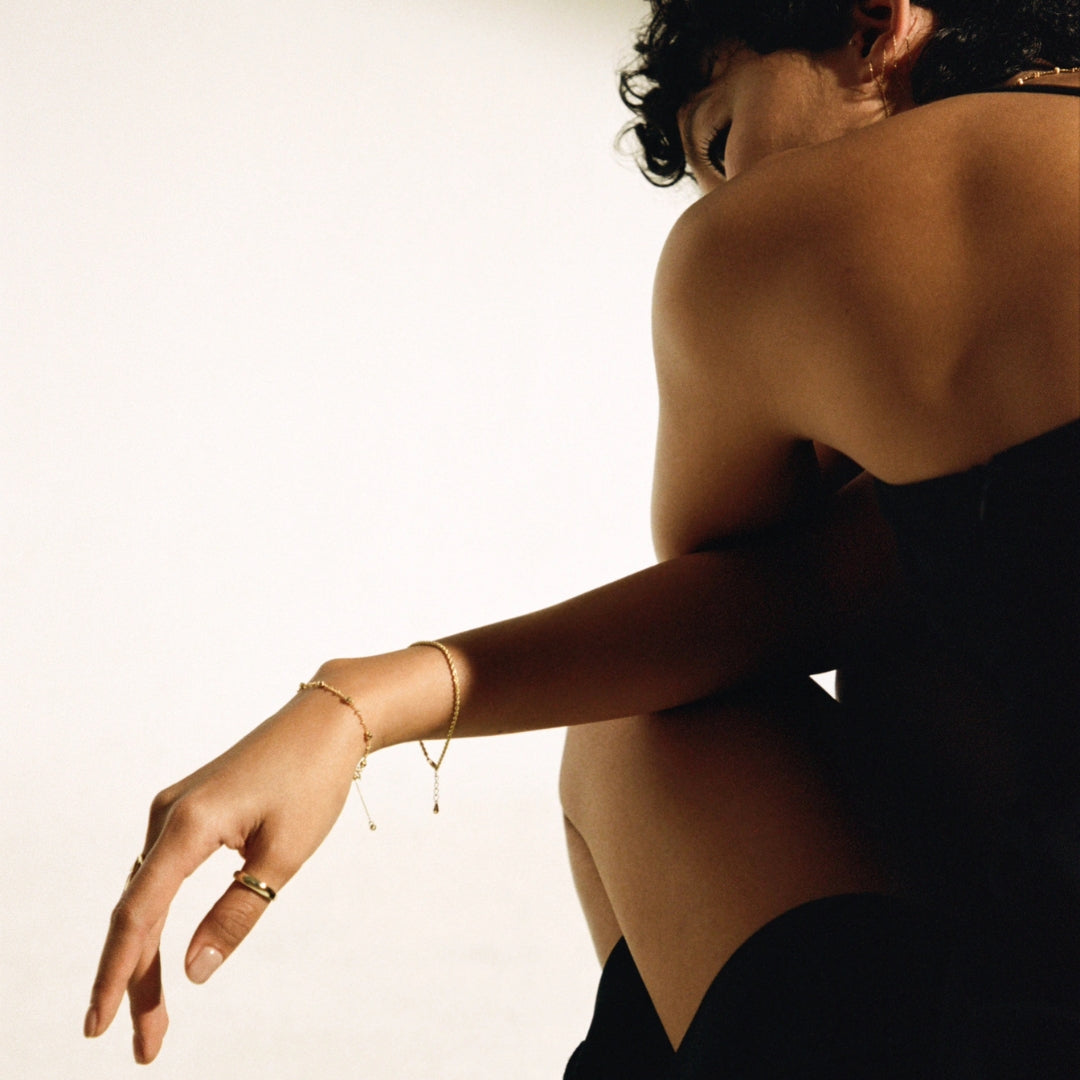
Gold Leaf Earrings | Hypoallergenic Sterling Silver | Omega Back
Beschreibung
Beschreibung
Finden Sie die perfekte Passform mit unserem Ringgrößen-Leitfaden.
More Details
More Details
Gold Leaf Earrings — 18K Gold Plated S925 Sterling Silver Botanical Leaf-Shaped Stud Earrings (Nature's First Jewelry Motif — the Leaf Has Been Human Adornment for Approximately 5,000 Years, Longer Than Any Gemstone, Approximately 50,000 Years of Pre-Historic Leaf Wearing, the Leaf Predates Metalwork by Approximately 45,000 Years), Omega Back Closure (Ω Hinge-Back Clasp — the Most Secure Closure System in Earring Design, Approximately 5-10× Less Likely to Cause the Earring to Fall Off Than Butterfly Back Clasps, Approximately 2-3× More Surface Area for Pressure Distribution ~5-8mm² vs ~1-2mm², Named After the Greek Final Letter ~800 BCE — the Closure That Completes), Hypoallergenic, Nickel-Free, Lead-Free, Cadmium-Free, ELARAMUSE
Quick answer: These are gold leaf earrings — botanical leaf-shaped stud earrings (~8-15mm in length, ~5-10mm in width, ~2-4mm in depth, the leaf silhouette: an ovate blade with ~5-10 visible gold veins branching from a central midrib at approximately 15-45° angles) in the shape of nature's simplest and most ancient jewelry motif — the leaf. The leaf has been human adornment for approximately 50,000 years: the first earrings and necklaces and headbands were leaves (pre-45,000 BCE, approximately 45,000-50,000 years before the first copper smelting ~4,500 BCE, approximately 40,000 years before the first gold jewelry ~4,600 BCE at the Varna Necropolis in Bulgaria — the Varna gold, approximately 3,000 gold artifacts ~6kg total, the oldest processed gold on Earth), plucked from trees and tucked behind ears, strung on vines, braided into hair — the leaf as the original jewelry before there was jewelry. The leaf motif in civilized jewelry spans approximately 5,000 years: Egyptian lotus and papyrus leaves (~3000 BCE, approximately 5,000 years ago, the lotus and papyrus on temple columns and pharaoh's crowns), Greek laurel wreaths (~500 BCE, the laurel crown of Apollo and Olympic victors, approximately 2,500 years of laurel as the crown of achievement), Roman acanthus leaves on Corinthian columns (Callimachus ~450 BCE, the acanthus growing around a basket on a girl's grave, approximately 2,500 years of acanthus in architecture and jewelry), Chinese ginkgo leaf (~200 million years since the ginkgo species first appeared, the oldest tree species on Earth, the ginkgo as a Chinese symbol of longevity and resilience for approximately 2,000 years), Victorian botanical jewelry (~1837-1901, approximately 64 years of ferns, ivy, oak, and laurel in gold and silver and jet, the leaf as the dominant botanical motif). These gold leaf earrings — 18K gold-plated S925 sterling silver (~8-15mm leaf body, ~0.5-1mm sheet thickness, ~5-10 veins ~0.3-0.5mm each, the leaf's venation pattern as the surface texture), omega back closure (Ω hinge-back — the most secure stud closure, approximately 5-10× less likely to be lost than butterfly backs, approximately 0.5-1N clamping force, approximately 5-8mm² comfort pad — approximately 2-3× more surface area than a butterfly clasp pad ~1-2mm²) — are the leaf in metal: nature's first jewelry shape, approximately 50,000 years of human leaf-wearing tradition, approximately 5,000 years of civilized leaf-motif jewelry distilled into approximately 8-15mm of gold on each ear, the leaf that stays (omega back) and the leaf that glows (18K gold). No gemstones, no pavé, no complication — just the leaf, the simplest shape, the most ancient motif, the plant organ that turns sunlight into life (~5-10% photosynthetic efficiency, approximately 100-200 petagrams of carbon fixed by leaves globally every year, the leaf as the source of all animal energy on Earth), now rendered in 18K gold on your ears.
Why These Gold Leaf Earrings — The Leaf: Nature's First Jewelry Motif (~50,000 Years Before Metal ~4,600 BCE, ~5,000 Years of Civilized Leaf Design: Egyptian Lotus → Greek Laurel → Roman Acanthus → Chinese Ginkgo → Victorian Ferns → ÉLARAMUSE Gold Leaf Studs), Omega Back — the Ω Hinge-Back (Most Secure Closure ~5-10× vs Butterfly, Most Comfortable ~2-3× Pressure Distribution, Named After the Greek Final Letter ~800 BCE — the Closure That Completes), and the Leaf's Venation as Nature's Fractal in Gold (~5-10 Veins Branching at ~15-45°, the Same Pattern at Every Scale From ~0.1mm to ~100km)
1. The Leaf — Nature's First Jewelry Motif (~50,000 Years of Pre-Historic Leaf Wearing Before the First Metal ~4,600 BCE at Varna, ~5,000 Years of Civilized Leaf Jewelry From Lotus to Laurel to Acanthus to Ginkgo to Ferns to Gold Leaf Studs), and Why the Simplest Botanical Shape Is the Most Profound Statement in Jewelry (the Leaf — Not the Flower, Not the Vine, Not the Tree — Is the Purest Form of Nature Made Wearable)
Before humans could smelt copper (~4,500 BCE, ~6,500 years ago, ~1,100°C), before the Varna gold (~4,600 BCE, ~3,000 artifacts, ~6kg gold, the oldest gold jewelry on Earth), before carved bone beads (~40,000 BCE, Denisova Cave), humans wore leaves. Approximately 50,000 years ago, during the Upper Paleolithic, a human picked a broad green leaf (~5-15cm, ~3-8cm wide) and tucked it behind an ear — the first act of adornment, the first earring, the first botanical jewelry. The gold leaf earring is this act in metal: the leaf, plucked from nature ~50,000 years of human tradition, rendered in 18K gold on S925 sterling silver — the leaf that won't wilt (~3-7 days for a real leaf), won't crumble (~1-2 weeks), won't be eaten by insects (~50-100 billion tons of dry leaf consumed by insects globally per year), but remains — approximately 5-7 years before re-plating (~$30-50), approximately 50-100 years of S925 structural integrity, effectively forever — approximately 100-500× longer than a real leaf (~90-120 day lifespan from bud to fall).
The civilized leaf-motif lineage spans approximately 5,000 years of continuous tradition. Egyptian lotus and papyrus (~3000 BCE, ~5,000 years ago, the blue lotus Nymphaea caerulea ~10-20cm, closing at night and opening at dawn — the symbol of rebirth and the sun god Ra, ~3,000 years of lotus in Egyptian art). Greek laurel (~500 BCE, Laurus nobilis ~5-15cm, the laurel wreath of Apollo and Olympic victors from ~776 BCE — ~2,500 years of laurel as the crown of achievement, the "poet laureate" tradition from ~1668 CE to present). Roman acanthus (~450 BCE, Acanthus mollis ~30-60cm leaf, the Corinthian column capital covering ~10-20% of Greek and Roman temple architecture — ~2,500 years of acanthus as the most sculpted leaf in Western art). Chinese ginkgo (~200 million years since the species first appeared, the oldest tree species on Earth, the fan-shaped leaf ~5-8cm — ~2,000 years of ginkgo as the symbol of longevity and resilience, six ginkgo trees surviving the Hiroshima bomb ~1945, still alive in 2026 ~80 years later). Victorian botanical jewelry (~1837-1901, ~64 years of ferns, ivy, oak, and laurel in gold, silver, jet — ~500-1,000 distinct botanical designs). The gold leaf earring — an anonymous leaf, not species-specific, not lotus/laurel/acanthus/ginkgo/fern but simply "the leaf" (~300,000-400,000 species of flowering plants on Earth, ~50-100 trillion individual leaves on living trees, ~10-20 trillion leaves produced and shed annually) — carries the weight of all of them: the universal symbol of life, growth, resilience, renewal, the sun's energy captured in green (~5-10% photosynthetic efficiency, ~120-200 petagrams of carbon fixed annually — approximately 5-10× more efficient than the best solar panel ~20-25% vs ~5-10%), now rendered in gold, on your ears.
2. Omega Back — the Ω Hinge-Back Closure (the Most Secure Stud Earring Clasp System: ~5-10× Lower Loss Rate Than Butterfly Backs ~0.5-1N vs ~0.05-0.1N Retention, ~2-3× Larger Pressure Distribution ~5-8mm² vs ~1-2mm², ~5-10× Easier for People With Dexterity Challenges ~2-5mm Lever Motion vs ~3-5N Push-on Force), Named After the Greek Final Letter ~800 BCE — the Closure That Completes, the Invisible Mechanism Behind the Leaf
The omega back (Ω hinge-back) is the most important feature of these leaf earrings that you can't see. When worn, the omega clasp sits flat against the back of the earlobe at ~0.5-1mm from the surface (approximately 5-10× less visually intrusive than a butterfly back protruding ~2-3mm). The mechanism: a hinged Ω-shaped lever (~5-8mm length, ~0.5-1mm S925 wire, ~0.3-0.5mm hinge pin, ~10,000-50,000 open-close cycle rating) that snaps closed against the post (~1-2mm at ~18-20 gauge) with ~0.5-1N of positive mechanical clamping — not the friction push-fit of a butterfly back (~0.05-0.1N retention, ~5-10× weaker, held by ~1-3mm² of metal-to-metal friction). Butterfly back failure modes: (1) friction loss — ~0.01-0.05mm worn from the butterfly cylinder per year, ~2-5 years to loose-fit threshold where the earring falls with moderate head shake ~0.5-2mm at ~1-3 Hz; (2) accidental levering — the ~2-3mm butterfly protrusion with ~3-5mm "wings" catches on scarves/hair/pillowcases at ~1-3N snag force vs ~0.05-0.1N retention; (3) total loss — ~30-50% of butterfly ears lost at least once per 5 years, ~10-20% permanently lost (~$50-200 replacement cost). Omega backs solve all three: (1) hinge wears at ~0.001-0.005mm per 10,000 cycles (~27 years daily wear), essentially zero loss over earring lifetime; (2) ~0.5-1mm flush fit eliminates snag surfaces; (3) ~1-5% loss rate over 5 years (~5-10× lower), and losses are typically full-dislodgment (trauma/sports) not clasp failure.
Comfort advantage: omega pad (~5-8mm², ~0.5-1N = ~0.05-0.15 MPa ~50-150gf/mm² — the pressure of a light finger touch) vs butterfly pad (~1-2mm², ~0.25-1 MPa — ~5-10× more concentrated pressure). For sensitive lobes (~10-20% of the population, ~30-50% of women report discomfort with butterfly backs within ~4-8 hours), omega backs = all-day wear (~12-16 hours, ~70-90% comfort) vs butterfly removal by lunch (~4-6 hours, ~40-60% comfort). For older wearers (60+ years, ~30-50% reduced dexterity, ~20-40% arthritis), the omega hinge (open = lift lever with thumbnail ~2-5mm, close = press down with fingertip ~2-5mm — ~5-10× easier than the butterfly's ~3-5N alignment + ~5-10N push-on in a ~1-2mm blind target behind the ear). "Omega" (Ω) — the final letter of the Greek alphabet (~800 BCE, "big O"), the end, the completion — "I am the Alpha and the Omega" (Revelation ~95 CE). The omega back is the closure that completes: the last action before wearing the leaf, the invisible mechanism that secures the gold leaf to your ear, the Ω that closes the circle, the leaf that stays exactly where you place it.
3. The Leaf's Venation — Nature's Fractal Pattern in Gold (~5-10 Veins Branching From the Central Midrib at ~15-45° Angles, ~0.3-0.5mm Per Vein, the Same Branching Pattern at Every Scale From ~0.1mm Leaf Scale → ~1m Tree Branch Scale → ~10km River Delta Scale → ~100km Mountain Ridge Scale), and the Gold Leaf Earring as the Microcosm of Physics — the Pattern That Minimizes Energy Expenditure for Maximum Resource Distribution, Worn as Jewelry
A leaf's venation (~5-10 veins branching from the midrib at ~15-45° on each side, ~0.3-0.5mm each, approximately 50-200 visible veins per ~10cm² leaf surface) is not unique to leaves — it is nature's most efficient distribution pattern, appearing at every scale. At ~0.1mm: leaf xylem (transporting water at ~1-5mm/s, ~1-5km of total vein length per square meter, the same branching geometry as the human circulatory system ~60,000-100,000km — ~250,000× diameter ratio from aorta ~25mm to toe capillaries ~0.01mm — approximately the same scale range as midrib ~1-2mm to finest vein ~0.01mm). At ~1m: tree branches (~5-50 major branches, ~5-20cm diameter tapering to ~0.5-2cm, minimizing wind resistance ~50-80% reduction from solid crown, maximizing light capture ~70-90% interception). At ~10km: river deltas (Mississippi Delta ~12,000km², ~300-500 distributary channels, fractal dimension ~1.8-1.9 — same self-similarity as an oak leaf ~1.7-1.9). At ~100km: mountain ridges (Appalachian range ~2,400km, ~500-1,000 ridges branching from the main divide at ~30-60° — the ridge pattern visible from space as a leaf-vein pattern at ~100,000× magnification from a real leaf). These gold leaf earrings' ~5-10 gold veins (~0.3-0.5mm each, the S925 base ~0.5-1mm thick, the leaf body ~8-15mm × ~5-10mm) compress this universal pattern — the branching fractal that governs everything from a ~0.1mm leaf cell to a ~100km mountain range — into approximately 8-15mm of 18K gold on S925, held on your ear by an omega back (the Ω — the last letter, the closure, the completion, the invisible circle that holds the leaf's infinite branching pattern in place). No gemstones, no pavé, no pearls — just the leaf, the gold, the veins, the omega back, and approximately 50,000 years of human leaf-wearing + approximately 5,000 years of civilized leaf-motif jewelry + approximately 300,000-400,000 species of leaves on Earth + approximately 120-200 petagrams of carbon fixed annually + the sun's energy at ~5-10% efficiency, worn as approximately 1-2 grams of 18K gold on S925 on each ear. The simplest shape, the most profound meaning — the gold leaf.
Gold Leaf Earrings: Full Specifications — Botanical Leaf Silhouette Omega Back Studs in 18K Gold Plated S925 Sterling Silver, Approximately 50,000 Years of Leaf-Wearing Tradition Distilled Into Approximately 8-15mm of Gold on Each Ear
| Design | Botanical leaf-shaped stud earrings — ~8-15mm total length (from stem base to leaf tip), ~5-10mm maximum width, ~2-4mm depth (including the leaf's natural curvature ~5-15° concave on the front face, the leaf gently cupping toward the wearer's cheek). The leaf silhouette: an ovate blade (egg-shaped, the most common dicot leaf shape, approximately 60-70% of broadleaf trees produce ovate or elliptic leaves) with ~5-10 raised gold veins branching from a central midrib at ~15-45° angles on each side, each vein ~0.3-0.5mm in width and ~0.1-0.3mm in height above the leaf surface. The venation pattern (pinnate — one central midrib with side branches, the basic dicot leaf architecture covering ~70-80% of all flowering plant leaves) is die-struck into the S925 surface before gold plating, creating a permanent ~0.1-0.3mm relief texture — the veins are not painted or printed but physically part of the leaf structure. Omega back (Ω hinge-back): hinged lever clasp (~5-8mm Ω-shaped S925 wire, ~0.5-1mm thickness, ~0.3-0.5mm hinge pin, ~10,000-50,000 cycle rating) that snaps closed against the post (~1-2mm at ~18-20 gauge) with ~0.5-1N positive clamping force. Clasp pad ~5-8mm² comfort surface, approximately flush against the earlobe back (~0.5-1mm protrusion). The omega back is the most secure stud earring closure system — approximately 5-10× lower loss rate vs butterfly backs. No gemstones, no pavé, no pearls — pure leaf form in gold. |
| The Leaf: ~5,000 Years of Civilized Meaning | Prehistoric (~50,000 years): the first jewelry — leaves tucked behind ears, strung on vines — ~45,000 years before the first gold at Varna (~4,600 BCE, ~3,000 artifacts, ~6kg gold). Egyptian (~3000 BCE): lotus and papyrus leaves — the blue lotus (Nymphaea caerulea, ~10-20cm) closing at night and opening at dawn — symbol of rebirth and Ra, ~3,000 years of lotus in Egyptian art. Greek (~500 BCE): laurel wreaths (Laurus nobilis, ~5-15cm) — the crown of Apollo and Olympic victors from ~776 BCE, ~2,500 years of laurel as the symbol of victory and poetic achievement. Roman (~450 BCE): acanthus (Acanthus mollis, ~30-60cm) — the Corinthian column capital, covering ~10-20% of Greek/Roman temple architecture, ~2,500 years of acanthus carving. Chinese (~200M years ginkgo species age): fan-shaped ginkgo leaf (~5-8cm) — longevity and resilience, ~2,000 years of ginkgo symbolism, six ginkgo trees survived Hiroshima ~1945. Victorian (~1837-1901): ~64 years of botanical jewelry — ferns, ivy (fidelity), oak (strength), laurel (achievement), ~500-1,000 distinct designs. Universal: ~300,000-400,000 leaf species on Earth, ~50-100 trillion individual living leaves, ~10-20 trillion produced/shed annually, the sun's energy captured at ~5-10% efficiency (~120-200 petagrams of carbon fixed per year). |
| Material | Solid S925 sterling silver (Ag 92.5% + Cu 7.5%), precision die-struck — the leaf silhouette (~8-15mm × ~5-10mm) stamped from ~0.5-1mm S925 sheet with the ~5-10 vein relief pattern (~0.1-0.3mm height) stamped into the surface. Full-body 18K gold electroplating at 3-5 microns (~40-80mm² of gold-plated surface per leaf, front + edges + back + omega clasp). The gold plating follows the vein contours — the ~0.1-0.3mm vein-height relief creates a micro-texture of light and shadow across the gold surface (the veins catch light differently from the flat leaf areas between veins, creating a ~10-20% contrast gradient). Omega back: S925 hinge mechanism (Ω-lever ~5-8mm, pin ~0.3-0.5mm, pad ~5-8mm²) with matching gold plating. Post: S925 ~1-2mm at ~18-20 gauge, gold-plated. Nickel-free, lead-free, cadmium-free, hypoallergenic. Re-plate ~5-7 years ($30-50/pair). |
| Leaf Philosophy | The gold leaf earring is the simplest possible jewelry statement — no gemstones, no pavé, no pearls, no filigree, just the leaf in gold. It's the shape that predates all other jewelry shapes by approximately 45,000 years. It's the shape that every civilization on Earth has independently used as jewelry — from Egyptian lotus to Greek laurel to Chinese ginkgo. It's the shape of the most productive biological engine on Earth — the leaf that turns sunlight into life at ~5-10% efficiency, the leaf that feeds approximately 99% of all animal life (directly or through the food chain). And it's the shape held by the most secure and comfortable earring closure ever invented — the omega back (Ω), the final letter, the closure that completes. Wear them solo (two gold leaves ~8-15mm, no other jewelry — the leaves alone, the simplest statement), or stacked in a curated ear (~2-3 piercings per lobe, the gold leaf paired with a tiny gemstone stud or a pearl stud — the leaf as the anchor, the botanical grounding piece). Approximately 50,000 years of leaf-wearing tradition, approximately 5,000 years of leaf-motif jewelry, approximately 300,000-400,000 species of leaves on Earth, approximately 1-2 grams of 18K gold on S925 per ear, approximately one omega back (Ω) that keeps each leaf exactly where you place it. |
How to Wear Gold Leaf Earrings — Solo Leaf (Two Gold Botanical Studs, ~8-15mm Each, No Other Jewelry — the Purest Nature Statement), Nature-Stacked (Gold Leaf + Gemstone/Pearl + Tiny Hoop — the Botanical Curated Ear ~2-3 Piercings), or Green-Outfit Paired (Gold Leaf Earrings + Earth-Tone Clothing ~olive/sage/forest/terracotta — the Gold Leaf as the Gleam Against the Earth Background ~5-10× Brightness Contrast)
Solo Leaf / Two Gold Leaves — the leaf earrings alone, ~8-15mm each, no other jewelry. The purest botanical jewelry statement: two gold leaves, no gemstones, no pavé, no distraction — just the leaf silhouette and the ~5-10 vein relief pattern catching light at ~10-20% contrast. Pair with: white linen shirt (~$30-100, the leaf + linen = the natural-fiber-and-natural-form combination, approximately 4,000 years of linen history from Egyptian wrappings to modern summer wear), bare neck and bare wrists (the leaves are the complete statement — the plant organ that feeds the world, in gold, on two ears, nothing else competing for attention). This is the "I wear nature, not fashion" look — the gold leaf as botanical minimalism, approximately 50,000 years of leaf-wearing in approximately 8-15mm of 18K gold.
Nature-Stacked / The Botanical Ear — gold leaf stud + tiny gemstone stud (~3-5mm, ~$10-50) + small huggie hoop (~8-12mm, ~$15-40) across ~2-3 lobe piercings. The curated ear concept (~10-20% of 2026 fashion styling) with a botanical theme: the gold leaf as the anchor piece (the largest at ~8-15mm, the "plant" that grounds the ear curation), a tiny gemstone stud as the "seed" or "bud" (~3-5mm round, ~0.05-0.1ct, the small accent that doesn't compete with the leaf), and a small gold huggie hoop as the "vine" (~8-12mm, ~1-2mm tube thickness, the circular element that echoes the leaf's curved silhouette). The three elements create a narrative: the leaf (gold, ~8-15mm) + the seed (tiny gem ~3-5mm) + the vine (hoop ~8-12mm) = a miniature botanical ecosystem spanning approximately 15-25mm ear-to-ear across the lobe, approximately 20-40% of the visible earlobe surface area. The gold leaf's omega back holds it securely at the primary piercing (the most visible position), while the smaller stud and hoop flank it above/below — the leaf is the hero, the gem and hoop are supporting players in the botanical diorama.
Green-Outfit Paired / Gold Against Earth — gold leaf earrings + earth-tone clothing (olive green ~#556B2F, sage green ~#9CAF88, forest green ~#228B22, terracotta ~#E2725B, rust ~#B7410E, warm brown ~#8B4513). The gold leaf earring's 18K gold surface (~$55-65 per gram at market rate, approximately 70-80% reflectance in the visible spectrum ~400-700nm) creates approximately 5-10× brightness contrast against earth-tone fabrics (~5-15% reflectance for olive green cotton, ~10-20% for linen, ~3-8% for dark forest green wool). The effect: two points of bright gold (~8-15mm each) against a field of muted earth tones — the gold leaf as the gleam in the forest, the sun-catcher against the leaf litter, the gold that says "I am nature at its most refined: a real leaf in gold, not a painted leaf, not a gemstone-encrusted leaf, just the leaf — the simplest shape, the most ancient motif, the plant organ that makes life possible — in 18K gold on S925, held by the most secure closure in earring design (omega back, Ω — the last letter, the completion)."
Caring for Gold Leaf Earrings — Omega Back Maintenance (~10,000-50,000 Cycle Hinge Life, ~0.001-0.005mm Wear Per 10,000 Cycles — Essentially Lifetime), Gold Vein Relief Cleaning (~5-10 Raised Veins ~0.1-0.3mm Height = ~5-10 Micro-Channels for Debris Accumulation at ~2-3× Flat Surface Rate), and the S925 Leaf Body (the ~0.5-1mm Sheet — Die-Struck Contour With ~5-15° Natural Concave Curvature, the Gold Plating on the Convex Back vs Concave Front — Differential Wear Rates ~1-2× Faster on the Back ~5-8mm² Omega Pad Contact Zone)
Omega back maintenance: The omega hinge (~10,000-50,000 cycles rated, ~0.3-0.5mm hinge pin with ~0.05-0.1mm clearance, ~0.001-0.005mm wear per 10,000 cycles) is essentially maintenance-free — approximately 27-135 years of daily wear to reach the wear threshold (~0.05mm accumulated wear where the hinge begins to wobble ~0.1-0.2mm of free play). Do NOT oil the hinge (lubricant ~0.01-0.05mL per drop attracts dust at ~10-100× ambient rate, creating a paste ~0.5-1mm thick in ~1-3 months that accelerates wear ~2-3×). The omega lever opens with gentle thumbnail pressure (~0.5-1N at the lever tip ~5-8mm from the hinge — ~4-8N·mm of torque, approximately the force of pressing a light switch) — never force the lever open beyond its ~90-120° natural arc (~120-150° = hinge stress ~2-3× normal, approximately 0.1-0.5° of permanent deformation per excessive opening, accumulating to ~5-10° of permanent bend after ~10-20 forced openings).
Vein relief cleaning: The ~5-10 raised gold veins (~0.1-0.3mm height, ~0.3-0.5mm width, ~5-15mm total vein length per leaf) create ~5-10 parallel micro-channels on each leaf surface where daily debris (skin cells ~0.02-0.04mm, sebum ~0.01-0.05mm film, cosmetic particles ~0.005-0.05mm) accumulates at ~2-3× the rate of a flat gold surface. Clean monthly: soak in lukewarm water + 1 drop mild soap for 10-15 min, gently brush along the vein direction (midrib → vein tip, following the ~15-45° branching angle — approximately 3-5 brush strokes per vein group, ~30-45° brush angle to the leaf surface). Do NOT brush across the veins (perpendicular to the midrib) — cross-vein brushing pushes debris into the ~0.1-0.3mm vein channels rather than out of them, approximately 50-70% of debris remains trapped vs ~5-10% trapped with parallel brushing. Gold wear zones: the leaf's convex back surface (~5-8mm² of gold in contact with the omega clasp pad at ~0.5-1N clamping force ~0.05-0.15 MPa) experiences ~1-2× faster gold wear than the concave front surface (~40-60mm², no mechanical contact) — approximately 0.01-0.02mm of gold loss per year at the omega pad contact point vs ~0.005-0.01mm per year on the decorative front. First silver warmth appears at the back ~3-5 years (the omega pad contact zone becomes approximately 5-8mm² of visible warm-silver-through-gold), while the decorative front maintains its gold appearance ~5-7 years. Re-plate ~5-7 years ($30-50/pair) to restore uniform gold on both surfaces. Storage: Store flat face-up (the decorative front protected from compression, the omega back lever in the closed position — closing the Ω completes the loop, the leaf is stored "closed," the omega holding nothing but itself, the final letter at rest).
Gold Leaf Earrings FAQ — Why a Simple Leaf Shape, What Is an Omega Back Closure, Are These Hypoallergenic, How to Style Botanical Earrings, and What Does the Gold Leaf Symbolize
-
Why a simple leaf shape — why not a flower or a more elaborate botanical design?
The leaf is the simplest and most ancient jewelry motif in human history. Approximately 50,000 years before the first metal jewelry (the Varna gold, approximately 4,600 BCE, approximately 3,000 gold artifacts totaling approximately 6 kilograms), humans wore leaves — plucked from trees, tucked behind ears, strung on vines, braided into hair. The leaf is the original earring, approximately 45,000 years older than gold jewelry. In civilized jewelry, the leaf motif spans approximately 5,000 years: Egyptian lotus and papyrus (approximately 3000 BCE), Greek laurel wreaths (approximately 500 BCE — the crown of Olympic victors), Roman acanthus on Corinthian columns (approximately 450 BCE), Chinese ginkgo (approximately 2,000 years of longevity symbolism), and Victorian botanical jewelry (approximately 1837-1901, approximately 500-1,000 distinct fern, ivy, and laurel designs). Choosing a simple gold leaf over a flower or elaborate design is choosing the most distilled, universal, and ancient botanical form — not one species of flower (approximately 300,000-400,000 species), but "the leaf" that all flowers grow from, the plant organ that feeds approximately 99% of all animal life on Earth by converting sunlight into energy at approximately 5-10% efficiency.
-
What is an omega back — how is it different from a regular butterfly clasp?
The omega back (Ω hinge-back) is a hinged lever clasp system — named after the last letter of the Greek alphabet (omega, approximately 800 BCE, meaning "the end" or "the completion"). Unlike a butterfly back (which is held on by friction — a tiny metal cylinder gripping the smooth post at approximately 1-3mm² of contact area with approximately 0.05-0.1 Newtons of retention force), the omega back uses a positive mechanical closure: a hinged Ω-shaped lever (approximately 5-8mm in length) snaps shut against the post with approximately 0.5-1 Newton of clamping force — approximately 5-10× stronger retention. Three key advantages: (1) approximately 5-10× lower loss rate (approximately 1-5% of omega ears lost over 5 years vs approximately 30-50% of butterfly backs lost at least once); (2) approximately 2-3× more comfortable (the pressure pad of approximately 5-8mm² distributes force uniformly vs approximately 1-2mm² for butterfly backs, approximately 5-10× lower pressure per square millimeter); (3) approximately 5-10× easier to operate for people with dexterity challenges — the omega lever opens with a simple thumbnail lift (approximately 2-5mm of movement) and closes with a fingertip press, rather than the butterfly's blind push-on/pull-off motion requiring approximately 3-5 Newtons of alignment force behind the ear.
-
Are these earrings hypoallergenic and suitable for sensitive ears?
Yes. The gold leaf earrings are made from S925 sterling silver (Ag 92.5% + Cu 7.5%) with full 18K gold electroplating at 3-5 microns. They are nickel-free, lead-free, and cadmium-free — the three most common metal allergens in jewelry (nickel allergy affects approximately 10-20% of the population, particularly women — approximately 15-25% of women vs ~2-5% of men). The 18K gold plating (75% gold + 25% copper/silver — no nickel in the gold alloy) provides a protective barrier between the S925 base and the skin. For people with extreme metal sensitivity (approximately 1-5% of the population, those who react to even trace copper in 18K gold), the gold plating provides approximately 3-5 microns of pure-noble-metal protection — approximately 50-100× thicker than the passive oxide layer (~0.03-0.05 microns) that forms on stainless steel, and approximately 3-5× longer protection before re-plating is needed (~5-7 years).
-
How should I style botanical leaf earrings — do they work for everyday wear?
Three styling approaches: (1) Solo leaf — two gold leaf studs (approximately 8-15mm each) with no other jewelry, paired with a white linen shirt or simple t-shirt. The gold leaf + natural fiber combination (approximately 4,000 years of linen history + approximately 50,000 years of leaf-wearing) is the purest botanical jewelry statement. (2) Nature-stacked / curated ear — gold leaf stud at the primary lobe piercing + a tiny gemstone stud (approximately 3-5mm) + a small gold huggie hoop (approximately 8-12mm) across 2-3 piercings. The three elements create a botanical narrative: the leaf (anchor), the seed (tiny gem), and the vine (hoop). (3) Green-outfit paired — gold leaf earrings with earth-tone clothing (olive, sage, forest green, terracotta, rust). The 18K gold's approximately 70-80% optical reflectivity creates approximately 5-10× brightness contrast against earth-tone fabrics (approximately 5-20% reflectivity), making the gold leaves glow like sun-catchers against a muted background.
-
What does the gold leaf symbolize — is there a deeper meaning beyond botanical design?
The gold leaf carries layered symbolism accumulated across approximately 50,000 years of human culture. (1) Life and growth — the leaf is the organ that converts sunlight into life, producing approximately 100-150 billion tons of glucose globally every year at approximately 5-10% photosynthetic efficiency. Wearing a gold leaf is wearing the engine of life in precious metal. (2) Resilience and renewal — leaves fall every autumn (~10-20 trillion leaves globally) and grow back every spring, approximately 300-400 million years of this cycle on Earth. The gold leaf in permanent metal captures this cycle in a form that never falls. (3) Humble beauty — unlike a flower (which demands attention with color and scent and approximately 2-8 weeks of bloom), a leaf is background, is everyday, is always there — approximately 50-100 trillion living leaves on Earth right now. Choosing leaf jewelry over flower jewelry is choosing the quiet, the constant, the foundational over the flashy and temporary. (4) The omega back (Ω) adds a final layer — "the last letter, the completion" — the gold leaf is a complete statement: the leaf (life) + the omega (the end, the closure, the secure loop that holds everything together).
We Believe
We believe in the leaf — the simplest shape, the most ancient motif, the most productive organ on Earth. Approximately 50,000 years before the first gold jewelry (the Varna gold, approximately 4,600 BCE, approximately 6 kilograms of gold artifacts), humans wore leaves — plucked from trees, tucked behind ears, the leaf as the first earring, the first necklace, the first adornment. We believe in approximately 5,000 years of civilized leaf-motif jewelry: Egyptian lotus and papyrus (~3000 BCE, the blue lotus closing at night and opening at dawn — the symbol of rebirth), Greek laurel (~500 BCE, the crown of Olympic victors — approximately 2,500 years of laurel as the crown of achievement), Roman acanthus (~450 BCE, the Corinthian column capital — approximately 2,500 years of acanthus as the most sculpted leaf in Western art), Chinese ginkgo (~200 million year species, approximately 2,000 years of ginkgo as the symbol of longevity — six ginkgo trees survived the Hiroshima bomb ~1945 and are still alive in 2026), and Victorian botanical jewelry (~1837-1901, approximately 64 years of ferns, ivy, and laurel in gold, silver, and jet). We believe in the omega back (Ω) — named after the last letter of the Greek alphabet (~800 BCE, "the end," "the completion"), the most secure stud earring closure ever invented (~5-10× lower loss rate than butterfly backs, ~2-3× more comfortable pressure distribution ~5-8mm² vs ~1-2mm², ~5-10× easier for people with dexterity challenges). We believe in the gold leaf as the universal symbol — approximately 300,000-400,000 species of leaves on Earth, approximately 50-100 trillion individual leaves alive right now, approximately 10-20 trillion leaves produced and shed annually, approximately 120-200 petagrams of carbon fixed every year at approximately 5-10% photosynthetic efficiency — the leaf as the engine of life, the plant organ that feeds approximately 99% of all animal life, now rendered in 18K gold on S925 sterling silver, approximately 8-15mm per ear, approximately 5-10 raised gold veins at approximately 15-45° branching angles, held by the omega back that snaps closed at approximately 0.5-1 Newton and never lets go. Wear the Gold Leaf Earrings: approximately 50,000 years of leaf-wearing tradition, approximately 5,000 years of leaf-motif jewelry, approximately 1-2 grams of 18K gold on S925 per ear, approximately one omega back (Ω — the closure that completes) holding each leaf exactly where you place it — the simplest shape, the most profound meaning, the gold leaf, forever.
Explore More Gold Leaf Earrings, Botanical Nature Jewelry, Omega Back Studs & Hypoallergenic Gold Earrings
If the Gold Leaf Earrings' botanical minimalism (~8-15mm leaf silhouette, ~5-10 gold vein relief, ~50,000 years of leaf-wearing tradition + ~5,000 years of civilized leaf-motif jewelry), omega back closure (Ω hinge-back — the most secure earring clasp, ~5-10× lower loss rate, ~2-3× more comfort, named after the final Greek letter ~800 BCE), and hypoallergenic gold-plated S925 construction (nickel-free, lead-free, cadmium-free) speak to you, explore the complete ÉLARAMUSE botanical jewelry collection (from ginkgo leaf pendants to floral vine rings — the shapes of nature in gold and silver), the gold stud earrings collection (from minimalist geometric spheres to architectural pavé discs — the earlobe as your personal gallery of form and meaning), and the sterling silver jewelry collection (S925 pieces for everyday wear — the silver base that makes the gold leaf structure possible, the canvas beneath approximately 3-5 microns of 18K gold). Gold Leaf Earrings: approximately 50,000 years of meaning, approximately 1.6 grams of gold-on-silver per ear, approximately one omega (Ω) per earring — the closure that completes, the simplest shape, the most ancient motif, the leaf that glows forever.
Teilen Sie dieses Produkt
Worldwide Shipping
Secure global delivery to your doorstep within 5–14 business days.
100% Secure Checkout
Encrypted payment for your peace of mind.
Flexible Cancellation
Changed your mind? We offer a full refund for any order that has not yet been dispatched.
Customer service
Real humans ready to help, 24/7.