A single row of diamonds — identical in size, identical in setting — tracing a perfect line around the neck. That's the tennis necklace. And for the past three decades, it's been trapped inside a jewelry box marked "special occasion." A piece you admire through glass, then return to the vault. A piece that whispers "not for everyday."
I disagree. And so, it turns out, does 2026.
The tennis necklace is having its ready-to-wear moment. Not because diamonds got cheaper — they didn't. But because a new category of jewelry has emerged between fast fashion rhinestones and vault-worthy natural diamonds. It's called demi-fine: lab-created gemstones, cubic zirconia, and high-carbon diamond simulants set in gold-plated sterling silver. The sparkle is real. The craftsmanship is real. What's different is the philosophy — this jewelry is made to be worn, not stored.
This guide covers everything: what a tennis necklace actually is, how to choose one that doesn't look costume, how to style it with a t-shirt (yes, a t-shirt), and the difference between a $30 strand and a $300 strand that could pass for $3,000.
Quick Answer: What Is a Tennis Necklace?
A tennis necklace is a strand of identically-sized gemstones (traditionally diamonds) set in a continuous line, connected by a fine chain. The stones are typically round, prong-set, and graduated or uniform in size. The name comes from tennis champion Chris Evert's 1987 U.S.
Open match, when her diamond bracelet broke and she paused play to find it — giving the "tennis bracelet" its name. The necklace version followed. In 2026, a quality demi-fine tennis necklace costs $60–$400, uses lab-created stones or high-grade CZ, and is set in gold-plated sterling silver — giving you the same visual impact as fine jewelry at 2–5% of the price.
What Is a Tennis Necklace? The Anatomy of the Design
A tennis necklace has four defining characteristics:
- Uniform stones: Every gemstone is the same size, shape, and quality — typically round brilliant cut, though princess-cut and emerald-cut tennis necklaces exist. This uniformity is what gives the tennis necklace its signature "line of light" effect.
- Continuous setting: Stones are set one after another with no visible gaps, usually in a prong or basket setting. The chain linking them is designed to be invisible from the front.
- Flexibility: A well-made tennis necklace drapes like fabric. Each stone-link connection articulates independently, so the strand follows the curves of your neck and collarbone rather than sitting stiffly.
- Symmetrical length: Most tennis necklaces are 16–18 inches (princess length), sitting at or just below the collarbone. Longer versions — 20–24 inches — create a more dramatic line but are harder to find in demi-fine.
The magic of a tennis necklace isn't any single stone — it's the cumulative effect. Each individual stone might be 2–4mm (0.03–0.10 carat equivalent), but together they create an unbroken ribbon of light. The whole is genuinely greater than the sum of its parts.
The History: From Chris Evert's Wrist to Every Woman's Jewelry Box
The story is too good to skip. At the 1987 U.S. Open, Chris Evert — then the world's number one women's tennis player — was mid-match when her lab diamond line bracelet snapped. She stopped play, searched the court, and refused to resume until she found it. Commentators called it her "tennis bracelet." The name stuck (GIA).
The tennis necklace didn't have a similarly cinematic origin, but it follows the same design logic: a line of identical diamonds, uninterrupted, creating a continuous band of light. In the 1990s and 2000s, tennis necklaces were reserved for red carpets, gala dinners, and jewelry stores with armed guards. They were, by definition, "important jewelry."
What changed everything wasn't a moment — it was a material. Lab-created gemstones and high-carbon diamond simulants (like ÉLARAMUSE's lab-grown nano zircon) reached a quality threshold where even trained jewelers struggle to distinguish them from mined diamonds without a loupe (GIA gemological standards).
When the visual impact is identical but the cost drops by 95%, the entire category opens up. The tennis necklace went from heirloom to everyday. And 2026's styling culture — which prizes high-low mixing, unexpected juxtapositions, and the confidence to wear "fancy" things casually — embraced it completely.
Tennis Necklace vs. Tennis Bracelet: The Same DNA, Different Presence
They share a design language — continuous line of uniform stones — but they occupy very different roles in your jewelry wardrobe:
- Visual impact: A tennis necklace frames your face. A tennis bracelet decorates your wrist. One commands the room; the other adds a detail. If you can only own one, the necklace makes the bigger statement.
- Everyday practicality: Bracelets clack against desks, catch on sweaters, and need to be removed for typing. A properly fitted tennis necklace settles against your collarbone and stays there — it's the lower-maintenance choice for daily wear.
- Cost: Even in demi-fine, tennis necklaces cost more because they use more stones (typically 50–80 stones for a 16-inch strand vs. 25–35 for a bracelet). Expect to pay $60–$150 for a quality demi-fine tennis bracelet and $120–$400 for an equivalent necklace.
- Layering potential: A tennis necklace layers beautifully with other necklaces because its uniform sparkle provides a "neutral" backdrop. A tennis bracelet competes with watches and other bracelets in a way the necklace doesn't.
If a tennis bracelet is the supporting actor, the tennis necklace is the lead. Plan your styling accordingly.
Types of Tennis Necklaces: Not All Lines Are Created Equal
1. Classic Diamond Tennis Necklace
Round brilliant stones, 2–4mm each, prong-set in a continuous line. The Platonic ideal. In demi-fine, look for high-carbon lab diamond simulants (not glass rhinestones — the difference is visible from across a room) set in gold-plated sterling silver. The prongs should be tiny and uniform; large, irregular prongs are the hallmark of fast fashion.
2. Station Tennis Necklace
Instead of continuous stones, a station necklace places clusters of gemstones at regular intervals along a fine chain — like lights spaced along a wire. This is the most wearable variation: lighter in weight, lower in cost, and easier to layer. It gives you the tennis-necklace sparkle pattern without the full commitment of continuous stones. ÉLARAMUSE's Sequin Station Necklace works on exactly this principle.
3. Name & Personalized Tennis Necklaces
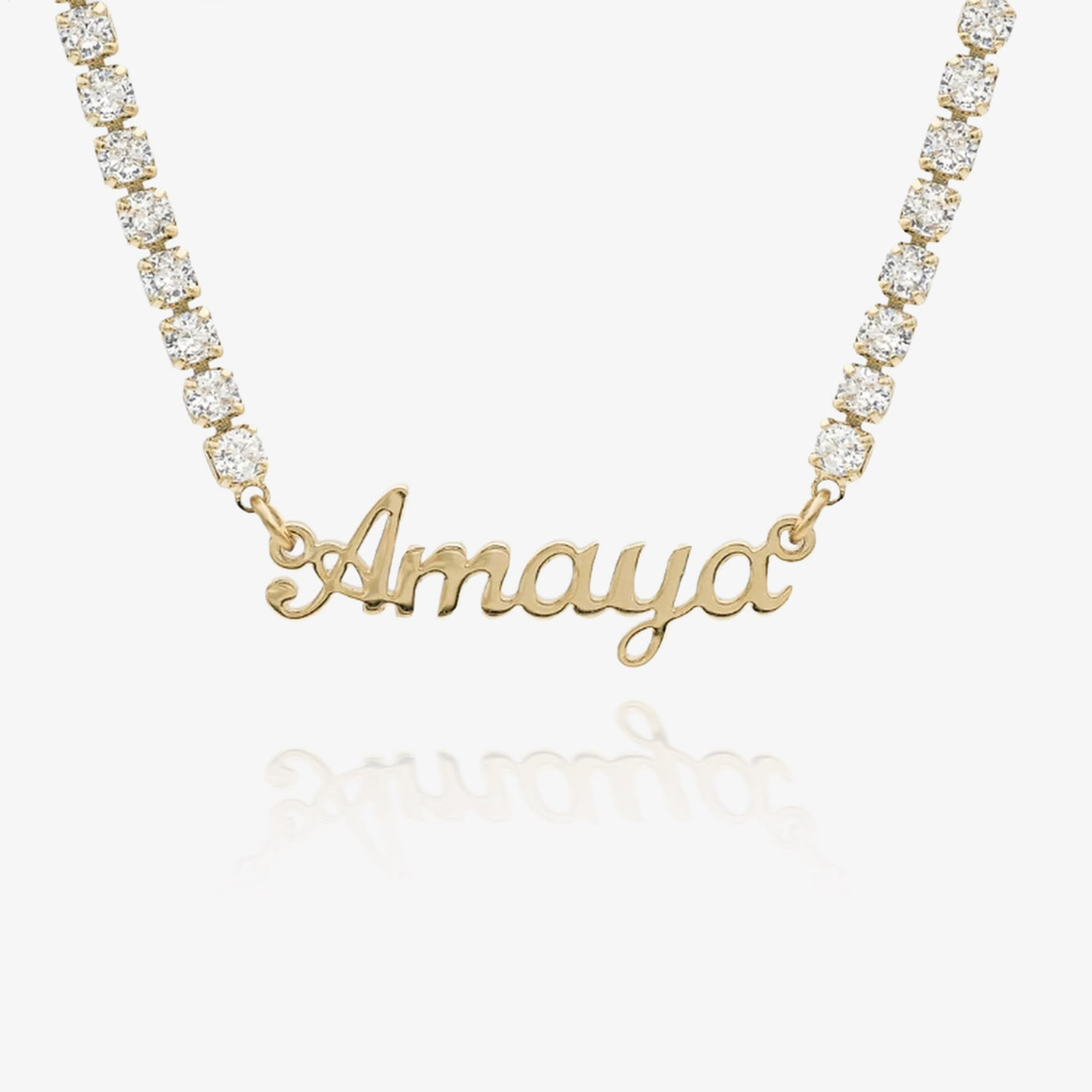
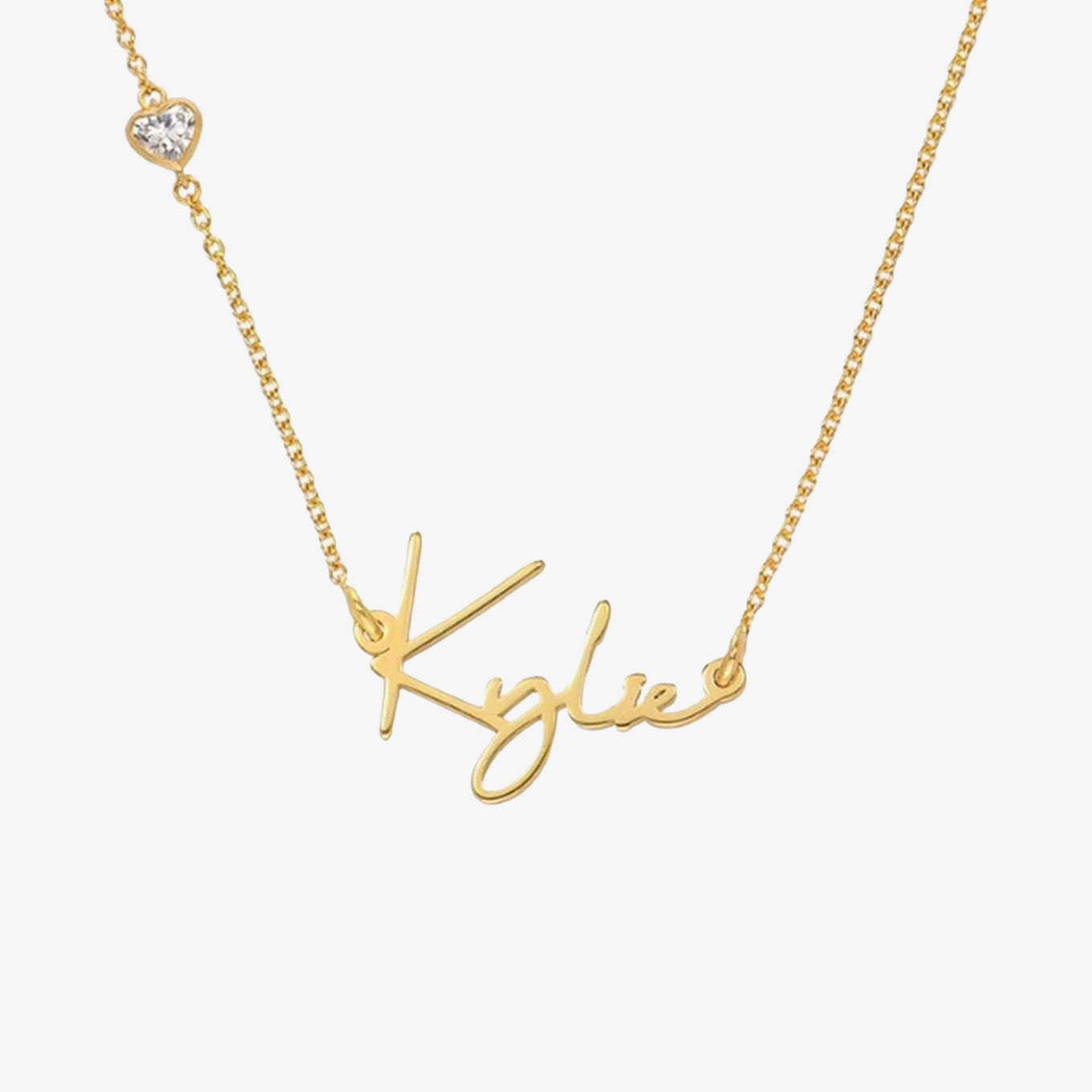
The 2026 innovation: cursive script or names rendered in pavé-set CZ crystals, suspended from a fine chain. This isn't a traditional tennis necklace — it's the tennis-necklace aesthetic applied to personalization.
The sparkle density and chain style echo the classic, but the focal point is your name, chosen word, or meaningful term. ÉLARAMUSE's Personalized Name Tennis Necklace brings demi-fine craftsmanship to the nameplate trend that's dominated personalized jewelry (learn about personalized necklace quality) for years.
4. Colored Gemstone Tennis Necklace
Sapphires, rubies, emeralds, or their lab-created equivalents, set in the same continuous line format. A sapphire tennis necklace reads as regal and unexpected — Princess Diana's famous sapphire-and-pearl choker was essentially a tennis necklace with colored stones. In demi-fine, lab-created gemstones make this option accessible for the first time.
How to Style a Tennis Necklace: Three Rules I Actually Follow
Rule 1: Wear it with a t-shirt. The single most effective styling move with a tennis necklace is to pair it with something aggressively casual. A white crew-neck t-shirt. A grey sweatshirt.
The contrast between "fancy jewelry" and "not trying" creates the kind of tension that makes personal style interesting. When you wear a tennis necklace with a silk dress, it reads as "dressed up." When you wear it with a t-shirt, it reads as "I'm so comfortable with myself that I wear diamonds to the grocery store."
Rule 2: Layer it as the "top line." If you're stacking necklaces (our Necklace Layering Guide has more technique),, put the tennis necklace at the shortest length (16 inches, at the collarbone) and let longer pendants fall below it. The tennis necklace becomes the sparkling horizon line, and everything cascades from there. A solitaire pendant at 18 inches beneath a tennis necklace at 16 inches is a combination that works every time.
Rule 3: Skip the matching earrings. A tennis necklace paired with matching studs reads as a set — which reads as "I bought this as a set," which reads as impersonal. Instead, wear your tennis necklace with something architecturally different: hammered dome studs, an ear cuff, or nothing at all. The tennis necklace is enough on its own.
How to Choose a Tennis Necklace: The Quality Checklist
When shopping for a demi-fine tennis necklace, run through this checklist:
- Stone type: Lab-created diamond simulant > cubic zirconia > glass. If the product description doesn't specify the stone type, assume glass.
- Metal base: 925 sterling silver with gold plating is the standard for quality demi-fine. "Alloy" or "base metal" will tarnish and react with skin within weeks.
- Clasp type: A lobster clasp is standard; a box clasp with a safety catch is better. Avoid spring-ring clasps on necklaces — they're too small to operate one-handed.
- Prong count: Each stone should have 4 prongs minimum. 3-prong settings are less secure. Count the prongs in product photos — if you can't see them clearly, that's a red flag.
- Length adjustability: Look for extender chains (2–3 inches of additional links at the clasp end). They let you adjust the necklace between 16 and 18 inches, which makes layering far more flexible.
- Weight: A demi-fine tennis necklace should have satisfying heft. If it feels weightless, the stones are too small or the metal is too thin. 15–25 grams is the sweet spot for a 16-inch strand.
Our Tennis Necklace Collection: Demi-Fine Sparkle, Every-Day Philosophy
At ÉLARAMUSE, the tennis necklace isn't about aspiration — it's about wearing. Here are three pieces designed for women who want the light, not the price tag:
1. The Personalized Name Tennis Necklace — Cursive script in pavé-set CZ crystals on a fine gold chain. This is personalization elevated to demi-fine: the sparkle pattern of a tennis necklace transformed into your chosen word. 18K gold-plated 925 silver. 16–18 inches adjustable. The most personal tennis necklace you'll ever own, because it literally spells you.
2. The Sequin Station Necklace — The station-style tennis necklace done the ÉLARAMUSE way. Sparkle dots spaced along a fine O-chain, each cluster dense enough to catch light but light enough for all-day wear. This is the tennis necklace for someone who thinks a full strand is too much — and it layers under everything.
3. The Diamond-Cut Marquise Chain — Not technically a tennis necklace, but spiritually adjacent. Diamond-cut marquise links create an uninterrupted shimmer that echoes the tennis-necklace effect without a single stone. For the woman who wants the line of light but doesn't want to wear anything that looks like a traditional diamond strand.
FAQ: Tennis Necklaces
How much should a tennis necklace cost?
A quality demi-fine tennis necklace (lab-created stones, gold-plated sterling silver) costs $120–$400. Below $80, you're looking at glass rhinestones on base metal — it will look costume within weeks. Above $500, you're approaching lab-diamond territory, which is a different tier. The $150–$300 range is where the best value lives in 2026.
Can I wear a tennis necklace every day?
Yes, if it's well-made. A gold-plated sterling silver tennis necklace with secure prongs can handle daily wear. Remove it before swimming, showering, or sleeping — not because the necklace can't handle it, but because friction against pillows and chlorine degradation will age the plating faster. Treat it with the same care you'd give any piece you love, and it'll stay brilliant for years.
What's the best length for a tennis necklace?
16 inches (princess length) is the standard — it sits at the collarbone and works with every neckline. If you're layering, choose 16 inches as your shortest strand and add longer pieces beneath. For a standalone statement on a taller person or someone who wants the necklace to sit lower, 18 inches is the next common length.
How do I know if a tennis necklace is good quality?
Three tells: (1) Flip the necklace over and look at the back. Are the settings uniform and clean, or messy with visible glue? (2) Hold it up to your ear and shake it gently — quality settings are silent; loose stones or cheap settings rattle. (3) Check the clasp — a lobster clasp stamped "925" is good; a spring-ring clasp with no marking is a warning sign.
The Bottom Line: A Tennis Necklace Shouldn't Live in a Safe
Jewelry that only comes out twice a year isn't jewelry. It's a museum exhibit you happen to own. The entire point of the tennis necklace's 2026 evolution — from vault piece to everyday signature — is that sparkle shouldn't require a special occasion. You are the occasion. Every Tuesday at 10 AM is the occasion. The necklace should be there for all of it.
That's why we make demi-fine tennis necklaces: so you can wear one with a t-shirt and not feel like you're cosplaying wealth. So the line of light at your collarbone feels like part of you, not something you borrowed. So the necklace becomes yours — not in the sense of ownership, but in the sense of identity.
Put it on Monday morning and forget it's there. Someone else will notice. That's the point.
Joyce | Founder, ÉLARAMUSE