Table of Contents
- What Are Jewelry Hallmarks
- Gold Purity Marks: 24K, 18K, 14K, 10K Explained
- Silver Marks: 925, Sterling, and Beyond
- Gold Plating Marks: GP, GF, HGE, Vermeil Decoded
- Maker's Marks and Country Stamps
- How to Find and Read the Mark on Your Jewelry
- 5 Red Flags When Reading Jewelry Stamps
- FAQ: Jewelry Stamps
Quick Answer: Jewelry hallmarks and stamps tell you three things — metal purity (e.g., 925 = 92.5% silver), manufacturing process (GP = gold plated, GF = gold filled), and maker origin. Reading them correctly helps you verify what you're buying and spot deceptive labeling before you pay.
You pick up a gold chain at a market, flip it over, and squint at a tiny stamp. "14K." Is that good? Is it real? What if it says "14K GF" or "14K GP" — is that the same thing? Those tiny markings stamped into your jewelry are not random. They follow internationally recognized standards that, once you learn to decode them, tell you exactly what you're holding.
This guide walks through every common stamp you'll encounter — from 925 to 18K to GF/HGE — and gives you the framework to read them correctly every time.
What Are Jewelry Hallmarks (and Why Do They Exist)?
A hallmark is a small marking stamped into a piece of jewelry that certifies its metal content. The practice dates back to 1300 AD in England, when King Edward I passed a law requiring all silver to be tested and marked by the Goldsmiths' Company — the origin of the term "hallmark" (literally "marked at Goldsmiths' Hall"). Modern hallmarks are less bureaucratic but serve the same purpose: they tell you what you're buying.
In the United States, the National Gold and Silver Stamping Act of 1906 (administered by the FTC) requires that any quality mark on jewelry be accompanied by a registered trademark — preventing manufacturers from stamping "14K" on a piece that isn't 14 karat gold. This is why you'll often see a brand mark next to a purity mark.
Every stamp you see on jewelry falls into one of three categories:
- Purity marks — tell you what percentage of precious metal the piece contains
- Process marks — tell you how the metal was applied (plated, filled, bonded)
- Origin marks — identify the manufacturer, country, or assay office
Gold Purity Marks: 24K, 18K, 14K, 10K Explained
Gold purity is measured in karats (K or kt). One karat equals 1/24th of the whole — so 24K gold is 24/24 parts gold (99.9% pure), 18K is 18/24 parts gold (75%), and so on. The stamp tells you the percentage.
| Stamp | Gold Content | Other Metals | Common In | Wear & Tear |
|---|---|---|---|---|
| 24K / 999 | 99.9% | 0.1% | Investment bars, Asian market jewelry | Very soft — scratches easily |
| 22K / 916 | 91.6% | 8.4% | Indian and Middle Eastern jewelry | Still soft — best for occasional wear |
| 18K / 750 | 75.0% | 25.0% | Fine jewelry, engagement rings | Good balance of purity and durability |
| 14K / 585 | 58.5% | 41.5% | Most common US fine jewelry | Harder than 18K — great for daily wear |
| 10K / 417 | 41.7% | 58.3% | Budget jewelry, chain stores | Very hard but less gold color |
Key insight: The higher the karat, the more gold — but also the softer the metal. Pure 24K gold can be bent by hand. That's why most daily-wear jewelry is 14K or 18K: enough gold for the rich color and hypoallergenic properties, enough alloy metal for durability. Gold content by karat: 24K = 100% pure; 14K = 58.5% — that 41.5% alloy is what gives the piece its structural integrity.
The three-digit number system (999, 750, 585, 417) represents parts per thousand — the European standard that's increasingly common worldwide. 750 = 18K, 585 = 14K, 417 = 10K. If you see a three-digit mark in the 300-999 range, divide by 1000 and multiply by 24 to get the karat equivalent.
Silver Marks: 925, Sterling, and Beyond
Sterling silver is the global standard for quality silver jewelry, and the mark is almost always "925" — meaning 92.5% pure silver. The remaining 7.5% is typically copper, which adds strength without dulling the white shine.
| Stamp | Silver Content | Meaning |
|---|---|---|
| 925 / .925 / S925 | 92.5% | Sterling silver — the international standard |
| STERLING / STER | 92.5% | Same as 925 — word-based equivalent |
| 999 / .999 | 99.9% | Fine silver — too soft for most jewelry |
| 950 | 95.0% | Britannia silver — British standard, higher purity |
| 800 / 830 | 80-83% | European coin/continental silver — common in vintage pieces |
| SS / Silver | Unregulated | No legal standard — verify before trusting |
Unlike "silver" or "SS" (which are unregulated terms), the "925" stamp is legally binding in most countries. If a piece is stamped 925, it must contain 92.5% pure silver — period. This makes it the most reliable silver mark you'll encounter.
Understanding silver purity — and the legally binding meaning of the 925 stamp — is essential for anyone buying jewelry. The Gemological Institute of America (GIA) provides independent verification of precious metal content for consumers who want additional assurance.
Gold Plating Marks: GP, GF, HGE, Vermeil Decoded
This is where most people get confused — and where deceptive sellers take advantage. When you see a stamp like "18K GP," the "GP" changes everything.
| Stamp | Meaning | Gold Layer | Base Metal | Value |
|---|---|---|---|---|
| 18K GF (Gold Filled) | Gold mechanically bonded to base metal | 5%+ by weight | Usually brass | Medium — lasts decades |
| 18K GP / GEP (Gold Plated / Electroplated) | Gold electroplated onto base | Varies (0.05-1.0 micron) | Brass, copper, or Ag925 | Varies — depends on thickness and base |
| 18K HGE (Heavy Gold Electroplate) | Thicker electroplating | 0.5-1.0 micron typically | Usually brass | Low-medium |
| 18K RGP (Rolled Gold Plate) | Gold sheet fused to base | ~2.5% by weight | Brass or copper | Medium |
| 925 with 18K Gold Plating | Gold electroplated onto sterling silver | 0.5 micron+ | Ag925 Sterling Silver | High — sterling silver base + good plating |
| Vermeil (pronounced "ver-may") | Gold over sterling silver, regulated | 2.5 microns+ | Ag925 only | Premium — thickest regulated plate |
The critical distinction: "18K GP" on a brass base and "18K Gold Plated on 925 Silver" are not the same product — but they can legally carry the same "18K" stamp. The difference is the base metal. Brass under gold plating will eventually oxidize, discolor skin, and wear through faster than sterling silver. Always look for the base metal information — either stamped alongside the karat mark or disclosed in the product description.
Unlike brass-based costume jewelry that fades within weeks, Ag925 sterling silver with 0.5-micron 18K gold plating delivers years of wear because the silver base is noble (won't corrode) and the plating thickness exceeds industry minimums. This is the demi-fine standard.
Maker's Marks and Country Stamps
Alongside the purity mark, you'll often find a symbol, set of initials, or logo — this is the maker's mark. In countries with active assay offices (UK, France, Italy), you may also find additional stamps indicating where and when the piece was tested:
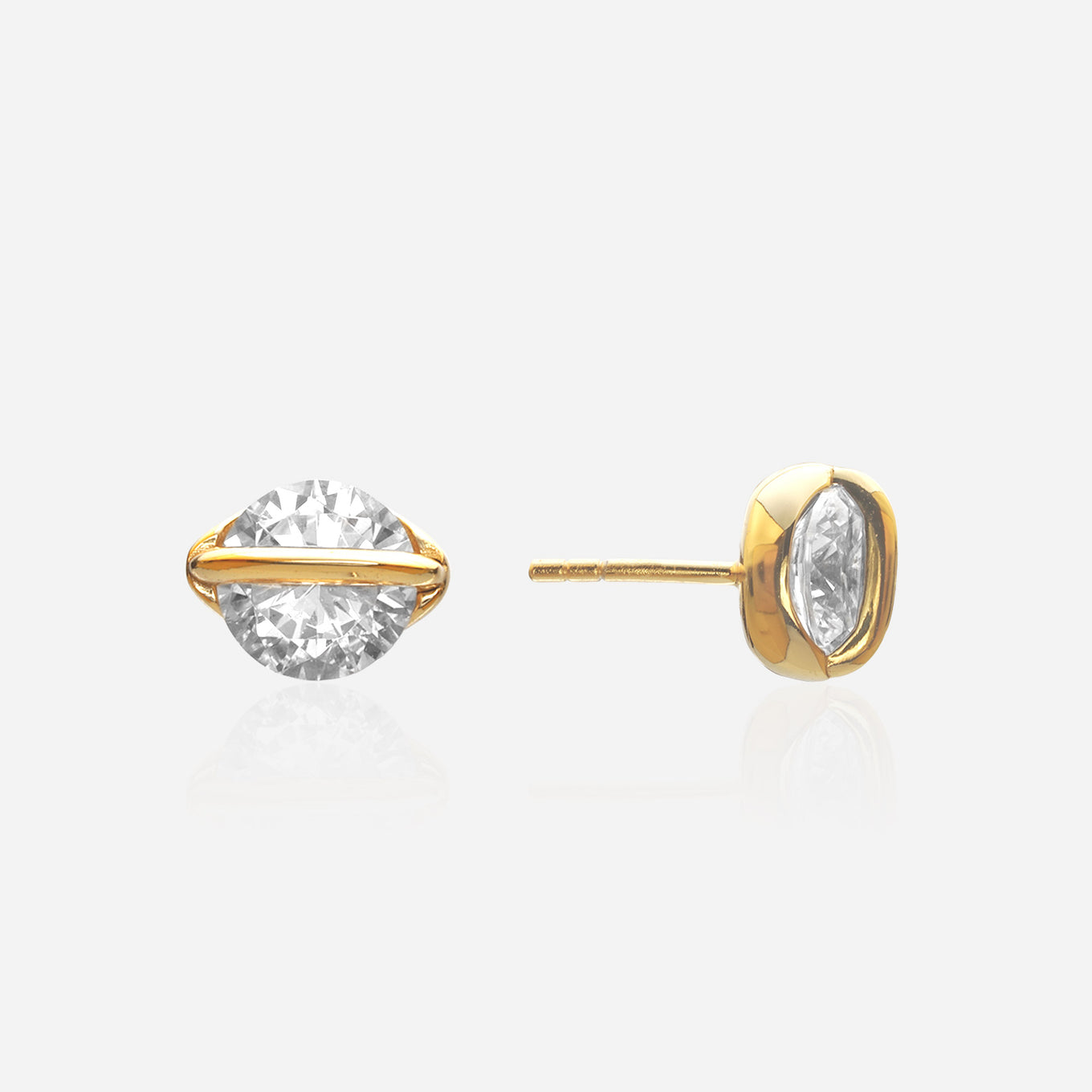
- Maker's Mark: Usually 2-4 letters or a symbol. ÉLARAMUSE pieces carry a signature maker's mark alongside the 925 stamp
- Country of Origin: "ITALY," "THAILAND," "CHINA," "USA" — indicates manufacturing location, not necessarily design origin
- Assay Office Mark: UK pieces carry a symbol identifying which office tested the metal (leopard = London, anchor = Birmingham, castle = Edinburgh)
- Date Letter: UK assay offices also stamp a letter indicating the year of testing — a full hallmark includes purity + office + date + maker
If a piece carries multiple stamps (e.g., "925 / ITALY / [logo]"), you're looking at sterling silver made in Italy by a specific manufacturer. This level of detail is a good sign — it means the manufacturer is following internationally recognized standards.
How to Find and Read the Mark on Your Jewelry
Stamps are typically placed in specific locations depending on the jewelry type:
- Necklaces and pendants: On the back of the pendant, near the bail (the loop where the chain attaches), or on a small flat tag near the clasp
- Rings: Inside the band — use a magnifying glass or your phone camera zoomed in
- Bracelets: Near the clasp or on a flat tag attached to the clasp assembly
- Earrings: On the post (stud earrings) or on the back of the earring body
- Chains: On a small flat tag near the clasp — chain links themselves are rarely stamped
If you can't find the mark, check these spots with your phone flashlight at a 45-degree angle — side lighting makes stamps easier to see than direct overhead light. A $10 jeweler's loupe (10x magnification) is even better and will last you a lifetime.
5 Red Flags When Reading Jewelry Stamps
- "18K" alone with no maker's mark. US law requires a trademark next to any quality mark. An isolated "18K" stamp has no legal accountability.
- "14K" on a magnetic piece. Gold and silver are non-magnetic. If a magnet sticks to a piece stamped 14K or 925, the stamp is either fake or the base metal isn't what it claims.
- "GP" or "GEP" after a karat mark with no base metal disclosure. "18K GP" on an unmarked base could be brass, nickel alloy, or worse. Legitimate sellers state the base metal.
- Stamps that look stamped over or scratched out. A blurry, uneven, or scratched-through stamp is a warning sign — legitimate marks are clean and uniform.
- Three-digit numbers under 300. "200" or "150" on gold-colored jewelry typically means the piece is costume jewelry with 0% precious metal content. These numbers are often lot codes, not purity marks.
FAQ: Jewelry Stamps
What does 925 mean on gold jewelry?
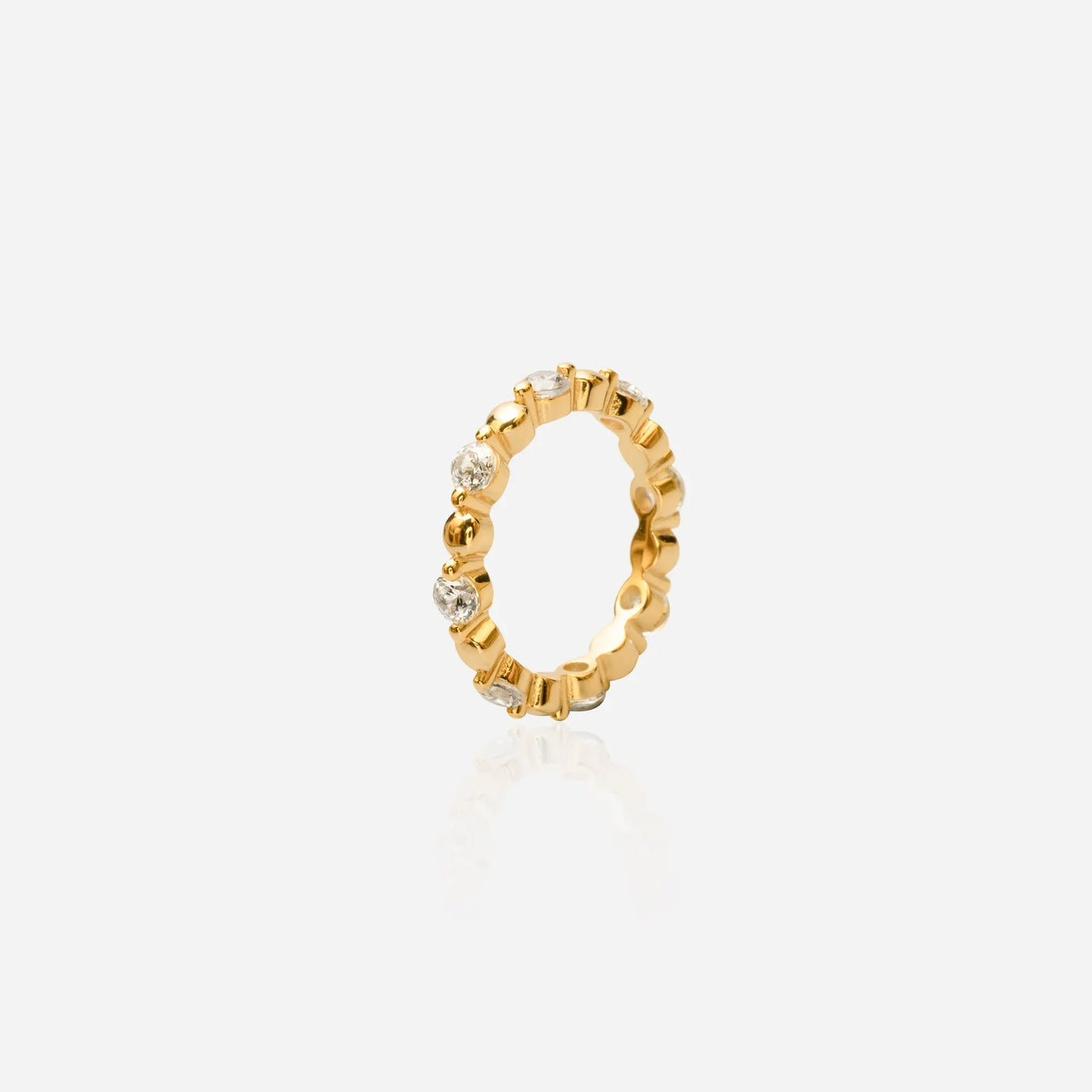
If you see "925" stamped on a piece that looks gold, it means the base metal is sterling silver (92.5% pure) with a gold plating or gold vermeil finish over it. This is actually a good sign — it tells you the piece uses genuine sterling silver underneath rather than mystery alloy. ÉLARAMUSE gold jewelry is built on Ag925 sterling silver with 0.5-micron 18K gold plating.
Is 18K GP the same as 18K gold?
No. "18K GP" means gold plated — a thin layer of 18K gold electroplated onto another metal. The "18K" refers only to the plating layer's purity, not the entire piece. An 18K GP piece may contain less than 1% gold by weight, while an 18K solid gold piece contains 75% gold. Price is your biggest clue: an 18K GP chain costs $20-$60; an 18K solid gold chain of the same size costs $500-$2,000.
Can I trust a jewelry stamp to be accurate?
In the US, fraudulent stamping is illegal but enforcement is limited — especially on online marketplaces. The best verification: buy from brands that disclose both stamp information AND base metal composition in their product descriptions. A stamp alone is evidence, not proof. If a deal seems too good to be true for a stamped piece, it probably is.
What's the difference between GF and GP?
GF (Gold Filled) contains at least 5% gold by weight, mechanically bonded (not electroplated) to a base metal — typically brass. It lasts decades and doesn't flake. GP (Gold Plated) is an electroplated layer that can be as thin as 0.05 microns — durability varies dramatically based on thickness and base metal. GF is superior to thin GP over brass, but GP over sterling silver with adequate thickness (0.5 micron+) rivals GF in durability.
Key Terms You Need to Know
- Ag925: International hallmark for sterling silver — 92.5% pure silver, the standard for quality jewelry.
- Karat (K): Measure of gold purity — 24K = 100% gold, 18K = 75%, 14K = 58.5%.
- GP / Gold Plated: A thin layer of gold electroplated onto a base metal — quality depends on thickness and base metal.
- GF / Gold Filled: Gold mechanically bonded to a base metal — at least 5% gold by weight. Lasts decades.
- Vermeil: 2.5+ microns of gold over sterling silver — thicker than standard gold plating, regulated in the US and UK.
- Nickel-Free: Zero nickel in the metal composition — the #1 cause of jewelry allergies.
The ÉLARAMUSE Standard
| Feature | Specification |
|---|---|
| Base Metal | Solid Ag925 Sterling Silver |
| Plating | 0.5-micron 18K gold plating |
| Safety | 100% Nickel-Free, Hypoallergenic |
| Durability | Water-resistant, Tarnish-resistant |
| Hallmark | 925 + Maker's Mark — stamped on every piece |
We believe transparency is the foundation of trust. Every ÉLARAMUSE piece carries a clear 925 hallmark alongside our maker's mark — because you deserve to know exactly what you're wearing. Ag925 sterling silver with 0.5-micron 18K gold plating. No mysterious alloys, no deceptive stamps, no nickel.
The next time you pick up a piece of jewelry — in a store, at a market, or from a box of family heirlooms — flip it over and read the stamp. Those tiny letters and numbers aren't decorative. They're the piece telling you its story. Learn to read them, and you'll never get fooled again.
— Joyce | Founder
Further Reading: GIA — History of Gemstone & Jewelry Hallmarks • V&A Museum Jewellery Collection