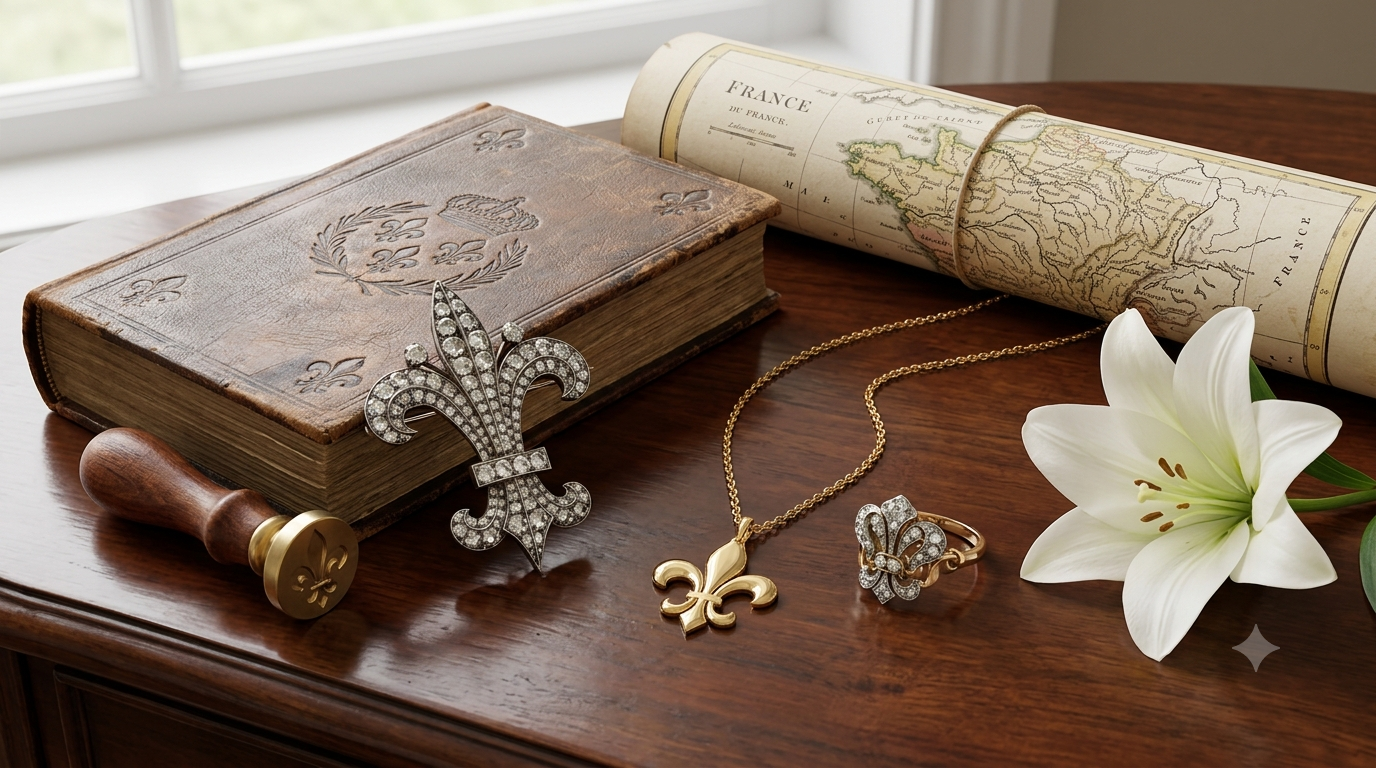
Quick Answer: The fleur de lis is an 800-year-old lily-inspired symbol that migrated from French royal heraldry to modern jewelry as a mark of sovereignty, spiritual aspiration, and personal resilience — quietly resurgent in 2026's talismanic jewelry movement.
📑 In This Guide
- What Is a Fleur de Lis — The 30-Second Version
- The History: From Clovis to Closets, an 800-Year Arc
- What Does Wearing a Fleur de Lis Mean Today?
- 5 Fleur de Lis Jewelry Styles You Will See Everywhere in 2026
- How to Wear a Fleur de Lis Pendant Without Looking Costume-y
- The ÉLARAMUSE Standard
- Frequently Asked Questions
- What We Believe
- References & Further Reading
What Is a Fleur de Lis — The 30-Second Version
The fleur de lis (pronounced "flerr-duh-LEE") is a stylized lily with three upright petals bound by a horizontal band. The central petal points straight up; the two side petals curve outward and downward. It is not a flower drawing — it is a heraldic charge, a visual code that carried specific meaning across medieval France, Renaissance Florence, colonial Louisiana, and the Boy Scouts.
In jewelry, it functions as a wearable emblem of belonging — to a culture, a faith, a city, or a personal code of strength.
Symbolism at a glance: The three petals represent faith, wisdom, and valor in Christian heraldry, or the trinity of body, mind, and spirit in secular interpretation. The horizontal band represents unity — the force that holds the three virtues in balance. Understanding this tripartite structure is the key to understanding why the fleur de lis has survived as a jewelry motif for eight centuries while most other heraldic symbols faded into textbooks.
Key Terms — Fleur de Lis Vocabulary
Fleur de Lis: A stylized lily motif with three upright petals and a horizontal binding band. Pronounced "flerr-duh-LEE." Originally a heraldic charge, now a jewelry motif associated with sovereignty, spiritual aspiration, and resilience.
Heraldic Charge: A symbol placed on a coat of arms or shield, governed by precise rules of proportion and color. The fleur de lis was the most important charge of the French monarchy — equivalent to a royal trademark enforceable by law.
Bicolor (Silver + Gold): A jewelry construction technique where two metal tones are used in the same piece — typically sterling silver as the base field and gold as the accent. In a fleur de lis pendant, a bicolor approach gives the lily visual separation from its background, making the three petals legible at distance.
Pavé Setting: Small stones set closely together with minimal visible metal between them, creating a "paved" surface of continuous sparkle. Used in fleur de lis pendants where diamond simulants line the three petals — the pavé technique keeps the emphasis on the lily shape rather than individual stones.
Talismanic Jewelry: Jewelry designed with symbolic intention rather than pure decoration. The fleur de lis is one of the oldest talismanic motifs still in circulation — worn not because it is pretty (though it is), but because it means something to the wearer.
The History: From Clovis to Closets, an 800-Year Arc
The story goes that Clovis I, the first king of the Franks, replaced his pagan banner of three black toads with the lily after his baptism. Whether myth or history, this narrative established the fleur de lis as a symbol of divine endorsement — a king ruling not by conquest alone but by divine right. This is the symbolic foundation from which every fleur de lis pendant descends, whether the wearer knows the story or not.
Heraldic golden age (12th–15th centuries): The fleur de lis reached its visual peak under the Capetian dynasty. Louis VII adopted it as the official royal seal, and by the time of Joan of Arc, it was emblazoned on shields, tapestries, and coronation robes. Crucially, it was heraldic — stylized to be recognizable at distance and reproducible in metal and thread.
This heraldic discipline is what makes the fleur de lis so adaptable to jewelry: it was designed for metalwork from the beginning.
Colonial and religious diffusion (17th–19th centuries): French settlers brought the fleur de lis to North America — it appears on the flag of Quebec to this day. The Catholic Church adopted it as a Marian symbol (the lily as a reference to the Virgin Mary's purity). New Orleans made it the city's unofficial emblem after Hurricane Katrina, transforming the fleur de lis from royal seal to resilience marker — a pivot that set the stage for its contemporary jewelry revival.
2026 jewelry revival: The fleur de lis is experiencing a subtle but unmistakable comeback in fine and demi-fine jewelry, driven by the same cultural forces that lifted talismanic and symbolic jewelry: a demand for pieces that carry meaning beyond decoration.
The Victoria and Albert Museum's jewelry collection has documented the fleur de lis as one of the most frequently reinterpreted heraldic motifs in contemporary design.
What Does Wearing a Fleur de Lis Mean Today?
The meaning of the fleur de lis in 2026 is less about what a king intended in 1150 and more about what the wearer brings to it. This is the genius of the motif: it is empty enough to hold personal meaning and specific enough to be instantly recognizable.
Sovereignty: In its original form, the fleur de lis declares independence — I answer to my own court, not yours. Worn as a pendant at the collarbone, it becomes a quiet assertion of self-sovereignty.
Spiritual aspiration: The three-petal structure maps cleanly onto almost any trinity — Father/Son/Holy Spirit, past/present/future, creation/preservation/destruction — making the fleur de lis an adaptable spiritual anchor. Unlike a cross, it carries no mandatory theological allegiance; a secular wearer can read it as three generations of family, three core values, or simply upward aspiration.
Resilience marker: The direction of the symbol has flipped from descent (born into the right family) to ascent (fought your way up). A fleur de lis pendant is increasingly chosen to mark surviving something — a health crisis, a career pivot, a personal loss — rather than inheriting a birthright.
Quotable insight: Symbolic jewelry philosophy: The fleur de lis is eight centuries old and still means something new to every person who puts it on — that is not design, that is alchemy.
5 Fleur de Lis Jewelry Styles You Will See Everywhere in 2026
1. The Classic Solitaire Pendant
A single fleur de lis on a chain. The Gold Fleur de Lis Pendant exemplifies this: a diamond simulant at the intersection of the three petals, mounted on a bicolor silver base that gives the lily visual definition without competing metals. The diamond simulant catches light at the exact point where all three petals converge — the visual and symbolic center of the piece.
Wear it on a 16-inch chain for a collarbone-level statement, or at 18 inches for a more subtle presence that slips under a blouse.
2. The Talismanic Narrative Piece
Fleur de lis combined with a second symbolic element — a serpent, a key, a cross — creating a two-layer narrative in one piece. The Arcana Key Necklace is the best example in the current market: a serpent coiled around a key that terminates in a fleur de lis. The key = access. The serpent = transformation. The fleur de lis = sovereignty. Three symbols, one necklace, zero visual clutter.
This stacking of meanings inside a single clean silhouette is the 2026 approach to meaningful jewelry — density without bulk.
3. The Architectural Cocktail Ring
A fleur de lis rendered as a dome ring or signet, projecting the motif outward rather than in profile. Less common than pendants but gaining ground in the statement ring space. The lily's three-dimensional geometry translates surprisingly well to a ring top: the three petals become three convex surfaces catching light from different angles.
4. The Fleur de Lis Drop Earring
Small-scale fleur de lis charms suspended from huggies or French wire hooks. The key design challenge is scale — a fleur de lis smaller than 10mm becomes illegible, while one larger than 20mm becomes theatrical. The sweet spot is 12–15mm: recognizable without overwhelming the earlobe.
5. The Engraved Fleur de Lis Band
A plain band — gold or silver — with a recessed fleur de lis engraving wrapping the circumference. Understated and ungendered, this form appeals to people who want the symbol without the pendant. A half-eternity version with diamond simulants alternating with engraved lilies merges two classic motifs into a single band.
How to Wear a Fleur de Lis Pendant Without Looking Costume-y
The line between "meaningful symbol" and "themed costume" is thin. Here is how to stay on the right side of it.
Rule 1: Let the pendant be the only symbol in the frame. A fleur de lis pendant paired with a cross necklace and a hamsa bracelet looks like a spirituality sample sale. One symbol at a time. The Arcana Key works precisely because all three symbols (serpent, key, fleur de lis) are integrated into one object.
Rule 2: Scale to your frame. A 40mm fleur de lis on a small frame reads as costume. A 15–20mm pendant on a 16-inch chain reads as intentional jewelry. Unlike aggressive logo pendants that advertise a brand, the fleur de lis advertises an idea — and ideas are better delivered quietly.
Rule 3: Mix metals deliberately. A bicolor fleur de lis — gold lily on a silver field, as in the Gold Fleur de Lis Pendant — gives the motif visual contrast and makes it easier to style with both gold and silver jewelry. Layer it with a thin silver chain for day, add a gold chain for evening — the pendant itself stays the same.
Rule 4: Wear it on skin, not over fabric. A fleur de lis is too delicate a symbol to be seen over a turtleneck. It needs bare skin — collarbone, décolletage, or at minimum visible under an open collar. The symbol invites reading, and reading requires proximity.
The ÉLARAMUSE Standard
We believe a talisman is only meaningful if it is built to stay with you — through showers, sleep, workouts, and years. Every fleur de lis piece we make is constructed on a solid Ag925 sterling silver core with Premium 18K Gold Plating, because a symbol of resilience should not tarnish after three wears.
| Feature | Specification |
|---|---|
| Base Metal | Solid Ag925 Sterling Silver (92.5% pure silver) |
| Plating | Premium 18K Gold Plating — 0.5-micron thickness, nickel-free underlayer |
| Stone Setting | Precision-set diamond simulants with Mohs 8.5 hardness |
| Safety | 100% Nickel-Free, Hypoallergenic — Ni <0.01% |
| Durability | Water-resistant, Tarnish-resistant — tested for daily wear, gym-to-office and shower-safe |
| Chain | Adjustable 16″–18″ with secure lobster clasp and 2″ extender |
Unlike costume jewelry that uses brass cores and flash plating to deliver a "royal look" that turns green in three weeks, our fleur de lis collection uses solid Ag925 silver as the foundation. Unlike fine jewelry brands that charge $400+ for a sterling silver pendant with the same material specifications, we deliver direct-to-consumer at demi-fine pricing — because eight centuries of history should not require an eight-century loan to afford.
Editor's Picks: Fleur de Lis Jewelry We Wear On Repeat
Gold Fleur de Lis Pendant | Diamond Simulant | Bicolor Silver: Gold Fleur de Lis Pendant | Diamond Simulant | Bicolor Silver — Our signature lily in bicolor gold-on-silver. Architectural precision, not costume excess.
Arcana Key Necklace | Serpent & Fleur-de-Lis Talisman | 18K Gold Plated S925 | ÉLARAMUSE: Arcana Key Necklace | Serpent & Fleur-de-Lis Talisman | 18K Gold Plated S925 | ÉLARAMUSE — Key + lily combined into one talismanic pendant. Unlocks nothing physical — everything symbolic.
Gold Compass Rose Pendant | Reversible Rigato Medallion | Pink Halo: Gold Compass Rose Pendant | Reversible Rigato Medallion | Pink Halo — Another heraldic charge reborn. Same DNA: symmetry, symbolism, centuries of meaning.
Frequently Asked Questions
Q: Is the fleur de lis a religious symbol?
A: It originated in Christian heraldry — the lily as a Virgin Mary symbol — but it is not exclusively religious. The fleur de lis has been used by secular institutions for centuries (Scouting, New Orleans, Quebec). In jewelry, it functions as a cultural and personal symbol; wearing one carries no implied religious affiliation unless the wearer brings one.
Q: What is the difference between a fleur de lis and a regular lily pendant?
A: A lily pendant is a botanical representation — curved petals, visible stamen, organic shape. A fleur de lis is a heraldic stylization: three rigid, upright petals, a horizontal band, geometric symmetry. The fleur de lis says "sovereignty"; the lily says "nature." Two distinct looks, two different symbolic weights.
Q: Can men wear a fleur de lis necklace?
A: Yes — the fleur de lis is historically a masculine heraldic symbol, worn on shields and armor by knights. In contemporary fashion, it works as a unisex pendant, particularly in darker metals and on longer chains (20–22″). The symbol itself is gender-neutral; the chain length and metal finish determine how it reads.
Q: How do I clean a fleur de lis pendant with intricate detailing?
A: A soft-bristle toothbrush, warm water, and mild dish soap. Gently brush the crevices between the three petals — those intersections catch skin oils and lotion residue. Rinse, pat dry with a microfiber cloth, and store in a sealed pouch. Avoid ultrasonic cleaners on pieces with pavé settings, as vibration can loosen precision-set stones over time.
Q: Does the fleur de lis have negative historical baggage I should know?
A: The fleur de lis was sometimes used as a branding mark on enslaved people in French colonies — a painful and important part of its history. In modern jewelry, the symbol has been overwhelmingly reclaimed as a marker of resilience (particularly in post-Katrina New Orleans), but awareness of the full historical record is part of wearing the symbol responsibly.
What We Believe
We believe a symbol is only as strong as the metal that holds it. The fleur de lis has survived eight centuries because it is a vessel — every generation pours its own meaning into those three petals. Your fleur de lis is not what Clovis thought it was. It is what you make it. Find your talisman, wear it like a second spine, and let the lily point the way forward — not toward a throne, but toward the person you are becoming.
References & Further Reading
- Victoria and Albert Museum — Jewelry Collection: Heraldic Motifs in Contemporary Design
- The Metropolitan Museum of Art — The Fleur-de-Lis in Medieval and Renaissance Art
- Encyclopaedia Britannica — Fleur-de-lis: History, Meaning, and Heraldic Usage