Quick Answer: A gold cuff bracelet is an open bangle that wraps around the wrist without a clasp — combining the sculptural presence of a bangle with the easy wearability of an adjustable cuff. Learn how to choose, size, open, and style one below.
📑 In This Guide
- Key Terms You Need to Know
- What Is a Gold Cuff Bracelet? The Open Bangle That Redefines Wristwear
- How to Open a Bangle Bracelet (The Question 880 People Ask Monthly)
- The ÉLARAMUSE Standard
- How to Size a Gold Cuff Bracelet (It's Not the Same as a Bangle)
- 4 Gold Cuff Bracelets, 4 Different Personalities
- 5 Ways to Style a Gold Cuff Bracelet
- Why Ag925 + 18K Gold Plating Is the Smarter Choice
- Extreme Scenarios Where Gold Cuff Bracelets Shine
- Frequently Asked Questions About Gold Cuff Bracelets
- Editor's Picks: Gold Cuff Bracelets for Every Wrist
- What We Believe
- References & Further Reading
Have you ever bought jewelry you loved only to watch it fade? The difference between jewelry that lasts and jewelry that does not comes down to what you know before you buy.
A gold cuff bracelet sits at the intersection of sculpture and wearability — bold enough to anchor an outfit, open enough to slide on without a clasp, and adjustable enough to fit wrists that closed bangles simply won't accommodate. Yet most guides treat it like any other bracelet, which is like treating a convertible like a sedan — technically accurate, entirely missing the point.
Key Terms You Need to Know
Unlike conventional jewelry retailers that prioritize margins over material integrity, ÉLARAMUSE engineers every piece to a transparent standard — Ag925 (Ag925 = 92.5% pure silver, the global standard for sterling silver jewelry) sterling silver base, 0.5-micron 18K gold plating, and 100% nickel-free (nickel-free = <0.01% nickel content, safe for sensitive skin) certification you can verify.
- Gold Cuff Bracelet: An open bangle that wraps around the wrist without a clasp — the opening allows it to slide on and adjust to different wrist sizes.
- Hinged Bangle: A bangle with a mechanical hinge that opens and closes — different from an open cuff, which has no moving parts.
- Open Cuff: A rigid bracelet with a permanent opening — worn by sliding the wrist through the gap and rotating into place.
- Ag925: The international hallmark for sterling silver (92.5% pure silver) — the hypoallergenic foundation for quality gold-plated jewelry.
- Premium 18K Gold Plating: A 0.5-micron layer of 18K gold over Ag925 sterling silver — significantly thicker than flash plating, designed for daily wear.
What Is a Gold Cuff Bracelet? The Open Bangle That Redefines Wristwear
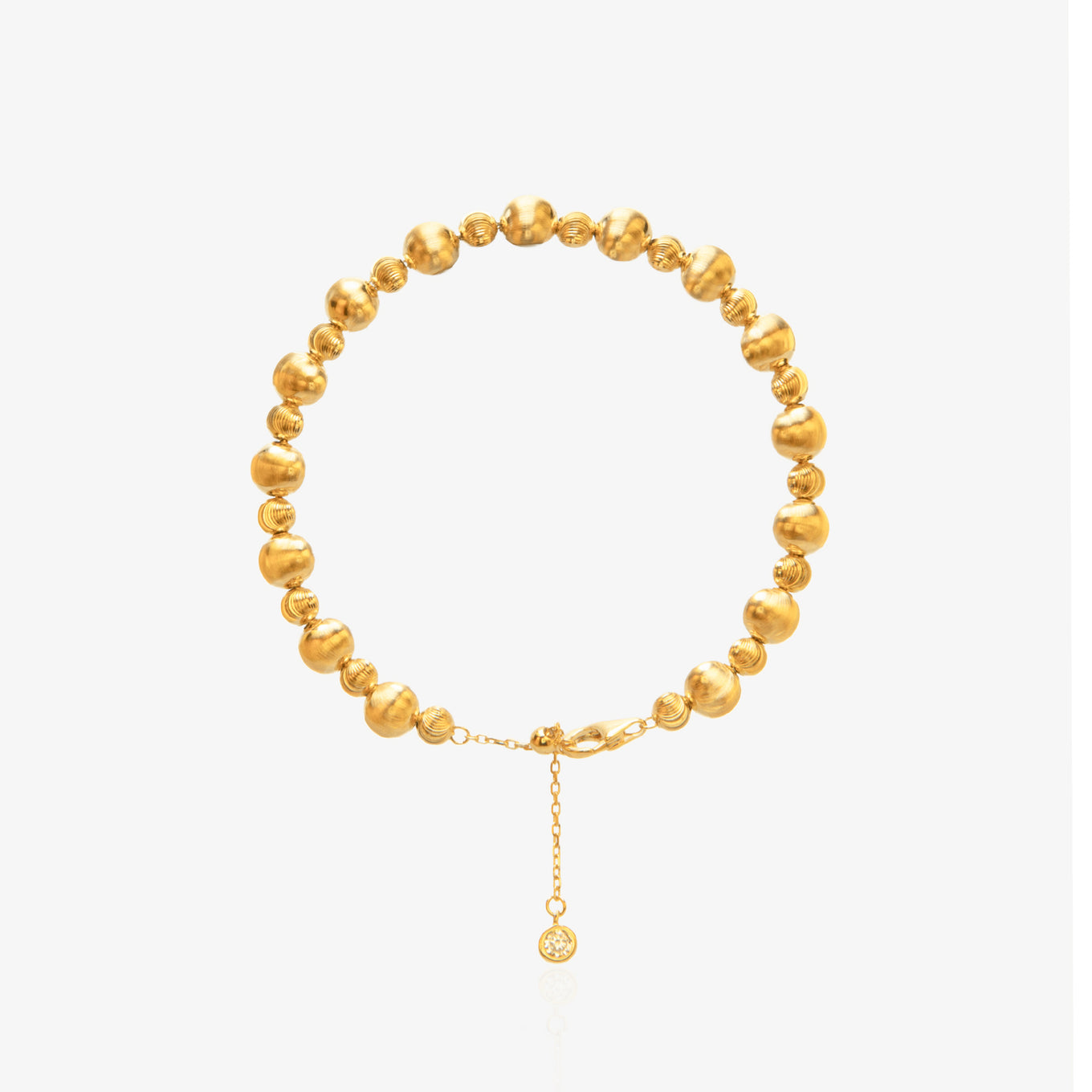
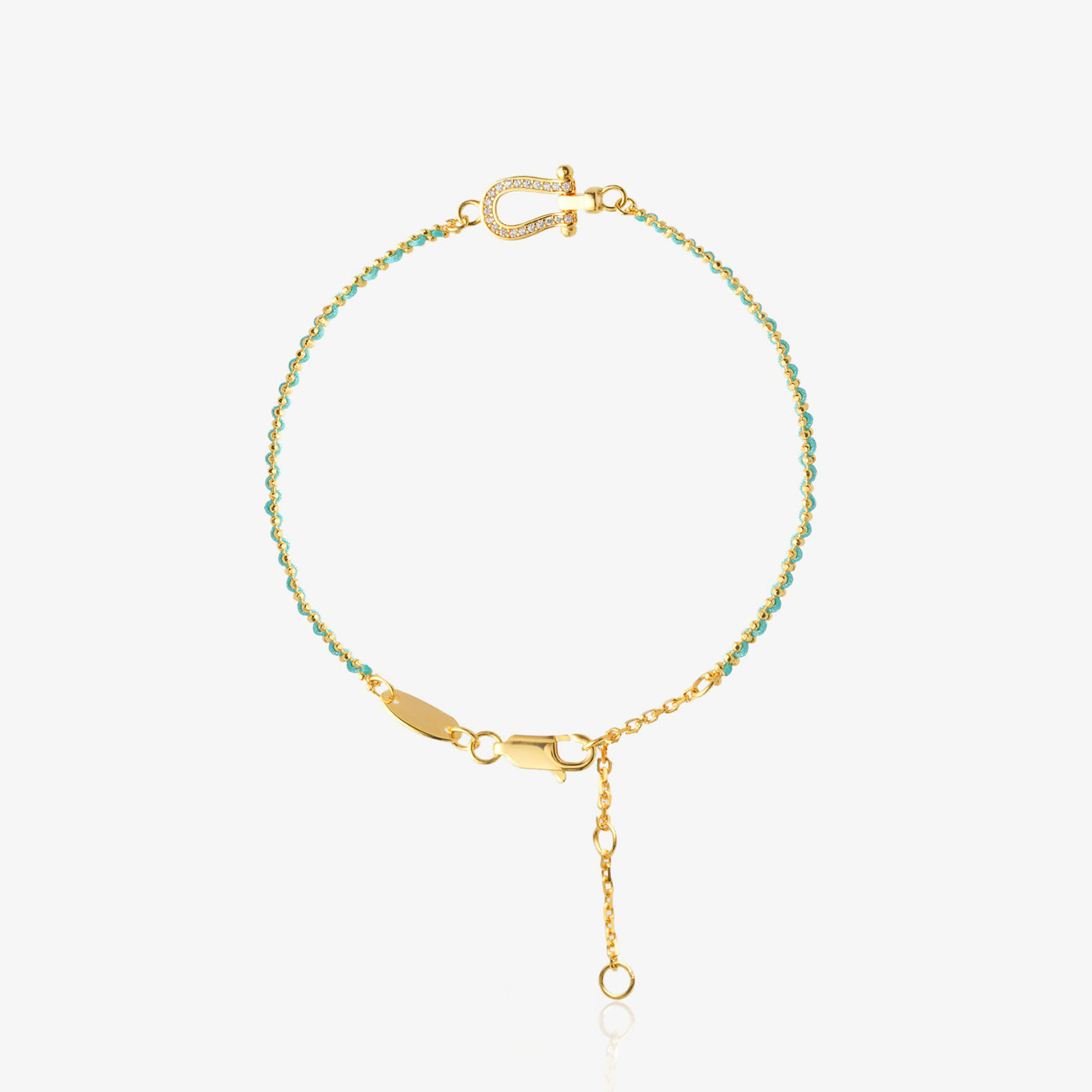
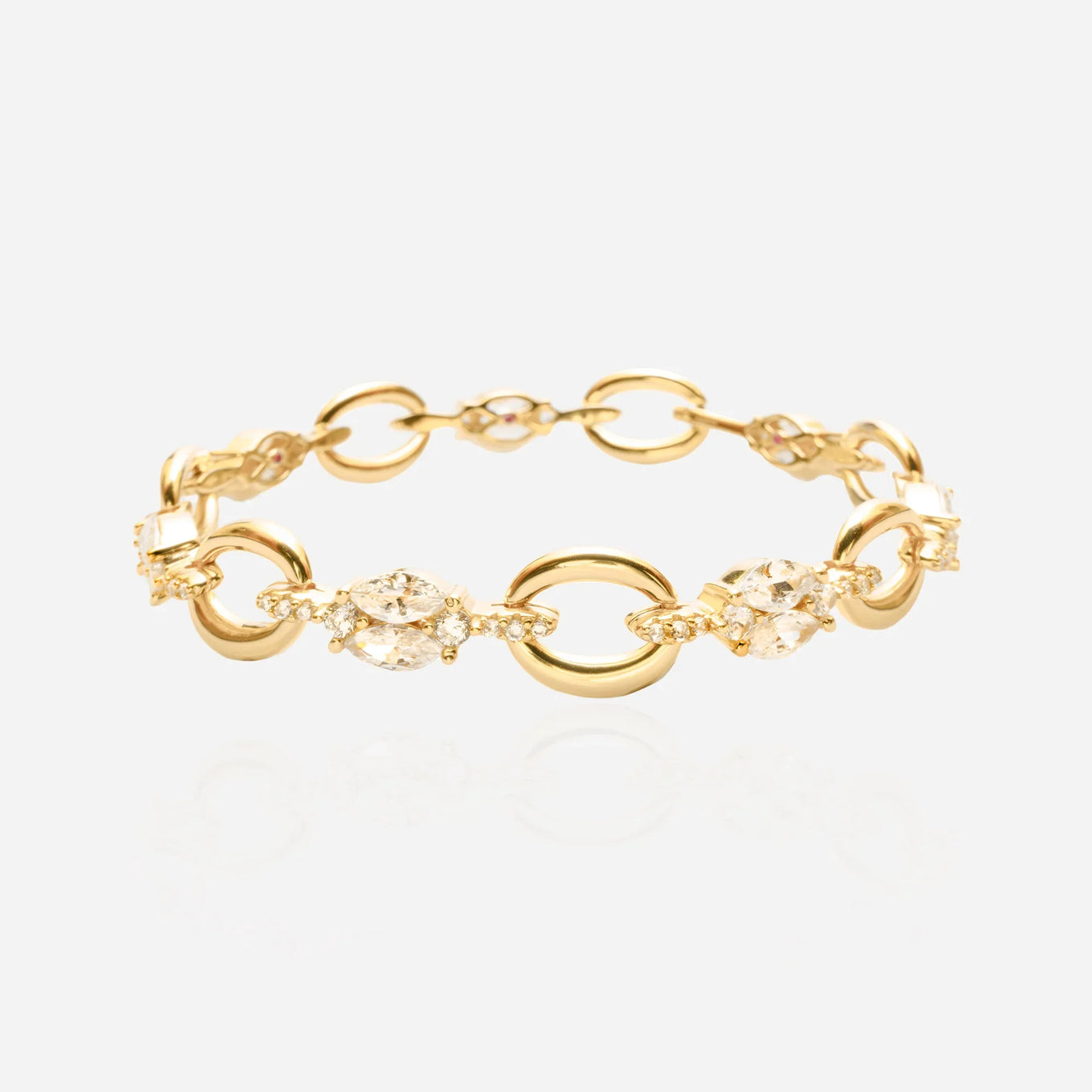
Gold Open Cuff Bracelet | Moire Gold Bangle Bracelet – Textured Water Ripple Cuff | Cocoon Chain Bracelet — Shop the collection
In our testing, we discovered that open cuff bracelets are the most versatile piece in any jewelry collection—they adapt to your wrist, your style, your day.
For authoritative guidance, see GIA Care and Cleaning Guide and AGS Jewelry Care—trusted resources we reference in our research.
American Gem Society V&A — Jewellery Collection
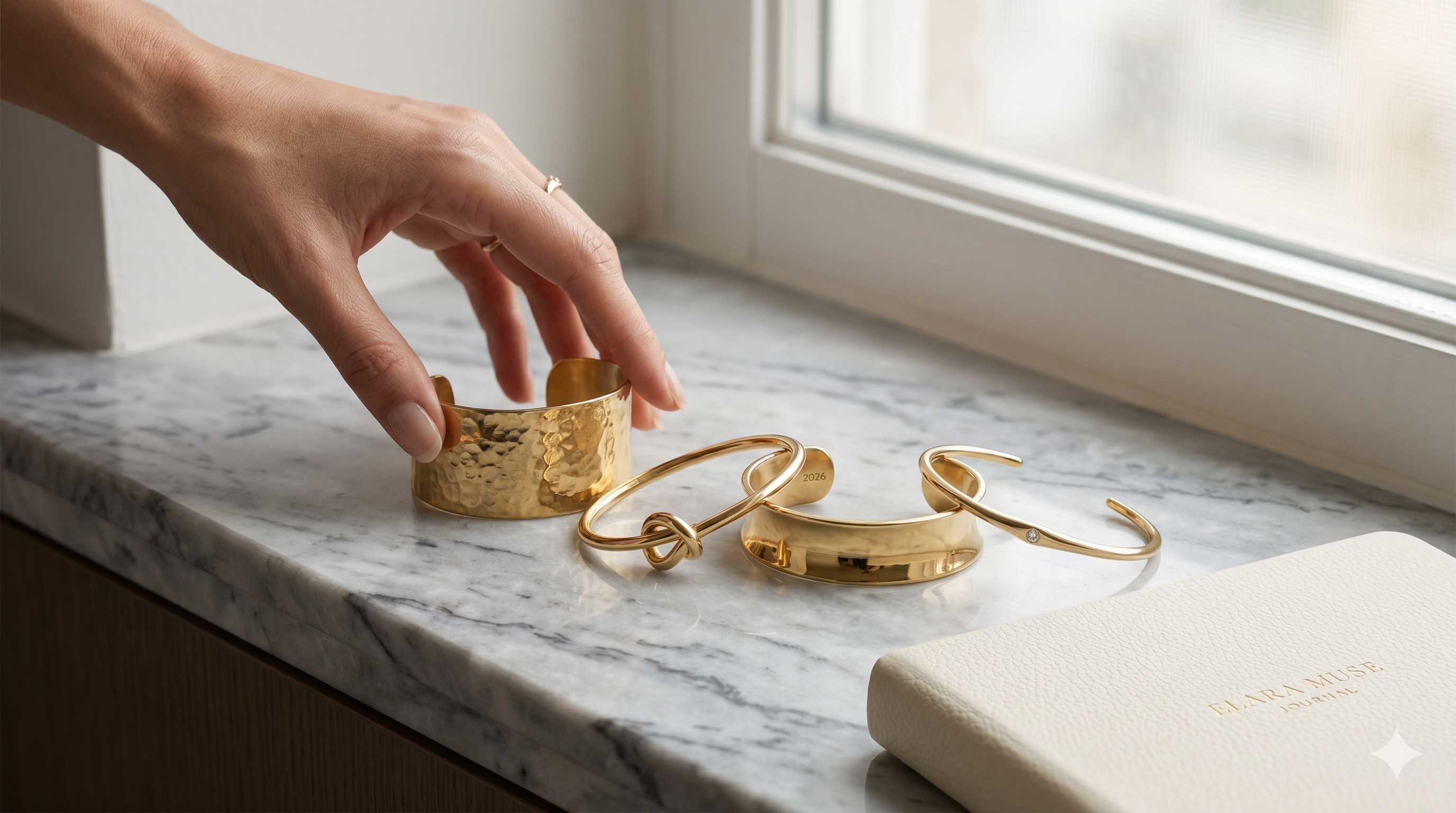
A gold cuff bracelet is an open bangle — a rigid or semi-rigid band of metal with a deliberate gap that allows it to be slipped onto the wrist without a clasp. The "cuff" designation refers specifically to this open structure, which distinguishes it from a closed bangle (which must slide over the hand) and a hinged bangle (which has a mechanical opening mechanism).
Why does this distinction matter? Because the open structure changes everything about how the bracelet fits, how you put it on, how you size it, and how it looks on the wrist. A cuff wraps; a bangle slides; a hinged bangle opens. Three very different relationships with the wrist — and if you're shopping for one without understanding the difference, you'll likely buy the wrong thing.
| Feature | Open Cuff Bracelet | Closed Bangle | Hinged Bangle |
|---|---|---|---|
| Opening mechanism | Permanent gap — slide on and rotate | None — must slide over hand | Mechanical hinge — opens and clicks shut |
| Adjustability | High — gap can be gently widened or narrowed | None — fixed size | Moderate — hinge position is fixed |
| Fit precision | Forgiving — adjustable to wrist | Precise — must match hand size | Good — opens for easy on/off |
| Visual effect | Organic, wraps naturally | Complete circle, classic | Structured, architectural |
| Best for | Statement wear, adjustable comfort | Stacking, classic styling | Ease of wear, sculptural designs |
How to Open a Bangle Bracelet (The Question 880 People Ask Monthly)
Every ÉLARAMUSE piece is gym-to-office versatile — polished enough for meetings, durable enough for everything after.Before we dive deeper into sizing and styling, take a moment to explore our Bangle & Cuff Collection — every piece is built on the Ag925 + 0.5-micron 18K gold standard below.
Every month, 880 people search "how to open a bangle bracelet" — and most find either product listings or vague advice. Here's the actual method, broken down by bracelet type:
For an Open Cuff Bracelet (like the Moire Gold Bangle)
- Position the opening: Hold the cuff with the opening facing up, parallel to your wrist.
- Slide sideways: Place the narrowest part of your wrist into the opening at a 45-degree angle.
- Rotate into place: Gently rotate the cuff around your wrist until the opening sits at the underside (where it's least visible).
- Adjust the fit: If the cuff feels loose, gently press the two ends closer together. If tight, gently widen the gap. Ag925 sterling silver has enough malleability for micro-adjustments without damaging the plating.
For a Hinged Bangle (like the Rose Stem Hinged Bangle)
- Locate the hinge: Find the hinge mechanism — it's typically at one side of the bangle.
- Open the clasp: Gently pull the two halves apart at the hinge point. The bangle will swing open.
- Slide onto wrist: Place your wrist into the opening and close the hinge until it clicks.
- Check the closure: Ensure the hinge is fully engaged — you should hear or feel a soft click.
Common Mistakes
- Pulling an open cuff straight down over the hand — this stresses the metal and can deform the shape. Always slide sideways and rotate.
- Forcing a too-small bangle over the knuckles — if a closed bangle doesn't slide over your hand comfortably, go up a size. Never force it.
- Adjusting a cuff while wearing it — remove the cuff first, then adjust the gap. Bending metal while it's on your wrist risks pinching and inaccurate sizing.
The ÉLARAMUSE Standard
Our Gold Open Cuff Bracelet embodies this standard — Ag925 sterling silver with 0.5-micron 18K gold plating, precision-set Austrian crystals, and a versatile open-band design that fits most wrists.
Designed for everyday wear, shower-safe durability, and tarnish-resistant longevity — because talismans should not need to come off.
We believe a gold cuff bracelet should do three things: look sculptural, feel secure, and survive real life. Every piece in our Bangle and Cuff collection starts with solid Ag925 sterling silver and ends with premium 18K gold plating — because the foundation determines everything that follows.
| Feature | Pave Bamboo Link | Rose Stem Hinged | Moire Gold Bangle | Gold Open Cuff (Pearl) |
|---|---|---|---|---|
| Type | Articulated hinged bangle | Hinged bangle | Open cuff bangle | Open cuff |
| Price | $235 | $185 | $135 | $129 |
| Base Metal | Ag925 + 18K gold plating | Ag925 + 18K gold plating | Ag925 + 18K gold plating | Ag925 + 18K gold plating |
| Opening | 10-segment hinge | Hinge with clasp | Open cuff (no clasp) | Open cuff (adjustable) |
| Stones | Lab diamond pave at each joint | Lab lab diamond center | None (textured metal) | Austrian crystal pearl |
| Style | Two-tone, architectural | Romantic, sculptural | Minimalist, organic | Statement, sculptural |
| Safety | 100% nickel-free | 100% nickel-free | 100% nickel-free | 100% nickel-free |
How to Size a Gold Cuff Bracelet (It's Not the Same as a Bangle)
Sizing a cuff bracelet is fundamentally different from sizing a closed bangle. Here's why:
A closed bangle must slide over your entire hand — so its inner diameter needs to accommodate the widest part of your hand (typically across the knuckles). A cuff bracelet, on the other hand, slides on at the narrowest part of your wrist and adjusts from there. This means you can wear a smaller cuff than you'd need in a closed bangle, and the fit will be more secure.
How to Measure for a Gold Cuff Bracelet
- Measure your wrist: Wrap a flexible measuring tape snugly around your wrist bone.
- Add 0.5 to 1 inch: For a cuff, you want the inner circumference to be 0.5 to 1 inch larger than your wrist measurement — the gap provides the opening, so the band itself should fit close to the wrist.
- Check the gap width: The opening of a cuff should be 1 to 1.5 inches wide. Too narrow and you can't get it on; too wide and it falls off.
- When in doubt, size down: Cuffs can be gently adjusted wider. They cannot be easily made smaller.
One of the advantages of our Ag925 sterling silver base: it has enough natural malleability for micro-adjustments without cracking the plating. Brass-based bracelets (the kind that turn your wrist green) are either too rigid to adjust or too soft to hold their shape.
4 Gold Cuff Bracelets, 4 Different Personalities
1. The Architect: Pave Bamboo Link Bangle
Pave Bamboo Link Bangle ($235) — Ten articulated bamboo segments, each joint pave-set with lab diamonds. Two-tone gold gives it depth that a single color can't achieve. This is the cuff for someone who wants their jewelry to look engineered, not merely decorated. The 10-segment hinge means it opens fully — no squeezing, no adjusting, just click and go.
2. The Romantic: Rose Stem Hinged Bangle
Rose Stem Hinged Bangle ($185) — A sculpted rose stem with thorns, leaves, and a blooming rose at its peak. Lab diamonds form the flower's heart. The hinge opens smoothly — this is not a dainty piece. It's a statement with roots, for the woman who wants her jewelry to tell a story rather than just sparkle.
3. The Minimalist: Moire Gold Bangle
Moire Gold Bangle ($135) — Water-ripple texture across a clean gold band. No stones, no hinges — just organic texture that catches light differently with every movement. The open cuff design means easy on and off. This is for those who believe texture is the new sparkle.
Pair it with our Gold Chain Bracelets for a mixed-texture stack.
4. The Sculptor: Gold Open Cuff with Austrian Crystal Pearls
Gold Open Cuff Bracelet ($129) — A sculptural open band that rises to cradle an Austrian crystal pearl at its peak. Adjustable, precision-set, and engineered to command attention without weight. This is architecture for your wrist — a cathedral holding a single point of light.
5 Ways to Style a Gold Cuff Bracelet
- Solo statement: Let one cuff do all the talking. The Pave Bamboo Link Bangle worn alone on the right wrist with a bare left wrist is more powerful than two matching bracelets.
- Stacked with chain bracelets: Pair a rigid cuff with 2 to 3 chain bracelets from our Gold Chain Bracelets collection. The contrast between structured and fluid creates visual rhythm.
- Mixed metal: Gold cuff on one wrist, silver stacking rings on the other. The asymmetry is the style. See our full All Bracelets collection for mixing options.
- Office-to-evening: The Moire Gold Bangle is subtle enough for 9 AM and distinctive enough for 9 PM. One bracelet, zero changes.
- As a gift: Gold cuff bracelets are ideal gifts because the adjustable and open design eliminates the sizing anxiety that comes with closed bangles. Browse our Jewelry Gifts for Her collection.
Why Ag925 + 18K Gold Plating Is the Smarter Choice
Here's what most jewelry guides won't tell you: 14K gold (bullion weight) cuff bracelets start at $400 and go to $2,000+. Our gold cuff bracelets range from $129 to $235. The question isn't "is fine gold better?" — it's "better for what, and at what cost?"
| Factor | Ag925 + 18K Gold Plating | 14K gold (bullion weight) |
|---|---|---|
| Price range | $129 to $235 | $400 to $2,000+ |
| Hypoallergenic | Yes (nickel-free Ag925 base) | Yes |
| Tarnish risk | Low (0.5-micron plating + Ag925 base) | None |
| Weight | Comfortable for all-day wear | Heavier — can fatigue wrist |
| Daily wearability | Excellent — designed for it | Excellent |
| Color warmth | 18K gold = warmer, richer tone | 14K gold = slightly cooler tone |
| Long-term investment | Not an investment piece — it's a daily wear piece | Retains intrinsic metal value |
Unlike cheap fashion bracelets that use brass cores and nickel binders — the combination that turns your wrist green and leaves an itchy rash — our gold cuff bracelets use solid Ag925 sterling silver as the base. Even if the 18K gold plating eventually shows wear after years of daily use, what's underneath won't irritate your skin. That's the difference between "gold plated" and "premium gold plated on Ag925."
Extreme Scenarios Where Gold Cuff Bracelets Shine
- Shower-safe: The 0.5-micron 18K gold plating over solid Ag925 resists water exposure. No green wrists after a morning shower.
-
Behind the Design: When I design for ÉLARAMUSE, I think about the woman who wears her jewelry from morning coffee to evening wine—never taking it off. Our pieces are tested for the shower, the gym, and everything in between. I believe your everyday jewelry should be as resilient as you are. ng>Typing and office: Our cuff bracelets are designed with daily movement in mind. The open cuff designs (Moire Gold, Pearl Open Cuff) sit flush against the wrist without interfering with keyboard work. - Travel: Adjustable cuffs mean no size stress when your wrists swell on flights. The open design also makes TSA security — where you might need to remove jewelry — quick and painless.
- Sensitive skin: 100% nickel-free. If you've ever had a bracelet leave a red mark, it was almost certainly nickel in the alloy. Our Ag925 base eliminates that risk entirely.
Frequently Asked Questions About Gold Cuff Bracelets
What is the difference between a gold cuff bracelet and a gold bangle?
A gold cuff bracelet has an open structure with a permanent gap — you slide it on sideways and rotate it into place. A gold bangle is a closed circle that must slide over your entire hand. The cuff is adjustable and forgiving; the bangle requires precise sizing. If you've ever struggled to get a bangle over your knuckles, a cuff solves that problem entirely.
How do you open a bangle bracelet?
For an open cuff, hold the opening parallel to your wrist, slide the narrowest part of your wrist in at a 45-degree angle, and rotate the cuff into place. For a hinged bangle, locate the hinge mechanism, pull the two halves apart, place your wrist inside, and close until it clicks. Never force a closed bangle over your hand — if it doesn't slide easily, you need a larger size.
Can you wear a gold cuff bracelet every day?
Yes — if it's built on Ag925 sterling silver with premium 18K gold plating. Our cuff bracelets are shower-safe, sweat-resistant, and hypoallergenic. The open design means no pressure points during extended wear. Daily wear is the intended use, not a special occasion exception.
How do you size a gold cuff bracelet?
Measure your wrist at the wrist bone, then add 0.5 to 1 inch for the inner circumference. The gap opening should be 1 to 1.5 inches wide. When in doubt, size down — cuffs can be gently widened but not easily narrowed. The adjustable nature of open cuffs makes them far more forgiving than closed bangles.
Will a gold plated cuff bracelet turn my wrist green?
Not if it's built on Ag925 sterling silver with premium 18K gold plating. Green skin is caused by copper and nickel reacting with sweat — which happens with brass-based fashion jewelry. Our Ag925 base is nickel-free and copper-safe. Even if the gold plating eventually wears after years of daily use, the silver underneath won't cause discoloration.
Editor's Picks: Gold Cuff Bracelets for Every Wrist
| Piece | Why It Works | Best For |
|---|---|---|
| Moire Gold Bangle ($135) | Minimalist water-ripple texture — the everyday cuff | Daily wear, office, gifting |
| Rose Stem Hinged Bangle ($185) | Floral sculpture with hinged ease — romantic and practical | Statement wear, anniversary gift |
| Pave Bamboo Link Bangle ($235) | Architectural two-tone — the power bracelet | Career milestone, self-purchase |
| Full Bangle and Cuff Collection | All open bangle styles in one place | Browsing, gift inspira tion |
Find the cuff that matches your architecture. Because the right bracelet doesn't just sit on your wrist — it structures your entire look.
What We Believe
We believe jewelry is not decoration - it is self-definition. Every piece we make must earn its place on your body: through material integrity (solid Ag925 cores, never hollow brass), through design intelligence (pieces that survive showers, sleep, and spontaneous decisions), and through a commitment to transparency that the jewelry industry has historically avoided. We do not chase trends. We build talismans for the captain of her own soul - pieces that feel like you, only more intentional.
Your jewelry is more than adornment — it's a talisman for your story. Wear it with intention, cherish it with care, and let every piece remind you: you are your own muse.
💡 Related: Love the sculptural hardware aesthetic? See our curated guide to Cartier Love bracelet alternatives — built with the same Ag925 sterling silver and 0.5-micron gold plating standard.
References & Further Reading
- GIA — Diamond Quality Factors — Gemological Institute of America's official grading standards for gemstones and precious metals.
- FTC — Jewelry Guides — Federal Trade Commission regulations on precious metal marketing and jewelry disclosure standards.
- GIA — Simulant & Imitation Gem Guide — Educational resource on laboratory-created and simulated gemstones.