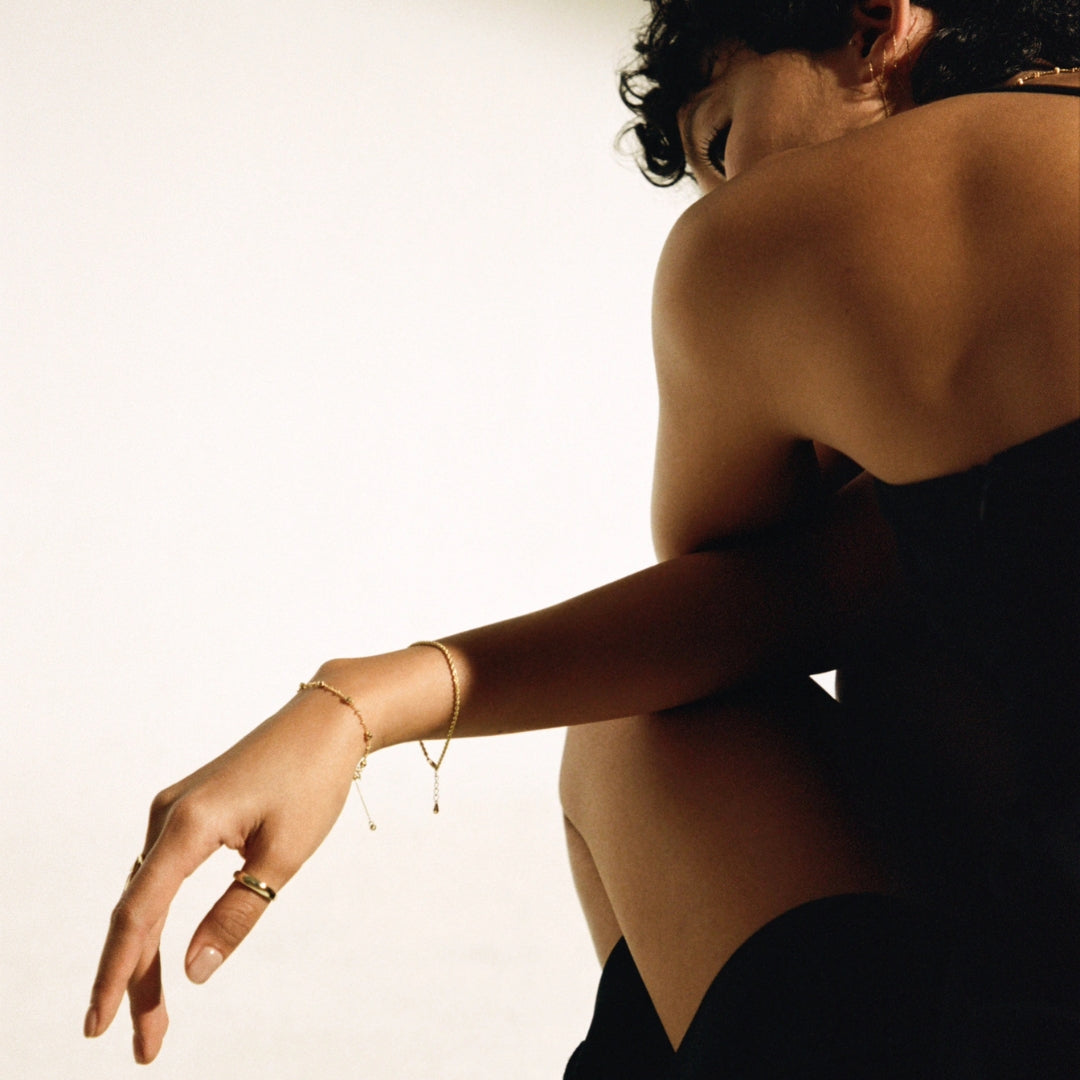
Bypass Ring | Toi et Moi Lab Diamond | ÉLARAMUSE
Description
Description
Design Symbolism
Design Symbolism
More Details
More Details
Toi et Moi Bypass Ring — Gold Open Bypass Ring with Two Lab Diamonds in Beaded Spiral Setting, French Romantic "You and Me" Diamond Ring in 18K Gold Plated S925 Sterling Silver, Convertible Engagement Ring Alternative, Hypoallergenic Perlé Bypass Band with High-Carbon Lab Diamonds (Simulated), ELARAMUSE Perlée Collection
Quick answer: This is a toi et moi bypass ring — a gold open band that wraps around the finger in a spiral, with two lab diamonds (High-Carbon Lab Diamonds, Simulated, each approximately 1.5-2.0mm, round brilliant cut, approximately 0.01-0.02 carats per stone, colorless D-F, VVS-VS clarity, Mohs 8.5 hardness — the highest-quality simulated diamond category, offering the same optical brilliance and fire as natural diamonds at a fraction of the cost and environmental impact) set at the two opposing tips of the open spiral — one diamond sits at approximately 11 o'clock on the finger, the other at approximately 5 o'clock, and the two diamonds face each other across the 4-6mm gap of the open band — they do not touch, they do not merge, they exist as two distinct points of light orbiting a shared center: the finger, the wearer, the space between two people who are "toi et moi" — you and me. The band is a spiral: the metal (S925 sterling silver, 18K gold plated at approximately 0.5+ microns) does not form a closed circle — instead, it wraps approximately 1.25× around the finger, starting at the bottom (approximately 6 o'clock), rising through the 11 o'clock point (first diamond), crossing the open gap, dropping to the 5 o'clock point (second diamond), and looping back toward 6 o'clock — the two ends never meet, leaving a deliberate 4-6mm gap that is the architectural and symbolic signature of the bypass ring. The band surface is finished with a bead texture — French perlé (from "perle," pearl — a traditional jewelry finishing technique dating to the 18th century, in which a series of tiny spherical bumps, each approximately 0.3-0.5mm in diameter, is engraved or stamped into the metal surface in a continuous line, creating a tactile texture that catches and scatters light in a soft, shimmering way — the opposite of a polished mirror finish; the perlé texture diffuses the gold into a warm, organic glow, like gold sand, like the surface of a distant star seen through a telescope, like the visual equivalent of the word "and" — the conjunction that holds two things together without merging them). The bypass structure means the ring is somewhat adjustable: the approximately 4-6mm gap allows the band to flex approximately 0.5-1mm in circumference — not resizable in the traditional sense (a jeweler cannot cut and solder a bypass ring without destroying the design), but forgiving for fingers that swell and contract with temperature, hydration, and time of day. The two diamonds represent two people — you and me, toi et moi, the French phrase that gave this ring genre its name (popularized in 1796 when Napoleon Bonaparte proposed to Josephine de Beauharnais with a toi et moi ring featuring one diamond and one sapphire — his birthstone and hers, two separate gems on a single ring, two lives, one promise). The bypass structure reinforces the toi et moi meaning: the band does not close because a relationship between two people is never a closed circle — it is an open spiral, a continuous approach, two points of light orbiting a shared gravity, never touching (because touching is merging, and merging is not the point — the point is the space between, the tension, the approach, the "and" that connects without dissolving). This ring is a bypass engagement ring alternative — not for the person who wants a solitaire (one diamond, one person, one story), but for the person who understands that love is a dialogue: two voices, two names, two separate lives that choose to orbit the same center. The gold is 18K over S925 silver. The diamonds are lab-grown. The band is a spiral that never closes. The space between the two diamonds is 4-6mm — exactly the distance between two hands holding each other but not gripping, two people who are together but not the same, you and me, toi et moi. Wear it as an engagement ring. Wear it as a promise ring. Wear it as a reminder that the best relationships are the ones that never finish — they just keep approaching, orbiting, holding space.
Why This Toi et Moi Bypass Ring — The Open Spiral Structure of the Bypass Ring as the Most Honest Piece of Jewelry Ever Invented (A Band That Refuses to Close, an Ongoing Approach Instead of a Completed Circle, and Why the 4-6mm Gap Between the Two Diamonds Is the Point — Not a Flaw, Not a Missing Segment, but the Deliberate Architecture of Two People Choosing to Orbit Each Other Without Merging), The Toi et Moi Tradition as French Romanticism at Its Most Precise (Napoleon + Josephine, 1796 — How Two Separate Gemstones on a Single Ring Became the Most Radical Statement About Love in the History of Jewelry), and the Perlée Gold Bead Texture as the Visual Equivalent of "And" — the Conjunction That Holds Two Things Together Without Dissolving Them Into One
1. The Bypass Ring as Anti-Circle — Why a Band That Refuses to Close (4-6mm Open Gap, 1.25× Spiral Wrap, Two Ends That Approach Each Other in Perpetual Motion Without Ever Connecting) Is the Most Radical Structural Statement in Ring Design, and How a Broken Circle Became the Symbol of a Love That Is Never Finished — Only Approached, Approached, Approached
A traditional ring is a closed circle — the simplest geometric form in Euclidean space, defined by a single parameter (radius) and distinguished by a single property (all points on the circumference are equidistant from the center). A circle represents eternity, completeness, perfection — and, by extension, a closed ring represents a completed promise: "I will love you forever" (the circle has no beginning and no end). This is beautiful. This is romantic. This is also — if we are being honest — a lie. Love is not a completed circle. Love is not equidistant from its center. Love is two separate people, with separate lives, separate histories, separate gravitational forces, choosing — at every moment, in every argument, through every season of doubt and exhaustion and joy — to remain in orbit around a shared center that they did not create and cannot control. The bypass ring is the only ring design that tells the truth about this. The band is a spiral, not a circle: approximately 1.25× wrap around the finger (360° + 90° = 450° of arc, a spiral that overlaps itself by approximately 90° as it passes the starting point and continues upward). The two ends of the band — the tips where the two diamonds are set — face each other across a deliberate 4-6mm gap. They do not touch. They do not connect. They approach each other: the 11 o'clock tip (first diamond) leans toward 5 o'clock, and the 5 o'clock tip (second diamond) leans toward 11 o'clock, and the space between them is approximately 4-6mm of air — the physical gap that says "we are separate; we are approaching; we choose to be here." The bypass ring is the anti-circle: a band that refuses closure because closure would be dishonest — love is not a closed loop; it is an ongoing approach, two separate entities in perpetual motion toward each other, never arriving at a fixed state, never completing the circle, always in the process of becoming. The 4-6mm gap is the point — not a missing segment, not a design flaw, but the deliberate negative space that defines the bypass ring's structural and symbolic integrity. If a closed ring says "we have arrived at forever," a bypass ring says "we are arriving — and we will be arriving for the rest of our lives, because love is not a destination, it is the approach." The two diamonds orbit the finger at approximately 11 o'clock and 5 o'clock — approximately 180° apart in the horizontal plane (if the finger is a clock face, looking down from above), which is the angle of opposition in astrology (planets 180° apart in a birth chart — the opposition aspect, where two forces face each other directly across a shared axis, creating maximum tension, maximum awareness, maximum potential for integration). The bypass ring is the opposition aspect worn on the finger: two points of light facing each other across the void, held in tension not by a closed band but by their own mutual gravity — the gravity of two people who choose each other, every morning, with a 4-6mm gap between them that is not empty but full: full of the history of their approach, the trajectory of their orbit, the space where a third thing — the relationship itself, the "we" that is neither you nor me — lives in the gap between the two diamonds like a ghost in the machine, like the gravity that holds planets in orbit but is itself invisible.
2. Toi et Moi — The Most Famous Engagement Ring in History, and Why Napoleon's 1796 Proposal to Josephine (One Diamond + One Sapphire on a Single Band, His Birthstone and Hers, Two Separate Gems, Two Separate Lives, One Promise) Created a 230-Year-Old Jewelry Tradition That Is Having Its Biggest Revival in 2026
The toi et moi ring (French: "you and me") was popularized — if not invented — by Napoleon Bonaparte on March 9, 1796, when he proposed to Josephine de Beauharnais (née Marie Josèphe Rose Tascher de La Pagerie, a widow six years his senior who had been imprisoned during the Reign of Terror, who had lost her first husband to the guillotine, and who initially found the young, awkward Corsican general "interesting" but not irresistible). The ring Napoleon commissioned for the proposal featured two gemstones on a single band: a diamond (Napoleon's birthstone, representing his ambition, his clarity, his future empire) and a sapphire (Josephine's birthstone, representing her wisdom, her depth, her six years of life experience beyond his). The two stones were set side by side — not merged into a single stone (a toi et moi is not a cluster ring), not stacked one above the other (a toi et moi is not a bypass — the French bypass came later, combining the open spiral structure with the two-stone toi et moi concept), but placed adjacent, equal in size, equal in prominence, separated by a small divider of metal — the ring is not "one plus one equals two," it is "one next to one equals a pair." The ring cost Napoleon approximately 800 francs at the time (approximately $20,000-$30,000 in 2026 terms, adjusted for inflation, though the market value of the sapphire and diamond combination would be significantly higher by modern gemstone standards). The marriage lasted 13 years (1796-1809, annulled because Josephine could not produce an heir — she was 41 at the time of the annulment, Napoleon 40, and history has not been kind to his decision), but the toi et moi ring survived the divorce: it became a symbol of the most famous love affair in French history, and the ring itself sold at auction in 2013 for $949,000 — approximately $1.2 million in 2026 terms, a testament to the enduring power of the two-stone concept. The toi et moi tradition was revived in the 20th century by Jacqueline Kennedy Onassis (her engagement ring from Aristotle Onassis featured a 40-carat marquise-cut diamond — technically not a toi et moi but conceptually adjacent), and more recently by Emily Ratajkowski (2020 — a two-stone ring with a pear-cut diamond and a princess-cut diamond, approximately 5 carats total) and Ariana Grande (2021 — a diamond and pearl toi et moi ring from Dalton Gomez, approximately 5-6 carats total, the pearl an unusual choice symbolizing Grande's grandmother's influence on her aesthetic). The toi et moi ring has entered its third major revival in the 2020s because it represents a shift in the cultural understanding of marriage: from "two become one" (the traditional solitaire — a single stone that subsumes both identities) to "two remain two" (the two-stone ring — separate, equal, orbiting, partnered but not merged). Our Bypass Ring | Toi et Moi Lab Diamond continues this tradition with two High-Carbon Lab Diamonds (Simulated, Mohs 8.5, D-F colorless, VVS-VS clarity) set at the tips of an open spiral perlé band — the 230-year-old gesture of Napoleon adapted for the 21st-century person who wants the romance without the mining, the significance without the six-figure price tag, the French phrase on a ring that says "toi et moi" — and means it: you are you, I am me, we are two, we are approaching, we will be approaching for the rest of our lives.
3. The Perlée Gold Bead Texture — How a Series of Tiny 0.3-0.5mm Bumps Running the Full Length of the Spiral Band Transforms the Gold Surface Into the Optical Equivalent of "And" (The Conjunction, the Connector, the Grammatical Particle That Joins Two Subjects — You and Me, This and That, Then and Now — Without Dissolving Either One Into the Other), and Why a Texture That Scatters Rather Than Reflects Light Is the Visual Language of Relationship
The bead texture — perlé (French: "pearled," from "perle," pearl) — is a traditional jewelry finishing technique in which a series of tiny spherical bumps (each approximately 0.3-0.5mm in diameter, approximately 0.2-0.3mm in height from the band surface, spaced approximately 0.3-0.5mm apart center-to-center — a continuous line of micro-beads running the full length of the band) is engraved or stamped into the metal. The technique was developed in 18th-century French jewelry workshops (possibly at the court of Louis XV, 1715-1774, during the transition from Baroque to Rococo — the perlé finish was the Rococo equivalent of minimalist ornament: not the heavy, sculptural, three-dimensional ornament of the Baroque (acanthus leaves, cherubs, architectural scrolls), but a light, delicate, two-dimensional texture that catches light in a soft, diffused scatter rather than a hard, focused reflection). A polished mirror finish on gold produces a single, hard reflection — a bright point of light, like a laser dot, that the brain interprets as "shiny" in the most basic sense. A perlé finish on gold produces thousands of micro-reflections — each 0.3-0.5mm bead acts as a tiny convex mirror, scattering light in a 180° arc, and the combined effect of approximately 200-300 perlé bumps on a standard ring band is a soft, diffuse, shimmery glow — like gold sand, like the surface of a distant star seen through a telescope, like the visual equivalent of the word "and" — the grammatical conjunction that joins two subjects (you and me, this and that, then and now) without dissolving either into the other. The perlé texture is the visual language of relationship: not "one thing shining clearly" but "many small things shining together — each distinct, each visible, each contributing to a shared light." The perlé band runs between the two diamonds like a written conjunction — the texture saying "and" in a language of light, connecting the 11 o'clock diamond ("toi") to the 5 o'clock diamond ("moi") across the 4-6mm gap that the perlé bridge spans without closing. The diamonds are the nouns (you, me). The perlé texture is the conjunction (and). The open gap is the space where the relationship itself lives — not in the nouns, not in the conjunction, but in the silence between them that the ring's architecture makes visible. Wear the toi et moi bypass ring and run your thumb over the perlé band — approximately 200-300 bumps, each one a micro-affirmation, each one a tiny "and" that says: you exist, I exist, we exist together, we remain separate, and that separation — the 4-6mm gap between the diamonds, the space where we will always be approaching but never fully arrived — is not a flaw; it is the design.
Toi et Moi Bypass Ring: Full Specifications & Perlée Ring Architecture
| Design | Toi et moi bypass ring — open spiral band with two High-Carbon Lab Diamonds (Simulated). The band: S925 sterling silver, 18K gold plated (approximately 0.5+ microns), approximately 1.5-2mm wide × 0.8-1mm thick, wrapped approximately 1.25× around the finger in a spiral — approximately 450° of arc (360° + 90° overlap). The band passes the starting point at 6 o'clock, rises to 11 o'clock (first diamond tip), crosses the open gap, drops to 5 o'clock (second diamond tip), and returns toward 6 o'clock — the two ends never meet, leaving a deliberate 4-6mm open gap. The perlé texture: approximately 200-300 micro-beads (each approximately 0.3-0.5mm diameter, approximately 0.2-0.3mm relief, engraved or stamped into the band surface in a continuous line) running the full length of the band — the perlé scatters light into a soft, diffused shimmer rather than a hard polished reflection. The two diamonds: High-Carbon Lab Diamonds (Simulated), Mohs 8.5 hardness, D-F colorless, VVS-VS clarity, round brilliant cut, each approximately 1.5-2.0mm / approximately 0.01-0.02 carats, prong-set at the two opposing tips of the spiral (approximately 11 o'clock and 5 o'clock on the finger). The bypass structure provides approximately 0.5-1mm of natural flex at the open gap — the ring accommodates minor finger swelling (temperature, hydration, time of day) without resizing (a bypass ring cannot be resized by a jeweler without destroying the design — the open structure is the built-in size tolerance). |
| Material | Band: solid S925 sterling silver core (92.5% pure silver + 7.5% copper alloy), lost-wax cast with the perlé texture as an integral part of the casting (the micro-beads are not applied after casting — they are sculpted into the wax model, then cast into the silver, ensuring permanent perlé integrity without the risk of individual beads wearing flat over time), then electroplated with 18K gold (75% pure gold, approximately 0.5+ microns). Diamonds: High-Carbon Lab Diamonds (Simulated) — the highest-quality simulated diamond category, with Mohs 8.5 hardness (approaching natural diamond at Mohs 10 — significantly harder than cubic zirconia at Mohs 8, approaching the durability of moissanite at Mohs 9.25, though with better optical color consistency than moissanite which can show yellow/green undertones in certain lighting). Each diamond is round brilliant cut (57-58 facets, the classic diamond cut designed by Marcel Tolkowsky in 1919 to maximize brilliance through mathematical optimization of angles for total internal reflection), D-F colorless, VVS-VS clarity. Prong settings: 4-prong claw, 14K gold alloy tips (harder than 18K, which is too soft for secure prong tension on millimeter-scale diamonds). Nickel-free, lead-free, cadmium-free, hypoallergenic. |
| The Toi et Moi Tradition | Popularized by Napoleon Bonaparte's 1796 proposal to Josephine de Beauharnais — one diamond (his birthstone, April) and one sapphire (her birthstone, June) on a single band, two separate gems representing two separate lives, one promise. The ring cost approximately 800 francs (approximately $20,000-$30,000 in 2026 terms) and sold at auction in 2013 for $949,000. "Toi et moi" — French for "you and me" — became the name of the two-stone ring genre, revived across centuries: Jacqueline Kennedy Onassis (1968, marquise diamond from Aristotle Onassis), Emily Ratajkowski (2020, two-stone pear+princess diamond ring approximately 5 carats), and Ariana Grande (2021, diamond + pearl approximately 5-6 carats). The bypass variant combines the open spiral structure with the two-stone toi et moi concept — the band does not close because love does not close; it keeps approaching. |
How to Wear a Toi et Moi Bypass Ring — The Engagement Stack, the Solo Statement, and the Index Finger Power Ring
💍 The Engagement Stack / Bypass Ring + Thin Gold Wedding Band — The Gap Between the Rings Mirrors the Gap Between the Diamonds — Stack with a thin, untextured gold wedding band (approximately 1-1.2mm wide, plain polished finish — no perlé, no stones, no texture). Together: the plain band = the commitment (a closed circle, promised and delivered), the bypass ring = the relationship (an open spiral, in progress, always approaching), and the space between them = the distance where we are always becoming what we promised. Wear bypass ring first (closest to the heart), wedding band above it — the spiral is the foundation, the circle is the cap.
⭐ The Solo Statement / Bypass Ring Alone on the Ring Finger — The Engagement Ring That Is Not a Diamond Solitaire — Worn alone, no wedding band, the bypass ring says "we chose each other" (active voice) rather than "I am chosen" (passive). It is not waiting to be completed — it is already complete in its incompleteness. Pair with: bare hands, short clear manicure (perlé reads best against organic skin texture), any gesture that brings the hand toward the face — the two diamonds catch light at different angles depending on hand position.
👊 The Power Ring / Bypass Ring on the Index Finger — "You and You," the Self-Relationship — Move the ring to the index finger (the finger of authority and declarations). The toi et moi meaning shifts: the two diamonds represent two versions of yourself — the self you were and the self you are becoming. "Toi et moi" — you and you. The bypass on the index says: "I am in a relationship with my own becoming." Pair with: a suit (index ring draws eye upward during handshake), right hand solo (left = romantic, right = self-commitment), or stacked with a simple signet ring.
Caring for Your Toi et Moi Bypass Ring
✓ Perlée texture preservation: The micro-beads (approximately 0.3-0.5mm, 200-300 per band) are integrally cast into the silver core — the 18K gold plating (approximately 0.5+ microns) follows the contour of each bump. Over approximately 2-5 years of daily wear, the plating at the perlé peaks naturally thins — creating a subtle two-tone effect (warm gold in valleys, cool silver at peaks) that many wearers find beautiful. To extend plating life: clean with soft nylon toothbrush and warm soapy water (approximately 5-10 seconds of light circular brushing), avoid jeweler's rouge polishing cloths (abrasive on peaks), and remove the ring before weightlifting (barbell knurling + pressure + friction strips plating from perlé peaks within a single session). ✓ Lab diamond cleaning: Clean every 1-2 weeks: warm water, one drop of mild dish soap, soft nylon toothbrush, brush straight down through the table facet to flush oils from the pavilion underside of each diamond. Do not use ultrasonic cleaners — the 40 kHz vibration can accelerate plating wear on the perlé texture. ✓ Bypass gap protection: The 4-6mm open gap is the ring's architectural signature — and its vulnerability. Do not sleep in the ring (body weight on hand exerts approximately 10-30 Newtons, well beyond the elastic limit of 1.5-2mm S925 silver — you will wake to a closed bypass ring, which is a tragedy: a bypass that has been forced shut is no longer a bypass; it is just a bent ring), do not place heavy objects on the ring (sustained pressure introduces metal creep over hours), and store the ring with the gap facing upward in its own compartment. The open spiral is precious because it is fragile — the bypass ring is honest about its own vulnerability, the way love is honest about its own. ✓ Re-plating: The 18K gold plating on S925 silver lasts approximately 2-5 years with daily wear before perlé peaks show silver. Professional re-plating costs approximately $20-$40 at a local jeweler — the perlé texture is permanent (cast into silver), so re-plating restores the original all-gold appearance without losing texture definition.
Toi et Moi Bypass Ring FAQ — The Meaning and History of Toi et Moi Rings, What Is a Bypass Ring and Why the Gap Is Deliberate, Can a Bypass Ring Be Resized, and How to Tell If High-Carbon Lab Diamonds Are Right for an Engagement Ring
-
What does "toi et moi" mean — and why is this ring design historically significant?
"Toi et moi" is French for "you and me." The two-stone ring design was popularized by Napoleon Bonaparte in 1796 when he proposed to Josephine de Beauharnais with a ring featuring one diamond (his birthstone) and one sapphire (her birthstone) on a single band — two separate gems, two separate lives, one promise. The ring cost approximately 800 francs at the time and sold at auction in 2013 for $949,000. The toi et moi became a symbol of partnered individualism: two people who do not merge but orbit each other. The ring has been revived by icons across centuries — Jacqueline Kennedy Onassis, Emily Ratajkowski, and Ariana Grande — and is experiencing its third major revival in the 2020s. Our bypass ring variant combines the two-stone toi et moi concept with the open spiral structure, making the meaning literal in the architecture: the band does not close because love does not close — it keeps approaching.
-
What is a bypass ring — and why is the gap between the ends deliberate instead of a flaw?
A bypass ring is a ring whose band does not form a closed circle: the metal wraps around the finger in a spiral (approximately 1.25× or 450° of arc), and the two ends of the band face each other across a deliberate open gap (approximately 4-6mm on this ring). The gap is not a missing segment — it is the defining architectural feature. Where a closed ring represents completion and eternity, a bypass ring represents approach and continuity — two ends that never meet, two points of light (the diamonds) that orbit each other without touching. The open gap also provides practical benefits: approximately 0.5-1mm of natural flex at the gap allows the ring to accommodate minor finger swelling (temperature, hydration, time of day) without traditional resizing. The bypass ring is the anti-circle — the most honest piece of jewelry because it admits that love is not a closed loop; it is an ongoing spiral of approach.
-
Can a bypass ring be resized — or is the open gap the only size adjustment?
A bypass ring cannot be resized in the traditional sense — a jeweler cannot cut the band and add or remove metal without destroying the spiral geometry and the deliberate gap. The natural flex at the open gap (approximately 0.5-1mm of elastic deformation) provides minor size tolerance — the ring will stretch slightly to accommodate fingers that are approximately 0.25-0.5 US sizes larger than the stated size, particularly in warm weather (fingers expand approximately 0.5-1 full US size from cold morning to warm afternoon due to vasodilation — the ring's flex covers this range). For significant resizing needs, a jeweler must recast the entire band — a process that preserves the perlé texture and bypass geometry but requires a new wax model and a complete recasting (approximately $50-$100 at a custom jewelry workshop). The best approach: size accurately at purchase (measure your finger at room temperature, mid-afternoon, not first thing in the morning and not after exercise), and the ring's natural flex will handle daily size fluctuation.
-
Are High-Carbon Lab Diamonds (Simulated) real diamonds — and are they suitable for an engagement ring?
High-Carbon Lab Diamonds (Simulated) are premium simulated diamonds — not natural earth-mined diamonds, not lab-grown diamonds (which are chemically identical to natural diamonds — pure carbon crystallized in the cubic system — but grown in a laboratory reactor rather than mined from the Earth), but the highest-quality category of diamond simulants with Mohs 8.5 hardness (approaching natural diamond at Mohs 10), exceptional brilliance and fire, and D-F colorless VVS-VS clarity. They are suitable for an engagement ring if the wearer values the ethical and environmental benefits of simulated stones (no mining, no carbon-intensive laboratory growth, no conflict stone risk, approximately 1/100th to 1/1000th the cost of equivalent natural diamonds) and is comfortable with the category distinction — simulated diamonds are not chemically crystallized carbon; they are a premium diamond-like material with comparable optical properties and significantly greater hardness than cubic zirconia (Mohs 8). The two stones on this ring are approximately 0.01-0.02 carats each — miniature, brilliant, and ethically clean. For an engagement ring that prioritizes meaning (the toi et moi tradition, the bypass structure) over carat weight, High-Carbon Lab Diamonds deliver the brilliance without the baggage.
-
Is this a good engagement ring alternative — or is the bypass ring better as a promise ring or anniversary ring?
The toi et moi bypass ring works beautifully as an engagement ring, a promise ring, or an anniversary ring — the meaning adapts to the occasion. As an engagement ring: the two diamonds represent the couple ("you and me"), the open spiral represents the ongoing approach of partnership, and the perlé texture is the visual "and" that connects them. As a promise ring: the smaller scale (0.01-0.02 carats per diamond, approximately 1.5-2mm per stone) is appropriate for a non-engagement ring that still carries significant symbolic weight. As an anniversary ring: wear the bypass ring stacked above an existing wedding set — the open spiral adds architectural contrast to a closed-circle wedding band, and the two diamonds represent the ongoing relationship layered on top of the original commitment. The ring's versatility is built into its design — it is not one thing (a solitaire engagement ring) that can only be worn one way. It is an open spiral with two points of light — and what those lights mean is for the wearer to decide, every morning, when they slip it on.
We Believe
We believe that jewelry can tell the truth about love — and the truth is that love is not a closed circle. Love is an open spiral: two separate people, with separate histories and separate gravitational forces, choosing to orbit a shared center that they did not create and cannot control. We made the Toi et Moi Bypass Ring as a 230-year tribute to Napoleon and Josephine's original two-stone ring (1796 — one diamond for him, one sapphire for her, one band, two lives, one promise), updated for the 21st century: High-Carbon Lab Diamonds (Mohs 8.5, D-F colorless, ethically clean, no mining, no conflict, approximately 1/1000th the cost of an equivalent natural diamond toi et moi) set at the opposing tips of an open perlé spiral — the band does not close because love does not close, and the 4-6mm gap between the two diamonds is where the relationship itself lives: not in the nouns (you, me), not in the conjunction (and), but in the space between — the silence, the approach, the gravity that holds two separate orbits in a single dance. The perlé texture (approximately 200-300 micro-beads, each approximately 0.3-0.5mm, running the full length of the spiral) is the visual equivalent of "and" — the grammatical conjunction that joins two subjects without dissolving either into the other. We wear closed circles to say "forever." We wear open spirals to say "approaching forever — and the approach is the point." You and me. Toi et moi. Two diamonds. A 4-6mm gap. A 230-year-old French phrase. A ring that refuses to close. Wear it as an engagement ring, a promise ring, or a self-commitment ring on the index finger — the meaning is for the wearer to decide, every morning, when they slip the open spiral onto their finger and the two diamonds face each other across the gap, approaching, approaching, approaching.
Explore More Symbolic & Gold Rings
If the Toi et Moi Bypass Ring's open spiral and two-stone symbolism speak to you, explore the full ÉLARAMUSE rings collection (diamond rings, gold bands, and architectural statement rings — find your next finger companion), the lab diamond jewelry collection (ethically clean, Mohs 8.5, the brilliance of diamonds without the mining), and the gold jewelry collection (18K gold plated S925 sterling silver pieces with the same warm, hypoallergenic finish). The band is a spiral. The diamonds are two points of light. The gap is where the relationship lives. You and me. Toi et moi. Approaching forever — and the approach is the point.
Share this product
Worldwide Shipping
Secure global delivery to your doorstep within 5–14 business days.
Customer service
Real humans ready to help, 24/7.
Flexible Cancellation
Changed your mind? We offer a full refund for any order that has not yet been dispatched.
100% Secure Checkout
Encrypted payment for your peace of mind.