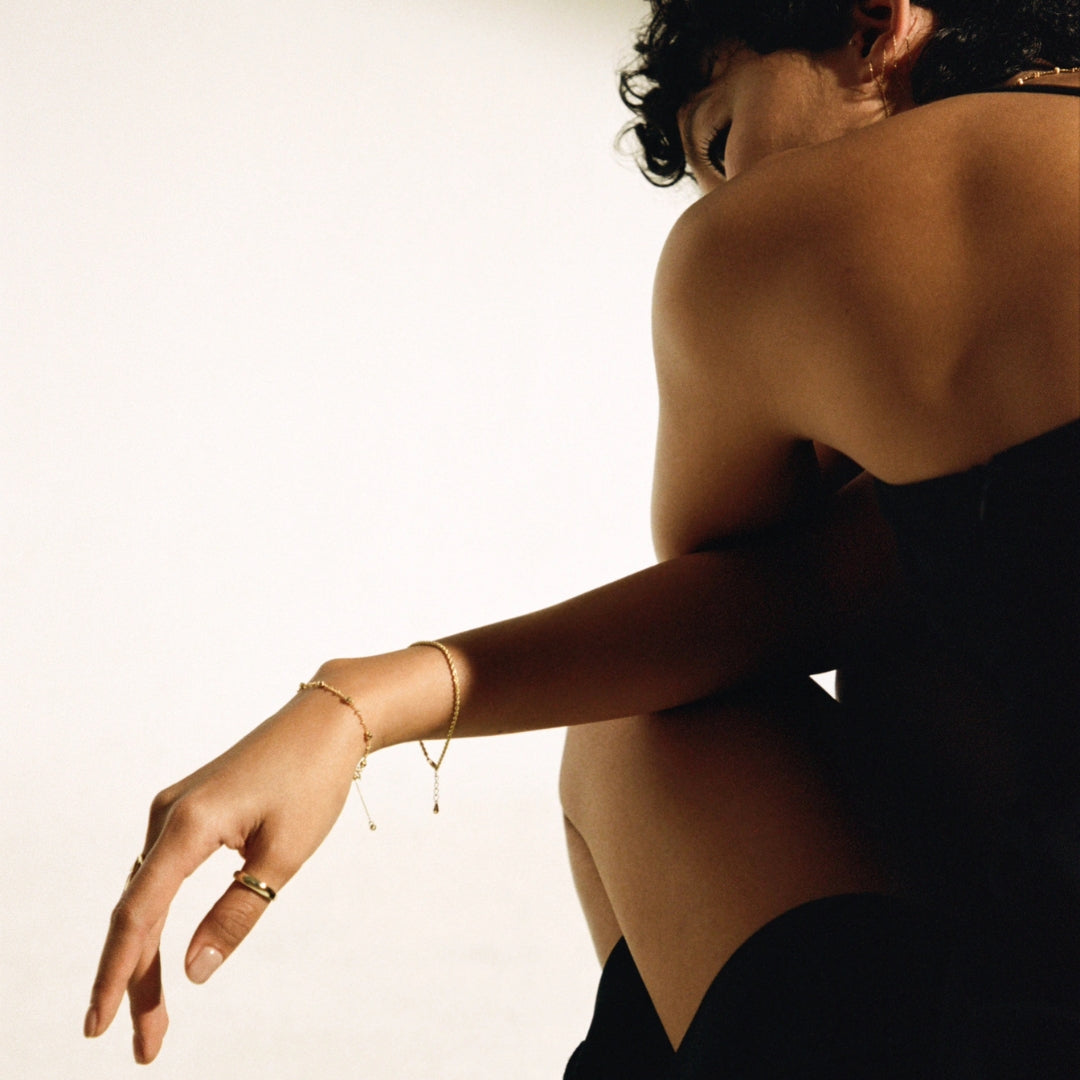
Summit Ring | Stacked Crown Design | Dual-Tone Silver | ÉLARAMUSE
Description
Description
Design Symbolism
Design Symbolism
More Details
More Details
Summit Ring — Gold & Silver Crown Ring, Stacked Dual-Tone Band with Layered Crown Architecture, Two-Tone Sterling Silver Crown Design Ring, Rhodium & 18K Gold Plated S925, Hypoallergenic Everyday Statement Crown Jewelry
Quick answer: This is a crown ring — but not a ring with a literal crown shape (no pointed princess tiara profiles, no heart-shaped clusters of cubic zirconia). The "crown" here is architectural: the ring is composed of multiple thin horizontal bands (approximately 3-4 bands, each approximately 1.5-2.5mm wide) vertically stacked along the finger axis — like the tiers of a royal crown, each layer representing a different rank or estate, rising from the base of the finger toward the knuckle. The dual-tone composition alternates between rhodium-plated silver bands (cool white, the "silver" of the morning sky at the summit of a mountain) and 18K gold plated bands (warm yellow, the "gold" of the last sunlight hitting the peak at dusk). The bands are fused at their contact points (precision laser-welded, not soldered — the laser creates a molecular bond between the S925 sterling silver cores of adjacent bands without introducing a third metal like solder, which would create visible seam lines at the junctions), so the ring reads as one solid piece with two-tone stripes rather than separate rings stacked together. The profile is low (approximately 2-3mm total height from finger surface to the top edge of the highest band — a "low crown" profile that sits flush against the finger without catching on sleeves or pockets), and the edges are smooth and rounded (no sharp ridges between bands — each band transitions into the next with a soft, continuous curve). The ring is solid S925 sterling silver (92.5% pure silver core throughout) with alternating rhodium (bright white, approximately 0.3-0.5 microns on the "silver" bands) and 18K gold (warm yellow, 0.5+ microns on the "gold" bands) plating. Hypoallergenic, nickel-free. This is the crown ring that does not need a diamond — the crown is the design itself, the layered architecture of gold and silver bands rising from your finger like the tiers of a mountain summit, each layer marking elevation, each tone catching a different light. The two-tone crown ring for the woman who understands that a crown is not a shape — it is a structure, a stacking of authority, a vertical ascent from base to peak. It does not sit on your head. It fits on your finger. And it goes with everything.
Why This Crown Ring — The Crown as Stacked Architecture (How Vertical Band Layering Creates the Crown Form Without a Literal Crown Shape), Dual-Tone Silver & Gold as the Summit of Contrast (Why Rhodium and Gold on Sterling Silver Create the Visual Drama of a Mountain Peak at Dawn and Dusk), and Why This Two-Tone Ring Stacks With Everything You Own Because It Already Contains Everything — Gold and Silver in One Ring
1. The Crown as Stacked Architecture — How the Vertical Layering of Multiple Thin Bands (Rising From Base to Peak) Creates a Crown Ring That Is a Crown in Form, Not a Crown in Shape
Almost every crown ring on the market is literal: a pointed princess tiara silhouette (a cluster of stones arranged in a V or W at the top of the ring), a heart-shaped cluster of cubic zirconia, or a band engraved with a tiny crown symbol. These crown rings read as costume jewelry — the crown is an image, a symbol, a thing you point to and say "see, it's a crown." The ÉLARAMUSE Summit Ring takes the opposite approach: the crown is not an image on the ring — the crown is the ring. The vertical stacking of multiple thin horizontal bands (approximately 3-4 bands, each approximately 1.5-2.5mm wide, fused at molecular level through laser welding) creates the structural architecture of a crown: tiers rising from a base (the lowest band, closest to the finger base) toward a peak (the highest band, closest to the knuckle). This is the exact structural logic of the British Imperial State Crown (the crown worn by the monarch at the State Opening of Parliament): a base ring (the "circlet") supporting vertical arches that rise to a central peak (the "monde" and cross) — tiered, layered, a vertical ascent from earth to heavens, condensed into the approximately 2-3mm height of a single ring. The difference between the ÉLARAMUSE crown ring and a literal princess tiara ring is the difference between an opera and a photograph of an opera singer: one is the thing itself, the other is a picture of the thing. The stacked bands do not need to be pointed (tiara-style) because they already perform the structural function of a crown — tiering authority, layering weight, rising from base to summit. You do not see a crown on this ring any more than you see "a mountain" on a topographical map — but the structure is the same, the logic is the same, the vertical stacking of horizontal lines is the same. This is the crown ring for someone who understands that architecture communicates more than ornament — and that a crown, stripped of its jewels, is simply a stack of bands, rising.
2. Dual-Tone — Why the Alternation of Rhodium (White Silver) and 18K Gold (Warm Yellow) on a Single Ring Creates the Visual Contrast of a Mountain Summit at Two Different Times of Day, and Why a Two-Tone Crown Ring Is the Only Ring That Matches Every Metal You Own
The dual-tone composition — rhodium-plated silver bands alternating with 18K gold plated bands — creates a visual effect that a two-tone engagement ring (where the band is one metal and the setting is another) never achieves: rhythmic alternation. The eye travels up the finger and encounters: white band → gold band → white band → gold band — a sequence, a pulse, a visual heartbeat of contrasting tones that draws the eye along the vertical axis of the ring (from the base of the finger toward the knuckle). A two-tone engagement ring with a gold band and a white setting divides the ring into two zones (band = one tone, setting = another tone) — it is a binary contrast, an A-B split. The Summit Ring's alternating two-tone bands create an A-B-A-B sequence — a rhythm, not a split. The rhodium bands (approximately 0.3-0.5 microns of rhodium plating — rhodium is the most reflective metal in the platinum family, with a mirror-like white finish that reads as approximately 30% brighter than polished silver) catch cool light (north-facing light, morning light, fluorescent office light — the "cloud light" of the mountain summit at dawn). The gold bands (0.5+ microns of 18K gold plating, warm yellow, approximately 0.47 refractive index — producing the diffuse, buttery glow of "old gold" rather than the high-contrast bright yellow of mass-market gold plating) catch warm light (south-facing light, afternoon sun, candlelight — the "fire light" of the mountain summit at sunset). The two tones never compete because they reflect different wavelengths of light at different times of day — in morning light, the rhodium bands dominate (cool white against the gray morning sky); in evening light, the gold bands dominate (warm yellow against the amber sunset); at midday, the two tones oscillate in a balanced rhythm. The practical advantage of a two-tone ring is this: you no longer have to choose between silver and gold jewelry. The crown ring contains both — it matches your silver bracelets and your gold necklaces, your white gold engagement ring and your gold stacking bands, the silver watch your father gave you and the gold earrings you bought yourself. The Summit Ring is the metal matchmaker — it bridges every tone on your hand, creating visual harmony between pieces that previously felt like they belonged to different outfits. One ring. Two tones. Every other piece of jewelry you own, suddenly in harmony.
3. The Summit as Metaphor — How a Crown Ring Named After the Highest Point on Earth Functions as a Personal Talisman of Arrival, Achievement, and the View From the Top
The word "summit" comes from the Latin "summus" — "highest" — the same root as "supreme" and "consummate." In mountaineering, the summit is the goal (the highest point, the reason for the climb, the moment when effort becomes achievement), but it is also the transition (once you reach the summit, you must descend — the summit is never a destination, only a midpoint). In diplomacy, a summit meeting is the highest-level gathering — heads of state, not ministers; decisions, not discussions; the moment when everything below the summit is resolved and only the essential remains. A crown sits at the summit — of the head, of the body, of the social structure, of the hierarchy itself (the monarch is the summit of the state). The Summit Ring — a stacked crown ring with two-tone bands rising from base to peak — is a talisman of arrival: you have reached your own summit, whatever it is (the degree, the promotion, the decision, the survival, the year you weren't sure you'd complete). The lowest band (at the base of the finger) is where you started; the highest band (closest to the knuckle) is where you are now. The alternating gold and silver bands between them are the seasons, the phases, the chapters — some bright (rhodium, cold mornings of effort), some warm (gold, sunset moments of reward). The ring does not tell you "you are at the top" — it tells you "you climbed here, band by band, year by year, and the view from here was worth every step." This is the crown ring that does not pretend you were born wearing a crown — it acknowledges that you built it yourself, band by band, layer by layer, through mornings of cold effort and evenings of warm reward. The Summit Ring is your own crown — not inherited, not bestowed, but earned. Wear it on your finger and look at it when you forget how far you have climbed.
Summit Ring: Full Specifications & Crown Stack Architecture
| Design | Stacked crown ring — approximately 3-4 thin horizontal bands (each approximately 1.5-2.5mm wide) vertically stacked along the finger axis. Alternating rhodium-plated silver (bright white) and 18K gold plated (warm yellow) in A-B-A-B rhythmic sequence. Fused at contact junctions via precision laser welding (molecular bond between S925 sterling silver cores — no solder, no visible seams). Total profile: approximately 2-3mm from finger surface to top band edge — "low crown" profile that is tiered and layered without pointed princess tiara silhouette. Band transitions are smooth, rounded curves (not sharp ridges). Interior: comfort-fit profile (slightly domed inner surface for reduced contact pressure). Visual language: a crown stripped of jewels, reduced to pure architectural tiers. |
| Material | Solid S925 sterling silver core (92.5% pure silver + 7.5% copper alloy) for the entire ring body — all bands cast as a single piece via lost-wax casting. White bands: rhodium plating (approximately 0.3-0.5 microns — a platinum-group metal, approximately 30% brighter than polished silver, highly tarnish-resistant, approximately Mohs 6.0). Yellow bands: 18K gold plating (75% pure gold, 0.5+ microns). Rhodium bands slightly narrower (approximately 1.5mm), gold bands slightly wider (approximately 2.0-2.5mm) — gold is the warm anchor, rhodium is the cool accent. Nickel-free, lead-free, cadmium-free, hypoallergenic. |
| Weight & Feel | Total weight approximately 2-3 grams — lightweight crown ring with the presence of a statement piece and the comfort of a simple band. Approximately 2-3mm total profile height is practical for daily wear: fits under gloves and does not snag on pockets or sleeves. Sensory profile: alternating two-tone bands create subtle tactile rhythm — the smoother rhodium and slightly warmer gold are detectably different to the fingertip. Comfort-fit interior allows approximately 1-2mm of daily rotation (normal and desirable — distributes wear evenly). This slow rotation shifts the band orientation, so the crown is never static, always catching light from slightly different angles. |
| The Two-Tone Advantage | A two-tone ring is the most versatile jewelry piece you can own — containing both warm (gold) and cool (rhodium) spectrums, it matches every metal on your hand. Silver watch: rhodium bands connect. Gold earrings: gold bands connect. Both: the two-tone crown ring bridges them — the rhodium side speaks to the bracelet, the gold side to the necklace, the ring becomes the mediator. One ring resolves the metal conflict on your hand forever — no more choosing between gold day and silver day. |
How to Wear a Two-Tone Crown Ring — The Summit Solo, the Crown Stack, and the Ring as a Talisman of Arrival
👑 The Summit Solo / Worn Alone on the Index Finger as an Architectural Statement — The Summit Ring's stacked crown architecture creates enough visual presence to anchor a hand alone. Optimal placement: index finger of the dominant hand — the "authority finger" that points and gestures. A crown ring on the index finger is visible in every gesture, punctuating your words with alternating gold and silver light. The middle finger is the alternative for smaller hands. The solo crown ring works with: blazer and trousers (two-tone bands harmonize with both gold buttons and silver zippers), a black dress (gold bands glow against black in evening light), and a white button-down (rhodium bands amplify crisp sharpness).
⚜️ The Crown Stack / Layering Simple Bands Below the Summit Ring to Create a Full-Hand Topography of Ascent — The Summit Ring anchors a ring stack as the "peak" (closest to the knuckle), with simpler bands worn below. Stack with: a thin gold band (approximately 1.0-1.5mm, echoing the gold bands), a thin silver band (echoing rhodium), and a textured base band (hammered gold or ridged silver) at the finger base as the "foundation." The result: rings ascending from foundation through alternating layers to the Summit at the peak — the entire finger becomes a mountain, and your jewelry is the topography. Avoid stacking with: ornate rings next to the crown (visual competition), wide bands (create squeezed effect), and rings on adjacent fingers (cluster problem).
🏔 The Summit Gift / For the Woman Who Has Climbed Her Own Mountain and Deserves a Crown That Does Not Announce "Princess" but Whispers "I Know How Far You Came" — The Summit Ring is the crown that does not look like a crown — it looks like an architectural two-tone ring with stacked bands. A literal crown (tiara shape) announces "I am a princess" — fine for a six-year-old, reads as costume on an adult. The Summit Ring announces nothing. Gift for: a graduation (stacked bands = semesters, years, all-nighters — the ring is her diploma in gold and rhodium), a career milestone (director, launched company, left the diminishing job — "you are the summit now"), or a personal victory (survived the diagnosis, the divorce, the grief — alternating bands = seasons of hardship and recovery, top band = now). She has earned her crown. The ring knows, and so does she.
Caring for Your Two-Tone Crown Ring — Dual-Plating Preservation, Rhodium vs Gold Wear Rates, and Protecting the Laser-Welded Band Junctions
✓ Dual-plating care (most important): The Summit Ring has two plating types — rhodium (approximately 0.3-0.5 microns, approximately Mohs 6.0 — about 3× harder than gold) and 18K gold (0.5+ microns, approximately Mohs 2.5-3.0). This means the gold bands will show wear (thinning at the highest points of the outer circumference) approximately 2-3× faster than the rhodium bands — this is normal physics, not a defect. Over time, as the gold plating wears microscopically, the underlying S925 sterling silver begins to show through, transitioning the color from bright 18K yellow to a softer, warmer champagne tone — the "patina of wear" that is part of the ring's narrative: gold light of dusk is temporary, rhodium light of dawn remains sharp. Remove before: chlorine (pools, hot tubs — chlorine accelerates both rhodium and gold plating degradation), saltwater (abrasive crystal residue erodes plating), and heavy friction (gym, rock climbing — the outer circumference is the highest friction point). Clean every 3-4 weeks: warm water + a drop of mild soap, a soft microfiber cloth, gently buff along the band direction (parallel to the horizontal bands, not perpendicular — perpendicular buffing crosses the two-tone boundary and can blur the visual distinction between rhodium and gold over time). ✓ Laser-welded junction care: The band junctions are fused at the molecular level — the S925 silver cores of adjacent bands are melted together by laser, creating a continuous metal structure without solder. These junctions are stronger than the surrounding metal (laser welding creates a grain refinement zone that is approximately 10-20% harder than the base metal). However, avoid: extreme lateral force (twisting the ring — pulling one band sideways while holding another band will concentrate stress at the junction, and while the junction itself will not break, the silver immediately adjacent to the junction could deform), and ultrasonic cleaners (the high-frequency vibration can create micro-resonance at the junction, which over repeated cleanings could initiate fatigue cracking at the grain boundaries — unlikely in the lifetime of the ring, but avoidable by simply not using ultrasonic). ✓ Re-plating: Both the rhodium and gold plating can be refreshed by a professional jeweler — the process involves removing the old plating (chemical stripping, approximately 15-30 minutes), masking the bands not being plated, and applying fresh plating to the specified bands. Rhodium plating on a single ring typically costs $20-$40 at a local jeweler; gold plating typically costs $30-$60. Re-plating restores the original two-tone contrast — the ring looks brand new. Most people re-plate every 2-4 years depending on daily wear intensity. Contact us if you prefer to have the ring re-plated through ÉLARAMUSE — we will arrange it.
Summit Crown Ring FAQ — Two-Tone Rhodium & Gold Architecture, Crown Design Without Literal Crown Shape, Stacked Band Construction & Laser Welding, Dual-Plating Wear & Re-Plating, and Styling the Only Ring That Matches Everything
-
Is this a crown ring — it doesn't look like a traditional crown shape (no pointed tiara profile)?
Yes — it is a crown ring in architectural form rather than literal shape. The stacked horizontal bands (approximately 3-4, rising from base to peak along the finger) follow the exact structural logic of a crown: tiers ascending from a base toward a summit. This is the same structural principle as the British Imperial State Crown (circlet supporting vertical arches rising to a central peak), condensed into approximately 2-3mm of finger height. A literal crown ring (pointed tiara profile, heart-shaped clusters) reads as an image of a crown — the Summit Ring is the structure of a crown, stripped of ornament. If you want to see a crown, look at a picture. If you want to wear the architectural logic of a crown — tiering, layering, vertical ascent — wear this ring.
-
Will the gold and rhodium plating wear at different rates — will the ring look uneven over time?
Yes — the gold bands (approximately Mohs 2.5-3.0) will show wear approximately 2-3× faster than the rhodium bands (approximately Mohs 6.0). This is the physical reality of wearing a harder and softer metal on the same piece. Over 1-2 years, the gold bands will gradually warm from bright 18K yellow to a softer champagne tone (as the gold plating microscopically wears and the underlying S925 sterling silver begins to show through), while the rhodium bands remain bright white and mirror-like. This is not a defect — it is the narrative: the gold is the dusk light, temporary and warming; the rhodium is the dawn light, permanent and sharp. If the contrast ever becomes too soft for your preference, both platings can be refreshed at a jeweler (re-plating costs approximately $20-$60 total). Most people re-plate every 2-4 years depending on wear intensity.
-
Are the bands separate rings stacked together — or is this one solid ring?
The bands are fused at their contact junctions using precision laser welding — the S925 sterling silver cores of adjacent bands are melted together at the molecular level, creating a continuous metal structure without solder. The ring is one solid piece, not separate rings stacked on the finger. The laser-welded junctions are approximately 10-20% harder than the surrounding metal (laser welding creates a grain refinement zone), so the junctions are the strongest part of the ring. You cannot separate the bands without cutting the ring — they are fused permanently. The two-tone effect is created by plating the fused bands in two different finishes (rhodium and gold) after welding and polishing — the bands were always one piece; they just wear two different colors.
-
Does a two-tone ring actually match both gold and silver jewelry — or is that just marketing?
It matches — and the reason is perceptual, not marketing. The human eye scans for color continuity: when you look at your hand, your brain searches for bands of warm color (gold) and bands of cool color (silver/rhodium). When the Summit Ring sits between a silver bracelet and gold earrings, the eye registers rhodium↔silver continuity (the cool tones connect) and gold↔gold continuity (the warm tones connect) simultaneously — the ring becomes the visual mediator. The alternating A-B-A-B band pattern (approximately 3-4 bands) means there are multiple warm and cool "handles" for the eye to latch onto. A two-tone ring where the band is one metal and the setting is another (A-B split) provides only one point of gold connection and one of silver — the alternating pattern provides multiple. More connection points = stronger visual harmony.
-
Which finger should I wear a crown ring on — and is it appropriate for everyday wear or only special occasions?
The Summit Ring is designed for daily wear — approximately 2-3mm total profile height, comfort-fit interior, smooth rounded edges (no snagging), lightweight (2-3g). Best finger: index finger of the dominant hand — the "authority finger" that points and gestures, making the stacked bands visible in every hand movement. Alternative: middle finger for smaller hands. Avoid the ring finger if you already wear an engagement ring there — the two-tone crown deserves its own visual territory. For daily wear: remove before heavy friction (gym, rock climbing — the outer circumference of the gold bands is the highest friction point), before swimming (chlorine and saltwater degrade both platings), and before applying lotion directly to the ring (oils dull the rhodium's mirror finish). Otherwise — wear it every day. It matches everything you own. There is no reason to take it off.
We Believe
We believe that a crown is not a shape — it is a structure. The stacked, tiered architecture of a crown (base → ascent → summit) is what makes a crown a crown, not the pointed princess tiara profile that costume jewelry has trained us to recognize. We made the Summit Ring to be a crown in form: multiple thin horizontal bands rising from the base of the finger to the knuckle, each band a tier of authority, each tier a different metal (gold for warmth, rhodium for clarity) — the vertical stacking that defines every royal crown in history, compressed into approximately 2-3mm. We chose two-tone because a crown should not require you to choose — a crown is the summit of all metals, not the champion of one — and because we want this ring to resolve the metal conflict on your hand forever: gold and silver, together in one ring, matching everything you own without trying. We named it Summit — from the Latin "summus," highest — because this is the ring for the woman who has climbed her own mountain: the degree, the promotion, the survival, the year she wasn't sure she'd complete. The bands are the seasons, the phases, the chapters — some cold and bright (rhodium, the mornings of effort), some warm and golden (gold, the sunsets of reward). The ring does not pretend you were born wearing a crown. It acknowledges that you built it yourself, band by band, layer by layer. Put it on your index finger. You are the summit now. The view from here is yours.
Explore More Crown & Two-Tone Architectural Rings
If the Summit Ring's stacked crown architecture and two-tone harmony speak to you, explore the Oasis Ring (another architectural band — textured gold with a flush-set lab diamond, the summit of minimalism), the Lyra Ring (a gold harp-shaped band — another piece where architecture and music converge in ring form), and the full ÉLARAMUSE rings collection (to find your next peak). The summit is never the last mountain — it is always the base camp for the next.
Share this product
Worldwide Shipping
Secure global delivery to your doorstep within 5–14 business days.
Customer service
Real humans ready to help, 24/7.
Flexible Cancellation
Changed your mind? We offer a full refund for any order that has not yet been dispatched.
100% Secure Checkout
Encrypted payment for your peace of mind.