How to Style a Statement Ring: The 2026 Guide to Wearing Bold Rings with Confidence
ELARAMUSE Difference: Unlike mass-produced jewelry that prioritizes price over quality, our pieces are crafted with premium materials and rigorous testing -- because what you wear every day should stand the test of time.
📑 In This Guide
- How to Style a Statement Ring: The 2026 Guide to Wearing Bold Rings with Confidence
- Statement Ring Types: Cocktail vs. Dome vs. Cluster vs. Sculptural
- Shop Statement Rings
- References & Further Reading
- From Our Studio
- What We Believe
- Behind the Design
- Key Terms
References
- GIA. "Gemological Institute of America." GIA.
- Met Museum. "Jewelry Through the Ages." Heilbrunn Timeline of Art History.
- V&A. "Jewelry Collection." V&A Collections.
A statement ring isn't just jewelry — it's a conversation starter, a mood-setter, and the quickest way to turn a simple outfit into a look. But the line between "intentionally bold" and "trying too hard" is razor-thin. Here's how to nail it every time.
When you're drawn to sculptural gold bands, cluster-set pavé, or gemstone cocktail rings, the principles of styling a statement ring are universal. At ÉLARAMUSE, we design rings that feel substantial without feeling costume-y — pieces that earn their place on your hand.
The best statement rings transition seamlessly from office-appropriate polish to date night drama. At ÉLARAMUSE, our rings are designed for everyday wear — crafted with Premium 18K Gold Plating over sterling silver, so they stay brilliant through workdays, weekends, and travel-friendly adventures.
The Golden Rule: One Statement Ring Per Hand
The most common mistake? Wearing too many bold rings at once. A statement ring needs breathing room. When it has to compete with neighboring rings for attention, nobody wins.
The formula: One statement ring on your dominant hand (or whichever hand you gesture with most). A simple, thin band on the other hand if you want balance. That's it. Let your statement piece own the spotlight.
Which Finger Should a Statement Ring Go On?
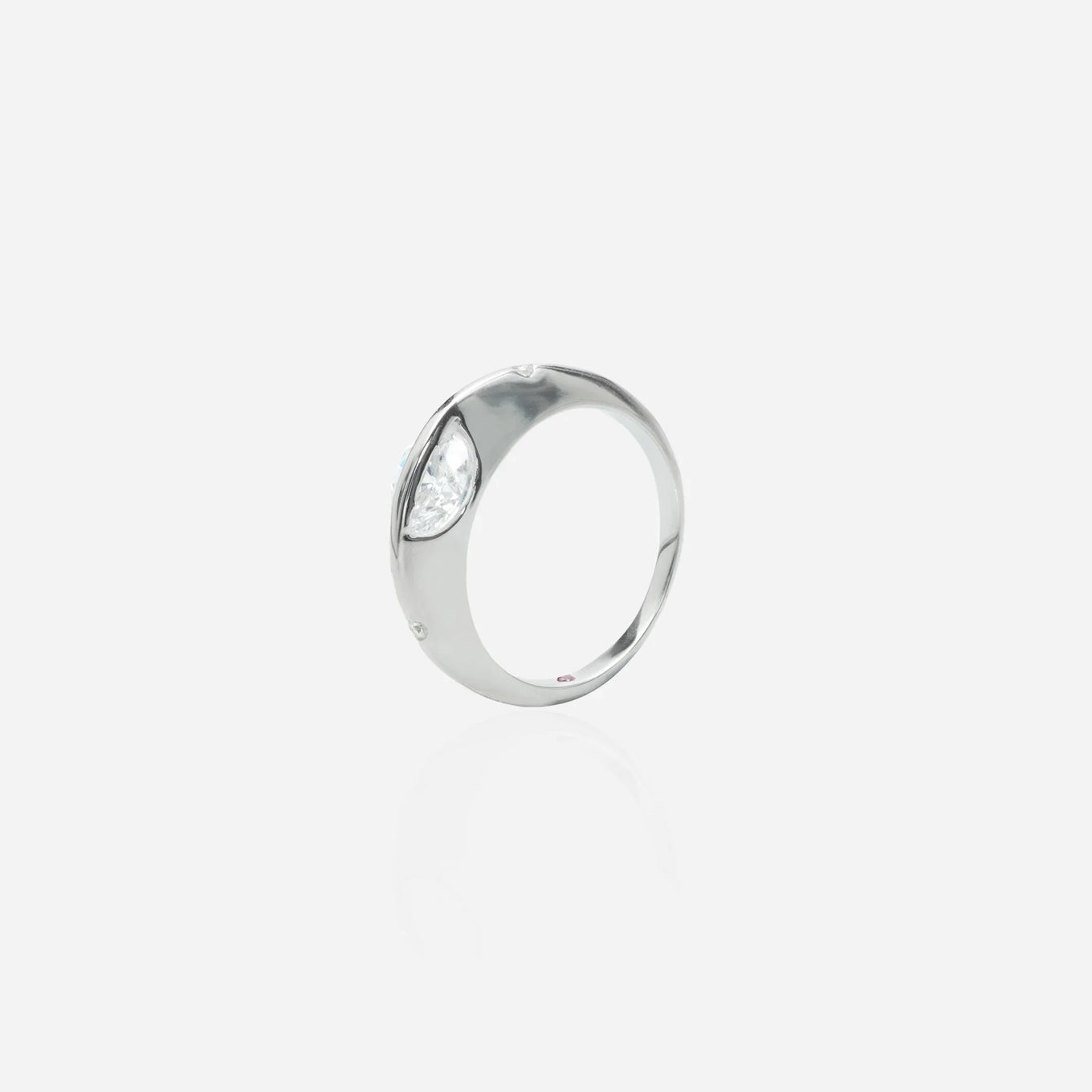
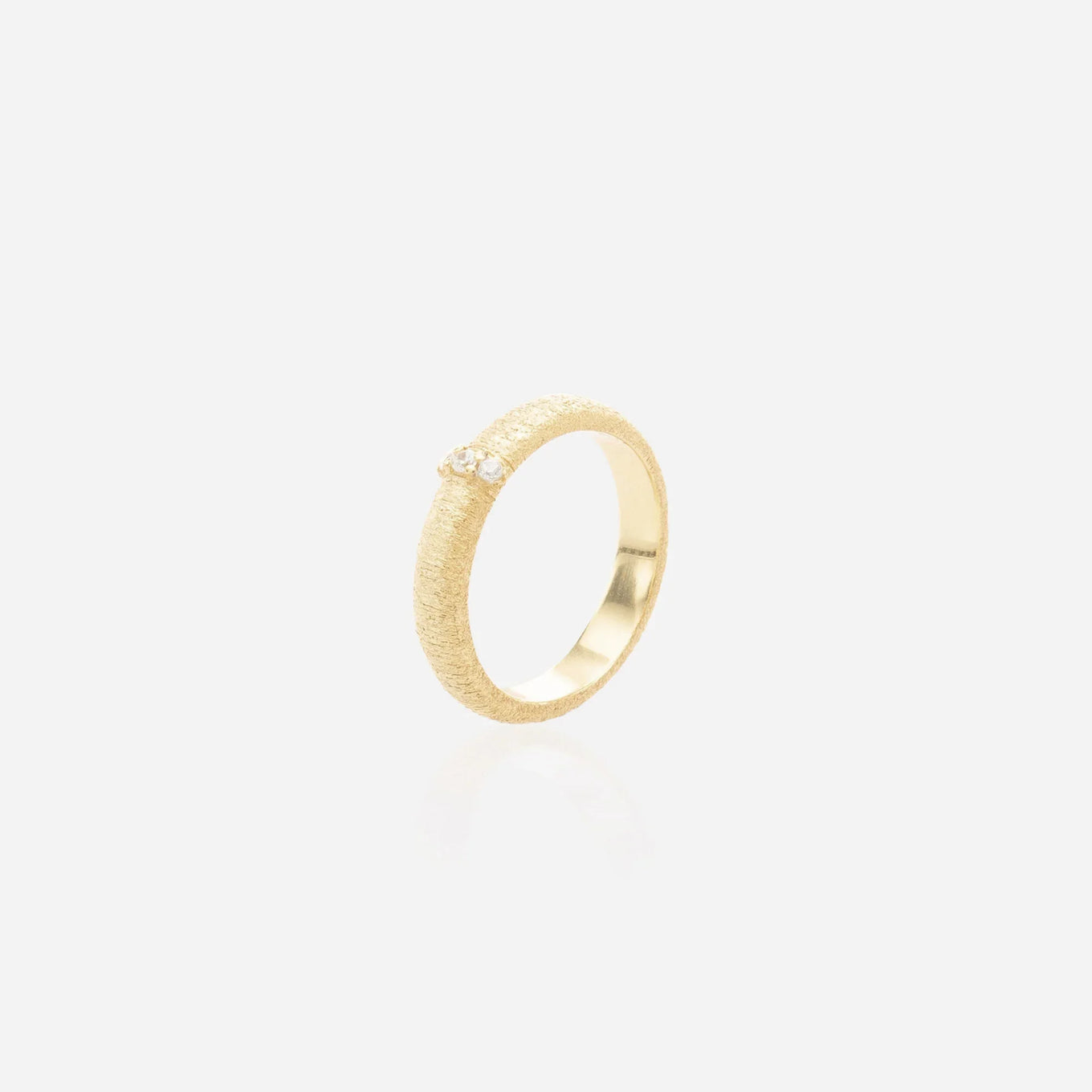
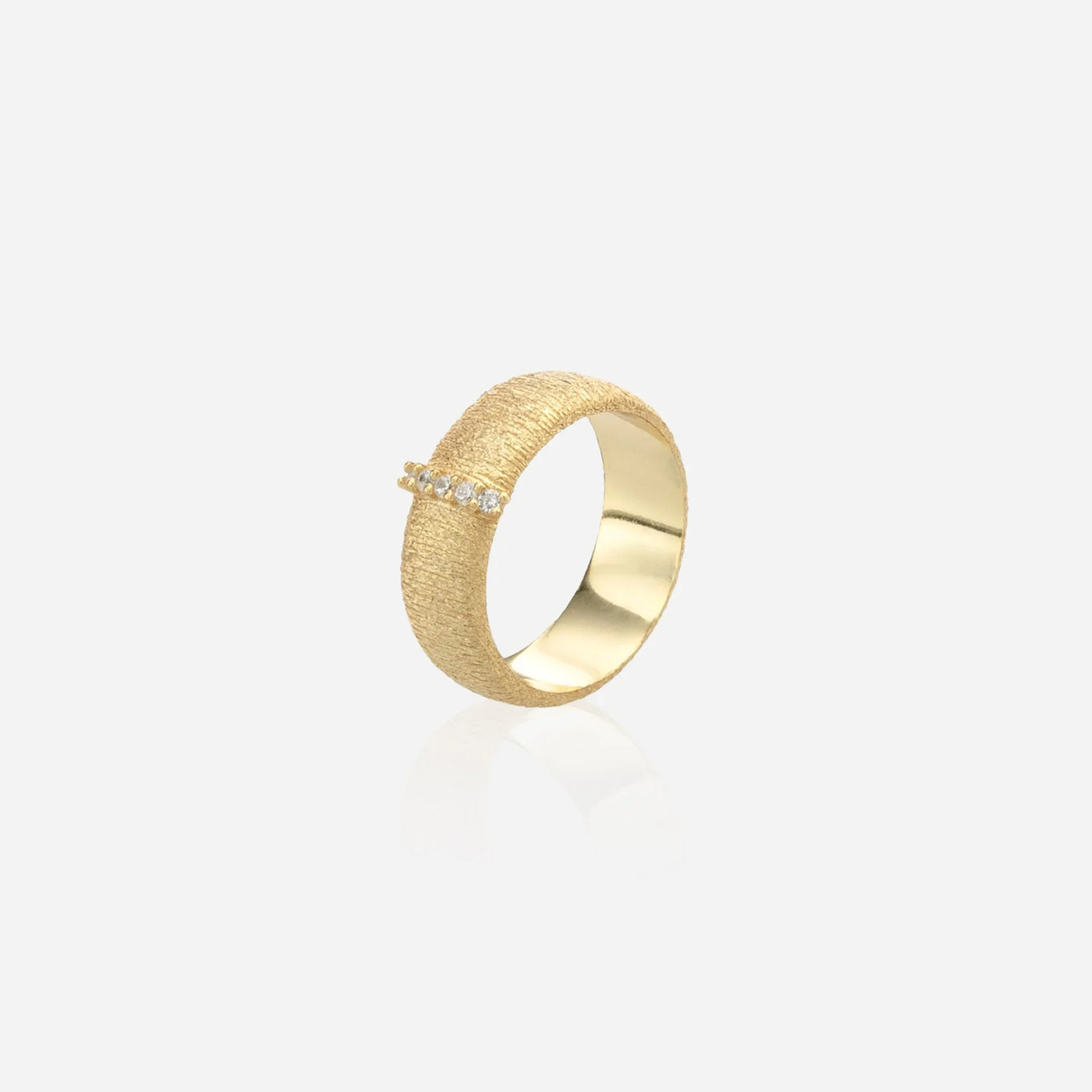
Index finger: The power move. An index finger ring signals confidence and authority. It's the most visible finger when you gesture, so your statement ring gets maximum airtime. Best for: sculptural, architectural designs like our Dunecrest Ring — its wavy gold silhouette catches light from every angle.
Middle finger: The balanced choice. Centered on the hand, a middle finger ring feels intentional without being aggressive. Best for: larger gemstone rings or cluster-set designs like the Bouquet Ring with its flower cluster pavé.
Ring finger: Classic territory. If you're not wearing a wedding band here, a statement ring on the ring finger reads as elegant and traditional. Best for: solitaire gemstone rings — the Carmen Ruby Ring with its lab-created ruby solitaire is a showstopper. If you are married, go right-hand ring instead.
Pinky finger: The signet approach. A pinky ring carries an air of old-money sophistication. Best for: smaller but distinctive designs, signet-style rings, or a delicate pavé band.
Thumb: The rebel move. Bold, bohemian, and undeniably cool. Best for: open-band or cuff-style rings like the Drusy Pebble Cuff Ring. Thumb rings work especially well with sleeveless tops and bare arms.
Unlike a delicate dainty ring that disappears on the hand, a statement ring creates presence. Unlike a flashy costume piece, a well-crafted gold ring becomes a talisman you reach for daily.
The V&A's ring collection shows how statement rings have served as personal talismans across centuries, while The Met Museum underscores their enduring appeal.
Outfit Pairing: Let the Ring Lead
Monochrome outfits are a statement ring's best friend. A black, white, cream, or navy base creates a blank canvas. Your ring pops. This works across casual and formal settings — a cream turtleneck with the Dunecrest Ring is just as effective as a black evening gown with the Carmen Ruby.
When wearing prints, match the ring's energy to the pattern's scale. Small floral prints pair better with delicate statement rings. Bold geometric prints can handle larger, sculptural rings. Never let a busy pattern and a massive ring compete — one will always lose.
Sleeve strategy: Three-quarter sleeves are the ideal ring-showcase length. Full-length sleeves can obscure a ring entirely. If wearing long sleeves, push them up slightly around the wrist — it creates a deliberate bracelet-stacking effect while showing off your ring.
Stacking with Other Rings
If you must stack, follow these rules:
We believe a ring should do more than sit on your finger—it should start conversations. "Your hands speak before your words do—let them say something worth remembering," as our founder Joyce reminds us. Every stone, every setting, every band we forge is built for hands that type, gesture, and live fully. When a ring can weather your entire day without a second thought—shower-safe, sleep-safe, life-proof—you wear confidence.
- One statement ring + two thin bands maximum on the same hand
- Keep all rings on the same finger family — gold with gold, silver with silver
- Leave at least one finger bare on the statement ring hand
- The statement ring should be visually heavier than any ring it's stacked with
Stacking works best on the middle or ring finger, where there's enough finger real estate for multiple rings without crowding.
Nail Polish: The Overlooked Accessory
Your nails frame your rings. A statement ring with chipped neon polish looks sloppy. A statement ring with clean, neutral nails looks expensive. The easiest wins:
- Nude/beige nails → lets any ring style shine
- Classic red → pairs beautifully with gold rings
- Deep burgundy or navy → dramatic contrast with silver or white gold
- Clean, natural nails → always appropriate, always chic
Hand Gestures Matter
If you wear your statement ring on the hand you use to talk (for most people, the dominant hand), it naturally draws eyes during conversation. This is a feature, not a bug — lean into it. A statement ring on your gesturing hand amplifies every point you make.
Occasion Guide
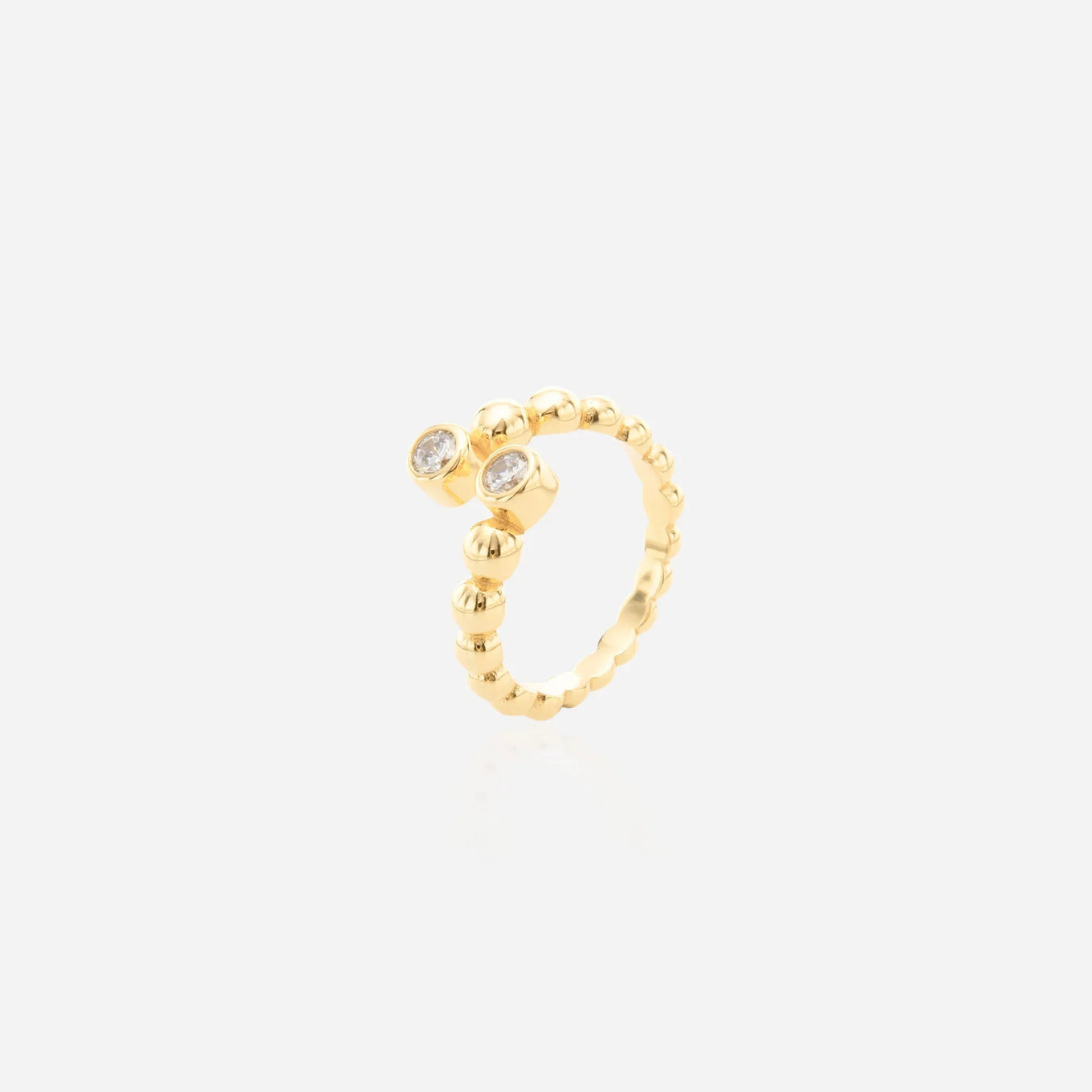
Work meetings: Choose architectural gold designs over glittering pavé. The Bypass Ring — with its Toi et Moi lab diamond crossover — adds polish without flash.
Date night: Now's the time for sparkle. A pavé cluster ring or a gemstone solitaire. Let your ring catch the candlelight.
Wedding guest: Statement ring, yes — but never one that upstages the bride's rings. Stick to sculptural metal designs or muted gemstones. Avoid white diamonds on the left ring finger (too bridal).
Everyday casual: The Dunecrest Ring or Drusy Pebble Cuff Ring work with jeans and a t-shirt. That's the magic of a well-designed statement ring — it refines without trying.
Material & Quality: What Makes a Ring "Premium"
A statement ring draws attention. That means people will look closely. Premium 18K Gold Plating over 925 sterling silver ensures your ring has the weight, luster, and longevity that costume jewelry can't match. Each ring: Solid Ag925 Sterling Silver base, 0.5-micron 18K gold plating, tarnish-resistant finish Our rings are nickel-free, hypoallergenic, and plated with a thick 18K gold layer that resists tarnishing and fading.
When evaluating a statement ring for quality, check: (1) the plating thickness — look for 0.5-micron plating or above over sterling silver — the proven demi-fine threshold for years of daily wear, (2) the base metal — sterling silver or surgical steel are the gold standards, (3) stone setting — prongs should be smooth, stones should sit flush.
Statement Ring Types: Cocktail vs. Dome vs. Cluster vs. Sculptural
Not all statement rings make their statement the same way. Match the mechanism to your mood:
| Type | Visual signature | Best occasion | Best finger | ELARAMUSE pick |
|---|---|---|---|---|
| Cocktail Ring | Oversized center gemstone, theatrical scale | Evening events, dinner parties, gallery openings | Index or middle finger | Carmen Ruby Ring |
| Dome Ring | Rounded, architectural metal surface | Day-to-night versatile, office to bar | Index finger | Dunecrest Ring |
| Cluster Ring | Multiple small stones arranged in a pattern | Luncheons, bridal showers, garden parties | Ring finger (right hand) | Bouquet Ring |
| Sculptural Bypass | Organic shapes, open shank, asymmetry | Creative workplaces, gallery visits, first dates | Middle or ring finger | Drusy Pebble Cuff Ring |
FAQ
Q: How big should a statement ring be?
A: "Statement" refers to visual impact, not just physical size. A sculptural gold band like the Dunecrest Ring makes a statement through design, not dimensions. Choose a ring that's proportional to your finger length — if the ring extends past your knuckle, it's too big.
Q: Can I wear a statement ring every day?
A: Yes, if it's well-made. A ring with Premium 18K Gold Plating over sterling silver can handle daily wear. Just remove it before swimming, showering, or applying lotion. Rotate between 2-3 rings to give plating time to "rest."
Q: Which hand should a single woman wear a statement ring on?
A: Either hand — there are no rules. Many women choose the right hand for statement rings to avoid the "engagement ring" assumption on the left ring finger. Your dominant hand (the one you gesture with) will give your ring more visibility.
Q: Is it okay to wear a statement ring with a watch?
A: Yes — on opposite wrists. A statement ring on your left hand pairs well with a watch on your right, and vice versa. Avoid wearing both on the same arm; it creates visual clutter.
Q: Do statement rings ever go out of style?
A: Cocktail rings and statement designs have been fashionable since the 1920s Art Deco era. What changes is the type of statement — currently, sculptural gold and architectural designs are dominant. Invest in a design you love, not a trend you're chasing.
Q: Can I wear a statement ring if I have short fingers?
A: Absolutely. Choose elongated designs (marquise-shaped stones, oval halos, vertical bar rings) that create visual length. Avoid wide bands that can make fingers appear shorter. Open-band or crossover designs like the Bypass Ring are especially flattering.
Q: What's the difference between a cocktail ring and a statement ring?
A: "Cocktail ring" traditionally refers to oversized gemstone rings worn for evening events — the term dates to Prohibition-era cocktail parties. "Statement ring" is a broader, more modern category that includes sculptural metal bands, cluster designs, and architectural pieces — any ring designed to be noticed, regardless of whether it has a center stone.
Shop Statement Rings
Four bold ways to make your point. Each built on Solid Ag925 Sterling Silver with 0.5-micron 18K Gold Plating — nickel-free, water-resistant, made to be noticed:
- Carmen Ruby Ring — Lab ruby centerpiece on a sculptural gold band. Cocktail-party energy, everyday construction.
- Dunecrest Ring — Architectural dome silhouette in 18K gold plate. The ring that catches light from across the room.
- Drusy Pebble Cuff Ring — Open-shank bypass design with drusy crystal texture and lab diamond accents.
- Bouquet Ring — Floral cluster of lab diamonds and pearls in rhodium-plated sterling silver.
Can I wear a statement ring every day?
Yes — if the ring is built for it. Solid Ag925 Sterling Silver with 0.5-micron 18K Gold Plating holds its finish through showering, hand-washing, and typing. For comfort weight, a statement ring under 8 grams won’t feel like a hand workout by 2PM. The Dunecrest Ring (6.2g) and Drusy Pebble Cuff Ring (5.8g) are both lightweight enough for all-day wear with statement-level presence.
Statement ring vs. cocktail ring — what’s the difference?
"Cocktail ring" traditionally refers to oversized gemstone rings worn for evening events — the term dates to Prohibition-era cocktail parties. "Statement ring" is a broader, more modern category that includes sculptural metal bands, cluster designs, and architectural pieces — any ring designed to be noticed. Every cocktail ring is a statement ring, but not every statement ring is a cocktail ring.
Does a statement ring have to be oversized?
No. "Statement" refers to presence, not scale. A 12mm dome in 18K gold plate (Dunecrest Ring) makes a visual statement through shape and light reflection, not diameter. The Drusy Pebble Cuff Ring makes its statement through organic asymmetry and drusy texture — modest in size but impossible to ignore because of the sparkle density and open-shank silhouette.
Editor's Picks: Statement Rings: Wear the Room
Dunecrest Ring | Wavy Gold Band | Lab Diamond | ÉLARAMUSE: Dunecrest Ring | Wavy Gold Band | Lab Diamond | ÉLARAMUSE — Freeform gold waves. Says *I know design* rather than *look at my ring.*
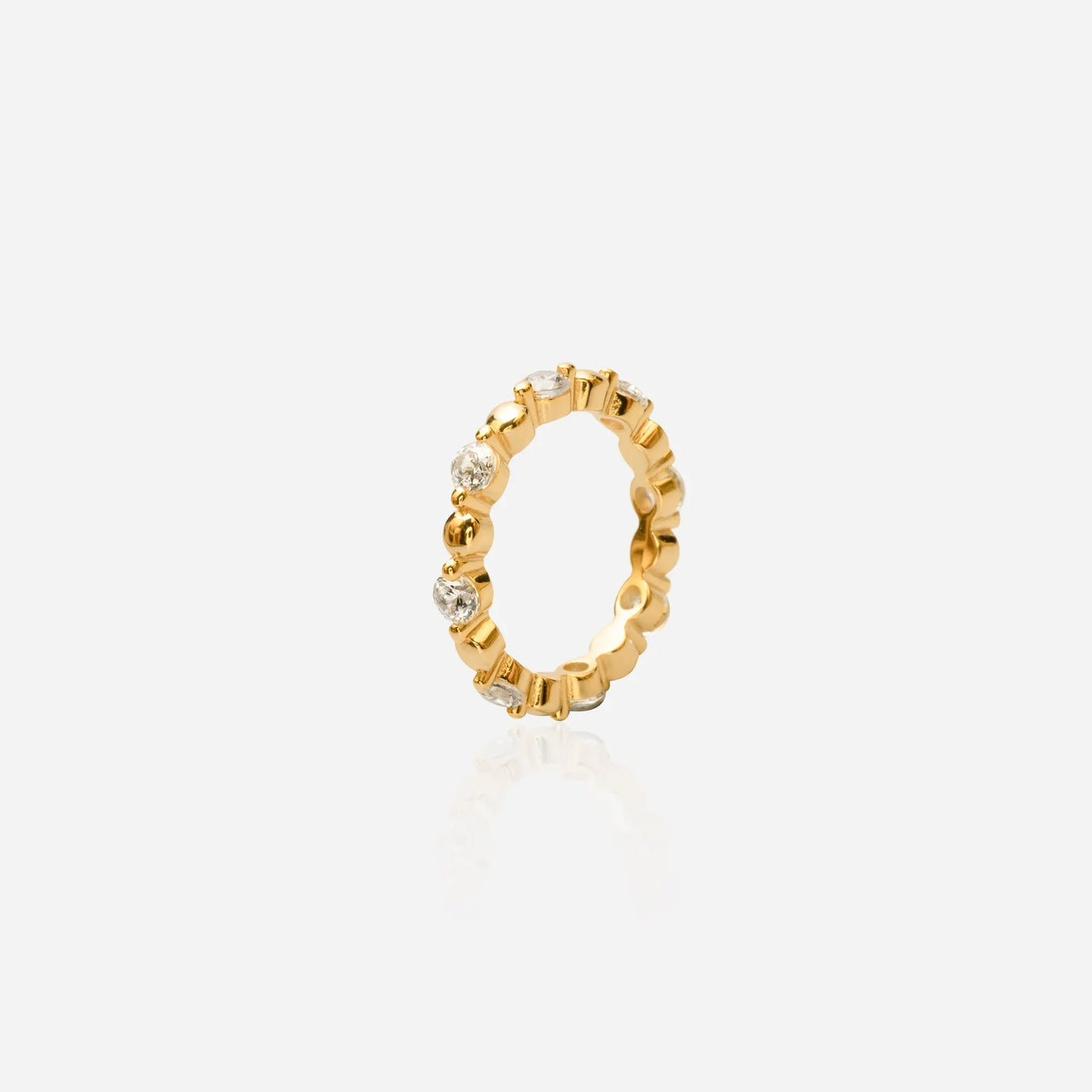
Bouquet Ring | Flower Cluster Pavé | 18K Gold Plated S925 | ÉLARAMUSE: Bouquet Ring | Flower Cluster Pavé | 18K Gold Plated S925 | ÉLARAMUSE — Flower cluster pave with dimensional petal work. Botanical art, not costume jewelry.
Drusy Pebble Cuff Ring | Gold Open Band | ÉLARAMUSE: Drusy Pebble Cuff Ring | Gold Open Band | ÉLARAMUSE — Raw drusy crystal in an open gold cuff. Organic texture that starts conversations.
References & Further Reading
Be your own muse.
From Our Studio
Every ÉLARAMUSE design begins with a question: what would make this piece something you never want to take off? Our studio tests every design for comfort, durability, and versatility — because jewelry should enhance your life, not complicate it.
Quick Answers
Q: Can I wear this in the shower?
A: Many pieces are water-resistant, but remove jewelry before showering, swimming, or applying products for maximum longevity.
What We Believe
We believe jewelry is not decoration - it is self-definition. Every piece we make must earn its place on your body: through material integrity (solid Ag925 cores, never hollow brass), through design intelligence (pieces that survive showers, sleep, and spontaneous decisions), and through a commitment to transparency that the jewelry industry has historically avoided. We do not chase trends. We build talismans for the captain of her own soul - pieces that feel like you, only more intentional.
Behind the Design
Every ÉLARAMUSE piece begins with a question: What makes jewelry worth wearing every day? Our design philosophy — Urban Naturalism — draws from organic textures and architectural precision, translating nature's asymmetry into wearable geometry. Each piece is crafted with a nickel-free Ag925 sterling silver core, finished in Premium 18K Gold Plating (0.5+ microns), and subjected to a 12-point quality inspection before it reaches you. We don't design for the drawer.
We design for the life you actually live.
Key Terms
- Statement ring: A bold, oversized ring designed to be the visual focal point of an outfit, typically worn on the index or middle finger.
- Cocktail ring: A subcategory of statement rings characterized by a large center stone, originally worn to Prohibition-era cocktail parties.
- Stacking: Wearing multiple rings on the same finger in a deliberate layered arrangement.
- Knuckle-to-knuckle: A ring that spans from the base to just below the first knuckle for dramatic coverage.