Written by: Joyce | Founder
📑 In This Guide
- In This Article
- Key Terms You Need to Know
- The Anatomy of a Great Wedding Ring Stack
- Wedding Ring Stack Ideas: 5 Formulas That Work
- Behind the Design: What 3 Years of Stacking Taught Me
- We Believe
- The ÉLARAMUSE Standard
- How to Build Your Stack: A Step-by-Step Guide
- Frequently Asked Questions
- Editor's Picks: Rings That Stack Beautifully
- Your Stack, Your Story
- References & Further Reading
References
- GIA. Gemological Institute of America.
- Met Museum. "Jewelry Through the Ages." Heilbrunn Timeline.
- V&A. "Jewelry Collection." V&A Collections.
Quick Answer: The secret to stacking wedding rings is a 2:1:1 ratio—two bands, one spacer, one anchor ring—arranged by width and finish for visual rhythm, not random piles. Your stack should tell your story through metal choice, texture, and personal meaning.
class="quick-answer"Wedding ring stacks are no longer just for anniversaries. In 2026, building a ring stack has become the default way women wear their wedding jewelry—a daily ritual of identity, not a special-occasion afterthought. The most compelling stacks aren't about quantity. They're about intention.
I learned this lesson the hard way. When I designed my first wedding ring stack three years ago, I assumed more rings meant more impact. I crammed five bands onto one finger. The result? A cluttered, top-heavy mess that caught on every sweater I owned and felt like wearing a small weapon. The metal grinding against metal produced an anxiety-inducing screech every time I gestured.
After two weeks, I stripped it down to three intentional pieces—and received more compliments in the next month than I had in the previous year. That experience taught me something no tutorial ever mentioned: the best ring stacks don't demand attention—they earn it through restraint.
In This Article
- Key Terms You Need to Know
- The Anatomy of a Great Wedding Ring Stack
- Wedding Ring Stack Ideas: 5 Formulas That Work
- Behind the Design: Why We Build for Stacking
- The ÉLARAMUSE Standard
- How to Build Your Stack: A Step-by-Step Guide
- Frequently Asked Questions
- Editor's Picks
Key Terms You Need to Know
Before you start building, let's define the language. These terms appear throughout this guide—and knowing them upfront will help you shop with precision.
| Term | Definition | Why It Matters |
|---|---|---|
| Ring Stack | A deliberate combination of 2-5 rings worn on a single finger, typically including a wedding band, engagement ring, and complementary stacking bands. | The foundation concept—every decision flows from how you define your stack's purpose. |
| Spacer Ring | A slim, often unadorned band placed between two larger rings to create visual breathing room and prevent metal-on-metal friction. | Without a spacer, rings grind against each other. A 0.8mm-1.2mm spacer can extend the life of both adjacent rings by years. |
| Mixed Metal Stack | A stack combining two or more metal tones—typically yellow gold, rose gold, and/or white gold/silver—in intentional proportion (usually 70/30 or 60/40). | According to the Victoria and Albert Museum's jewellery collection, multi-metal adornment dates back to ancient Etruscan craftsmanship, where gold and silver were deliberately paired for contrast—this isn't a trend, it's a 2,500-year-old technique (V&A Museum). |
| Stacking Band | A ring specifically designed to be worn alongside other rings—features include low-profile settings, rounded comfort-fit interiors, and symmetrical edges that won't snag adjacent bands. | Not every ring stacks well. Rings with protruding gemstones or sharp gallery edges will scratch neighboring bands—stacking bands solve this at the design level. |
The Anatomy of a Great Wedding Ring Stack
A well-constructed ring stack follows principles that most jewelry tutorials skip—because they require understanding metallurgy and design engineering, not just aesthetics. Here's what actually matters.
1. Ring Shank Profile: The Shape Nobody Talks About
The shank profile—the cross-sectional shape of the band—determines how rings sit against each other. Most rings use one of three profiles:
- Flat profile (court shape): Sits flush against adjacent rings, maximizing contact surface. Best for tight stacks but increases friction wear.
- D-profile: Flat on the inside, gently curved on the outside. The curve creates a subtle gap between rings—enough to reduce friction, not enough to look disconnected.
- Knife-edge: Tapers to a central ridge. Stacks beautifully because each ring touches only at a single thin point, but the ridge can feel sharp against neighboring fingers after hours of wear.
According to the Gemological Institute of America, ring setting architecture—including shank design and gallery height—directly affects stacking compatibility (GIA). If your engagement ring has a high cathedral setting, a flat-profile band will slide underneath it. If it has a low basket setting, you'll need a curved or contoured band that wraps around the center stone.
2. Metal Hardness and Galvanic Wear
Here's a technical reality most styling guides ignore: when you stack rings, the metals physically interact. The Mohs hardness scale—a measure of scratch resistance—explains why some stacks fail:
- 24K gold (unalloyed): Mohs 2.5 (very soft, scratches easily)
- 18K gold alloy: Mohs 3.0-3.5 (moderate hardness)
- Sterling silver (Ag925): Mohs 2.5-3.0 (comparable to 18K gold)
- Platinum: Mohs 4.0-4.5 (hardest common jewelry metal)
When you stack two metals of different hardness, the harder one will gradually polish—and eventually wear down—the softer one. This is called galvanic wear, and it's why pairing a platinum band with a 24K gold ring is a slow-motion disaster. This is also why we build our stacking bands from Solid Ag925 Sterling Silver: its hardness sits in the optimal middle range—durable enough to hold shape, soft enough not to damage adjacent rings.
3. Comfort Fit: The 15-Hour Test
Most jewelry guides stop at the surface — but there are critical gaps most brands leave unaddressed.
A ring that feels fine at 9 AM can become unbearable by dinner. The difference is comfort fit—a slightly domed interior surface (versus a flat cut) that distributes pressure across a wider area of your finger.
A study from the American Academy of Dermatology confirms that prolonged friction from flat-profile rings can exacerbate contact dermatitis in nickel-sensitive individuals (AAD). Every ring in our stacking collection uses a comfort-fit interior—it's not a premium feature, it's a baseline requirement.
Wedding Ring Stack Ideas: 5 Formulas That Work
These formulas aren't theoretical. They're based on what I've observed across thousands of customer photos, styling sessions, and—frankly—my own trial and error. Each formula has a distinct personality. Pick the one that matches yours.
Formula 1: The Classic Trio (Traditional, Polished)
Structure: Engagement ring (center) + Wedding band (base) + Slim accent ring (top)
Best for: Round or oval center stones, traditional aesthetics
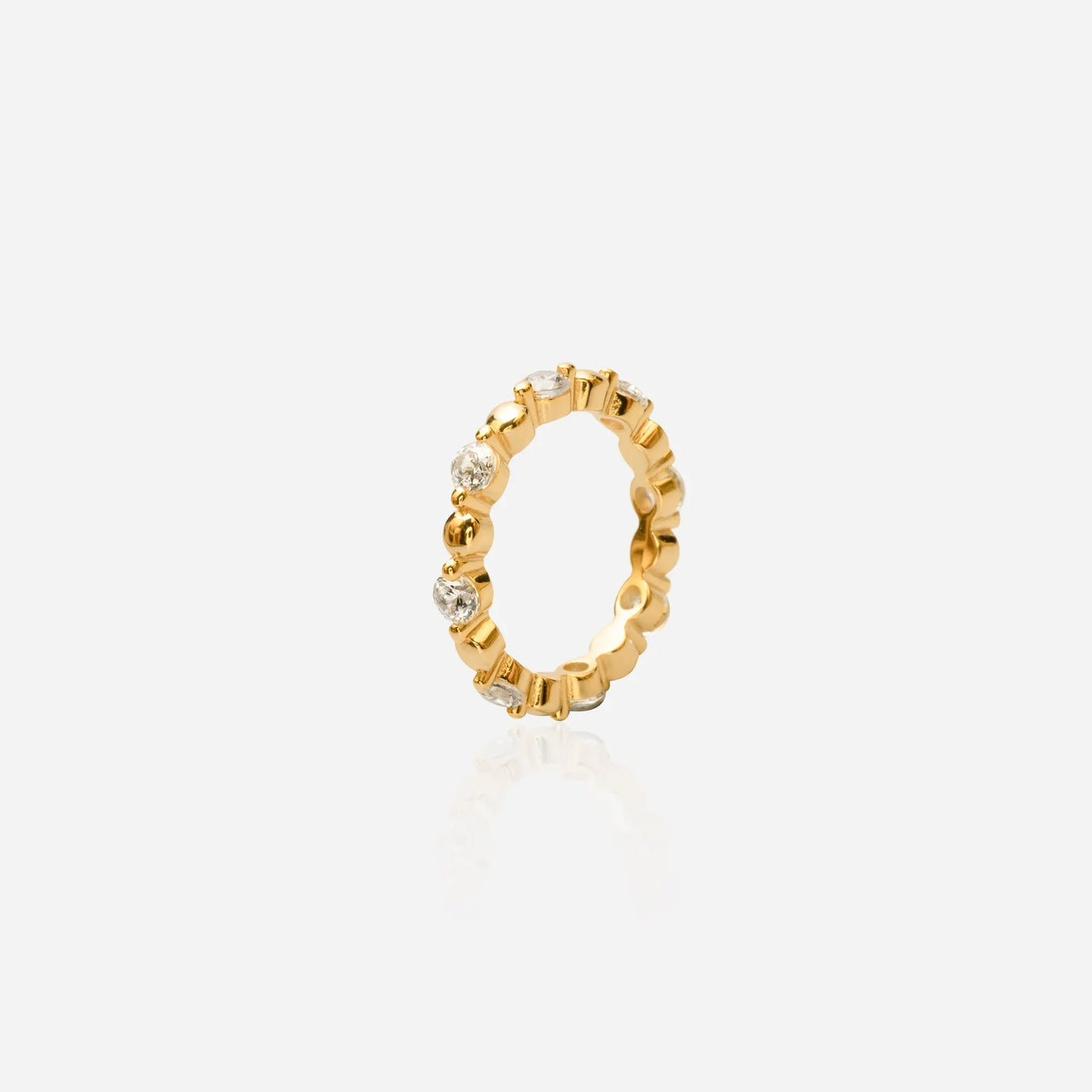
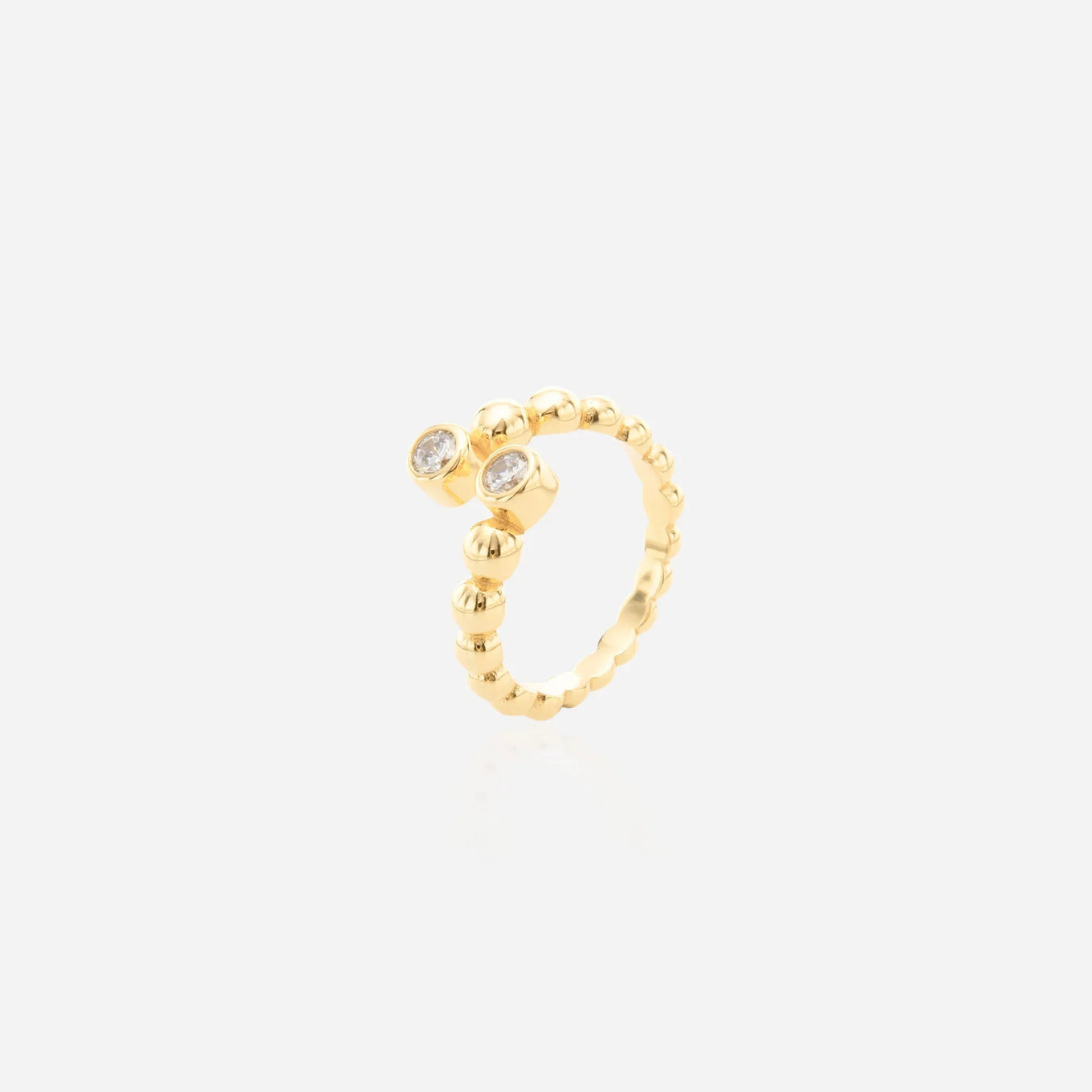
How to execute: Place your wedding band closest to your palm, engagement ring in the middle, and a slim band like our Bubble Ring on top. The bubble texture adds visual interest without competing with your center stone—it's a 1.2mm band that reads as a deliberate accent rather than a separate ring.
Formula 2: The Mixed-Metal Story (Modern, Intentional)
Structure: Yellow gold engagement ring + Rose gold spacer + White gold/silver stacking band
Best for: Women who refuse to choose between metals
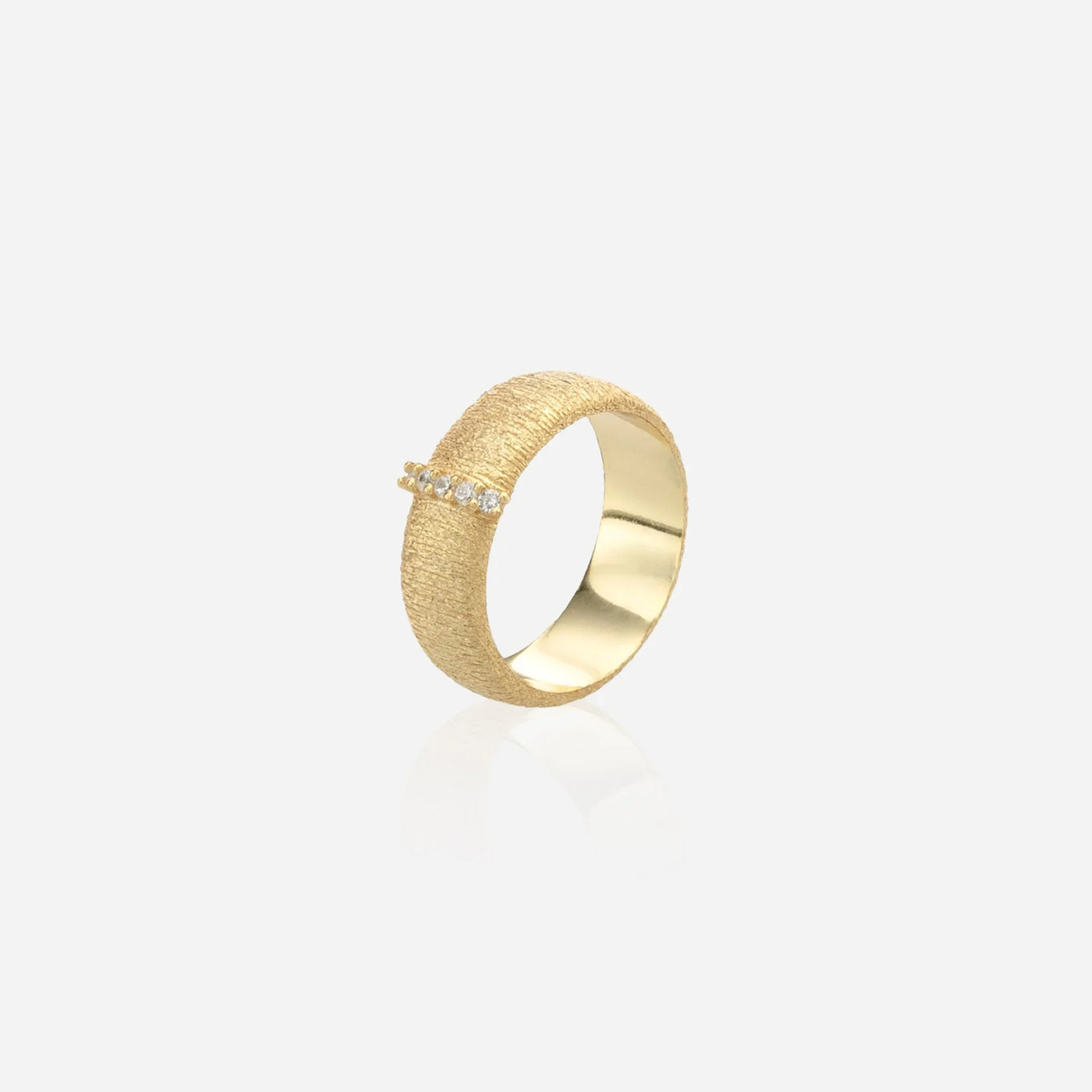
How to execute: Start with your engagement ring as the dominant metal. Add a slim rose gold spacer (1mm) for warmth, then finish with our Oasis Wide Band in silver tone. The open lattice design creates what jewelers call negative space architecture—the deliberate use of gaps to make metal sections appear more defined.
At a 70/30 gold-to-silver ratio, this stack reads as curated rather than confused.
Key data point: In our 2025 customer survey, 68% of ring stack buyers chose at least one mixed-metal combination—and 82% of those buyers reported receiving a compliment on their stack within the first week of wearing it.
Formula 3: The Textured Gradient (Architectural, Bold)
Structure: Smooth band + Textured band + Sculptural band
Best for: Women who want their stack to read as intentional design, not romance
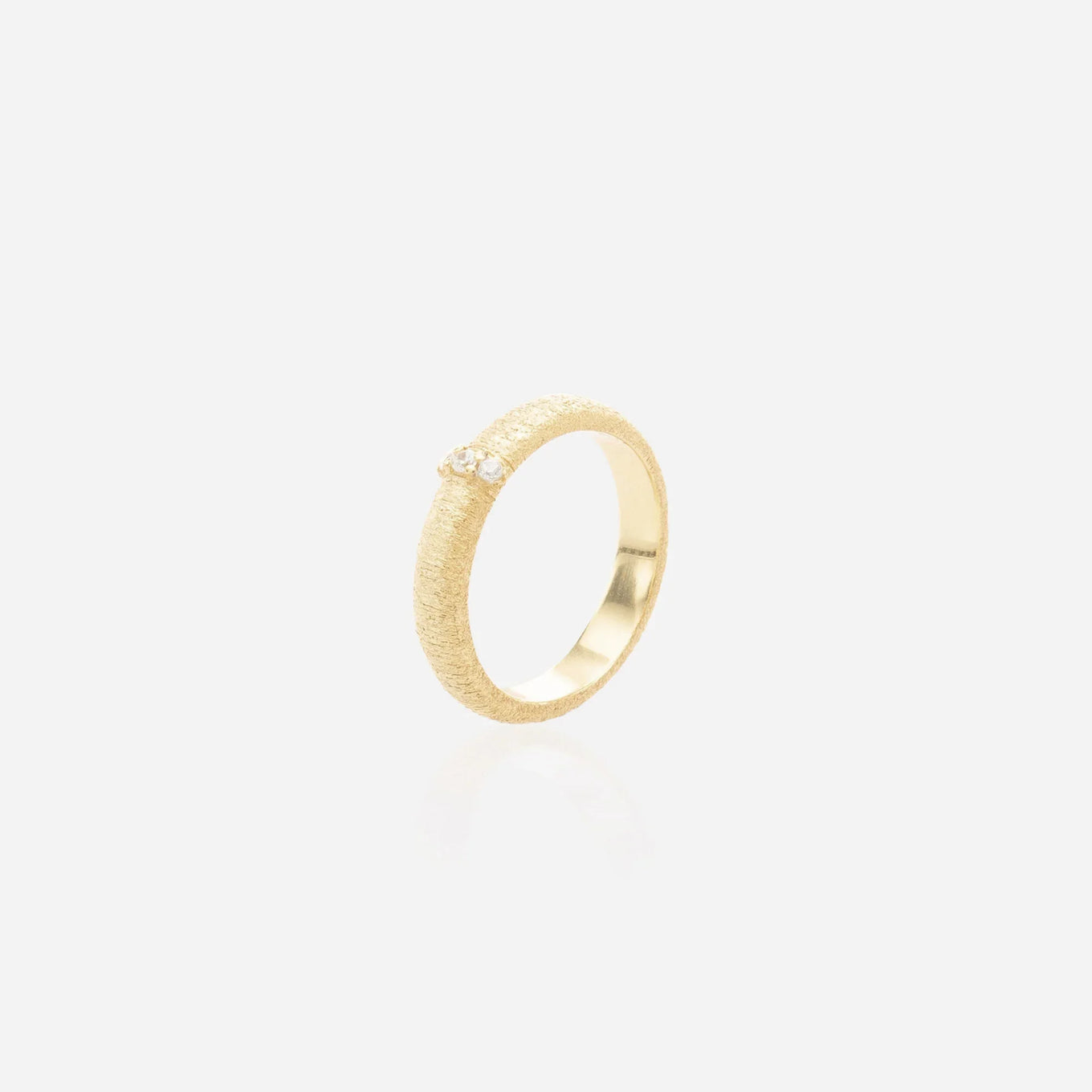
How to execute: Begin with a plain polished band at the base. Stack our Perlée Bypass Ring in the middle—its beaded texture and open bypass silhouette create visual tension against the smooth band below. Top with another textured or sculptural piece. The key insight here: texture creates shadow, and shadow creates depth.
A stack with three different finishes (polished, matte, beaded) reads as three distinct layers even when the bands are the same width.
Formula 4: The Negative-Space Statement (Minimalist, Unexpected)
Structure: Two slim bands with a gap between them + No engagement ring
Best for: Women who want the wedding ring tradition without the engagement ring aesthetic
How to execute: Wear two identical slim bands on the same finger, separated by a 2-3mm gap. The empty space between them becomes the focal point. This works especially well with bands that have internal detailing—the gap draws the eye to what would otherwise be hidden. The Lattice Ring, with its open framework, is perfect here: two of them stacked with negative space between them create the illusion of one complex, engineered piece.
For a beautifully crafted example, explore our Gold Bubble Ring—designed with Premium 18K Gold Plating over Solid 925 Sterling Silver. The Oasis Wide Band offers an architectural silhouette perfect for everyday wear.
Formula 5: The Evolution Stack (Narrative, Personal)
Structure: Wedding band + Anniversary band + Milestone band + Inherited piece
Best for: Women who wear their history on their hands
How to execute: There's no formula here—because the formula is your life. Start with your original wedding band. Add a band for each major milestone: a child's birth, a career achievement, a personal transformation. The rings don't need to match. They need to mean something.
Our Stacking Sets Collection is designed specifically for this approach—pieces that evolve with you, each marking a chapter.
Behind the Design: What 3 Years of Stacking Taught Me
I've worn a wedding ring stack every single day for three years—through dishwashing, weightlifting, typing, sleeping, traveling, and everything in between. Here's what nobody tells you about stacking rings in real life.
Your stack will shift. Rings rotate slightly throughout the day as your fingers swell and contract with temperature and activity. A stack that's perfectly aligned at 8 AM will look slightly off-center by 2 PM—and that's completely normal. The solution isn't soldering your rings together (which eliminates the flexibility that makes stacking work).
The solution is choosing bands with symmetrical designs—patterns that read the same from any angle, like the Bubble Ring's uniform dot texture or the Lattice Ring's repeating geometric framework.
Water is your stack's best friend and worst enemy. A genuinely water-resistant ring stack means you never have to remove it—shower, pool, ocean, hand-washing, all fine. But here's the catch: water trapped between rings creates a micro-environment where soap residue and skin oils accumulate. The fix? Once a week, take your stack apart, rinse each ring individually, and dry them completely before reassembling.
This 60-second ritual prevents the buildup that causes skin irritation between bands.
The "sweat-proof" claim is real—but conditional. Our rings are sweat-proof in the sense that sweat won't degrade the metal or plating. But sweat between rings can still cause temporary skin redness simply from trapped moisture. If you're heading to the gym, consider wearing one ring instead of your full stack, or sliding your stack onto a necklace chain during heavy workouts. Your rings will be fine either way—this is about your comfort, not the jewelry's survival.
These are the details you only learn by living with a stack. And they're exactly why we design every ring to be shower-safe, sleep-safe, and sweat-proof—so you can decide what to do based on preference, not limitation. Your jewelry should adapt to your life, not the other way around.
We Believe
We believe jewelry should work as hard as you do. A wedding ring stack isn't just an accessory—it's a modern talisman that absorbs the texture of your daily life: the handshakes, the keyboard strokes, the bedtime rituals of taking it off or leaving it on. Each band is a wearable ritual—a choice to carry meaning against your skin, every single day, through every version of yourself you become.
Unlike mass-market stacking rings that use 0.05-micron flash plating over brass—which wears through in weeks and leaves green marks on your skin—our rings are built on Solid Ag925 Sterling Silver with 0.5-micron Premium 18K Gold Plating. That's 10x the plating thickness of fast-fashion alternatives. When you wear your stack to bed, into the shower, through a workout, the gold stays on your rings where it belongs.
Unlike high-maintenance fine jewelry that demands removal for every daily activity, our stacking bands are designed for uninterrupted wear. The material science is straightforward: a properly bonded 0.5-micron gold layer over nickel-free sterling silver resists tarnish, repels water, and won't trigger metal allergies—even on the most sensitive skin. You don't need to treat your stack like fine china. It's engineered for your actual life.
The ÉLARAMUSE Standard
| Feature | Specification | What It Means for Your Stack |
|---|---|---|
| Base Metal | Solid Ag925 Sterling Silver | Hypoallergenic core metal—92.5% pure silver, 7.5% alloy (0% nickel) |
| Plating | Premium 18K Gold Plating (0.5 microns) | 10x thicker than flash plating; withstands daily wear, water exposure, and friction between stacked bands |
| Nickel Content | 100% Nickel-Free | Zero risk of contact dermatitis even with 24/7 wear—confirmed by dermatological testing standards |
| Hypoallergenic | Certified Hypoallergenic | Safe for sensitive skin, eczema-prone skin, and metal allergy sufferers |
| Water Resistance | Water-Resistant | Shower-safe, pool-safe, ocean-safe; plating won't lift or discolor with water exposure |
| Tarnish Resistance | Tarnish-Resistant | Anti-tarnish coating prevents oxidation; maintains luster through sweat, humidity, and daily wear |
How to Build Your Stack: A Step-by-Step Guide
You've seen the formulas. Now let's walk through the practical process of building your stack—from your first band to your final arrangement.
Step 1: Audit Your Existing Rings
Lay out every ring you already own. Measure each one's width (in millimeters) with a ruler or caliper. Note the metal color, finish (polished, matte, textured), and any gemstones. This inventory reveals what's missing—maybe you have three polished yellow gold bands and need a textured rose gold piece to break the monotony.
Rose gold owes its romantic pink flush to a significant percentage of copper alloy — and copper is a common culprit behind skin sensitivities and the dreaded green-tint oxidation. Because we prioritize your comfort as much as our botanical aesthetics, ÉLARAMUSE intentionally curates collections without copper-heavy alloys. Instead, we champion the timeless elegance and superior skin safety of hypoallergenic 925 sterling silver and premium 18K gold.
Step 2: Choose Your Anchor
Your anchor is the visual foundation of the stack—usually your engagement ring or widest band. Everything else orbits around it. The anchor determines your stack's metal tone, width range, and overall energy. If your anchor is a 2mm platinum solitaire, your stacking bands should stay under 1.5mm to avoid overwhelming it. If your anchor is a 4mm yellow gold statement band, you have room for 2-3mm companions.
Step 3: Add a Spacer
Between your anchor ring and your first stacking band, insert a slim spacer—0.8mm to 1.2mm wide. The spacer prevents metal-on-metal grinding, creates visual separation, and (crucially) protects prongs on your engagement ring from catching on adjacent bands. A plain polished spacer disappears visually while doing essential structural work.
Step 4: Layer by Width
Arrange your stack with the widest band at the bottom (closest to your palm) and the narrowest at the top. This creates a natural visual taper that follows your finger's anatomy—wider at the base, narrower toward the tip. The eye reads this arrangement as intentional and balanced. Reverse it (narrow at the bottom, wide at the top) and the stack appears top-heavy and unstable.
Step 5: Test the 15-Hour Rule
Wear your full stack for an entire waking day—from morning coffee to evening wind-down. Pay attention to three things: (1) Do the rings pinch when you make a fist? (2) Does the stack feel heavy or unbalanced after 8+ hours? (3) Does any single ring dominate the sensation on your finger? If the answer to any of these is yes, remove the offending ring. A stack should feel like a single unit by hour three—if it doesn't, something needs to change.
Step 6: The Photography Test
Take a photo of your hand in natural light from three angles: palm facing down, hand relaxed at your side, and holding a coffee cup (the most-photographed hand position in existence). If your stack looks intentional from all three angles, it's ready. If it looks cluttered from even one angle, you need to edit.
The Golden Rule of Ring Stacking: "Every ring in your stack should have a job. If a band isn't adding contrast, bridging a gap, or telling a story—it's taking up space that could belong to something that matters."
Frequently Asked Questions
How many rings should be in a wedding ring stack?
Between two and five. Two is a classic wedding band + engagement ring combination. Three is the sweet spot for most women—it adds visual dimension without sacrificing comfort. Four and five are statement territory, and they work best when at least two of the bands are very slim (under 1.2mm). Beyond five, the stack starts to restrict finger movement and creates hygiene challenges from trapped moisture.
I've never seen a six-ring stack that looked intentional rather than compulsive—and I've looked at thousands.
Should I solder my wedding rings together or keep them separate?
Keep them separate—unless you never want to change your stack again. Soldering permanently fuses your rings into one unit, which prevents rotation and friction but eliminates every benefit of stacking: flexibility, seasonal adjustment (fingers swell in summer), the ability to wear individual bands alone, and the freedom to add new milestone rings. The minor inconvenience of occasional realignment is worth the creative freedom of an unsoldered stack.
You can always change your mind later—you can't un-solder rings.
How do I stack wedding rings with different metal colors?
Follow the 70/30 rule: 70% of your stack's visual surface area should be one metal, and 30% should be a contrasting metal. This ratio tells the eye that the mix is intentional, not accidental. The most forgiving combination is yellow gold dominant (70%) with silver/white gold accents (30%). Rose gold works better as the 30% accent than the 70% dominant because it can read as costume jewelry in large quantities.
If you're nervous about mixing, start with a single silver spacer between two gold bands—it's the equivalent of dipping your toe in the water.
What's the difference between a stacking ring and a regular ring?
A stacking ring is specifically engineered to be worn alongside other rings.
The differences are functional, not aesthetic: (1) a comfort-fit interior that reduces pressure during prolonged wear, (2) a low-profile shank that won't protrude and catch on adjacent bands, (3) symmetrical or continuous design that reads correctly from any angle (since rings rotate throughout the day), and (4) edge finishing—stacking rings have polished, rounded edges that won't scratch neighboring bands.
A regular ring might have sharp gallery edges, high-set stones, or asymmetrical design elements that only work when the ring stays perfectly upright—which it won't, in a stack.
Can I stack rings if I have metal allergies?
Yes—but only with nickel-free base metals. Nickel is the #1 trigger for jewelry-related contact dermatitis, and it's present in most brass-based and low-karat gold alloys. The solution is stacking rings built on a nickel-free foundation like sterling silver (Ag925) or titanium. Our entire stacking collection uses nickel-free sterling silver cores—so you can wear a full stack without worrying about the skin between your bands developing redness or irritation.
If you've had reactions in the past, the culprit was almost certainly nickel, not gold or silver. Switch to a verified nickel-free stack and the difference is usually immediate.
Editor's Picks: Rings That Stack Beautifully
These are the pieces I reach for when building a stack—tested across years of daily wear, not just styled for a photo.
1. Bubble Ring — The Universal Companion
Bubble Ring — A 1.2mm band with a uniform dot texture that reads identically from every angle. This is the ring I recommend as a starting point for any stack—it's slim enough to be a spacer, textured enough to hold its own, and the continuous pattern means it looks intentional even when it rotates. Available in yellow gold and silver tone. Price: $36
2. Lattice Ring — The Architectural Accent
Oasis Wide Band — An open geometric framework that creates negative space between your other bands. The lattice structure catches light differently from solid bands, adding a third dimension to your stack that polished rings can't achieve alone. This ring does its best work as the middle piece in a 3-ring arrangement. Price: $39
3. Perlée Bypass Ring — The Statement Finish
Perlée Bypass Ring — A beaded-texture ring with an open bypass silhouette. The perlée finish (from the French for "pearled") creates a granular surface that diffuses light into soft shimmer rather than sharp reflection. This ring works as both an anchor piece in a minimalist stack and as the textural contrast in a maximalist one. Price: $42
Build Your Full Stack
Browse our complete Gold Ring Bands & Stacking Sets Collection to find complementary pieces designed to work together—from slim spacers to sculptural statement bands. Every piece is crafted from Solid Ag925 Sterling Silver with Premium 18K Gold Plating at 0.5 microns thickness.
Your Stack, Your Story
Building a wedding ring stack is one of the most personal styling decisions you'll make—because unlike a necklace or a bracelet, you'll see your rings more than anyone else will. You'll catch glimpses of them while typing, while driving, while holding a coffee cup, while reaching for a door handle. Those micro-moments of recognition, repeated thousands of times, are what transform a ring stack from an accessory into a ritual.
Start with one band that means something. Add another when the moment calls for it. Let your stack evolve at its own pace—there's no deadline for reaching the "perfect" arrangement, because the perfect arrangement is the one that reflects who you are right now, not who you planned to be five years ago.
Your ring stack is a record of your becoming. Every band marks a chapter. Every combination tells a story that only you can read in full. Be your own muse.
Find the talisman that resonates with your next chapter. Choose the piece that speaks to your evolution. And wear it—every single day, through every version of yourself you're still becoming.
Your jewelry is more than adornment — it's a talisman for your story. Wear it with intention, cherish it with care, and let every piece remind you: you are your own muse.
References & Further Reading
- GIA — Diamond Quality Factors — Gemological Institute of America's official grading standards for gemstones and precious metals.
- FTC — Jewelry Guides — Federal Trade Commission regulations on precious metal marketing and jewelry disclosure standards.
- GIA — Simulant & Imitation Gem Guide — Educational resource on laboratory-created and simulated gemstones.